By Eric Andrew Kristof, RN, CAHIMS | Healthcare IT Professional | HIMSS Arkansas Chapter Member
About This Series: The HIMSS Word of The Day is a running blog series drawing from the HIMSS Dictionary of Health Information and Technology Terms, Acronyms, and Organizations, 6th Edition (2025) — the authoritative reference for healthcare IT professionals and the primary study resource for CAHIMS and CPHIMS certification. Each post paraphrases the term in plain language, grounds it in real-world healthcare IT context, and adds a bedside nursing perspective you won’t find in a textbook.
📖 The Term: AIDC (Automatic Identification and Data Capture)
Source: HIMSS Dictionary of Health Information and Technology Terms, Acronyms, and Organizations, 6th Edition (2025)
🔍 Plain-Language Definition
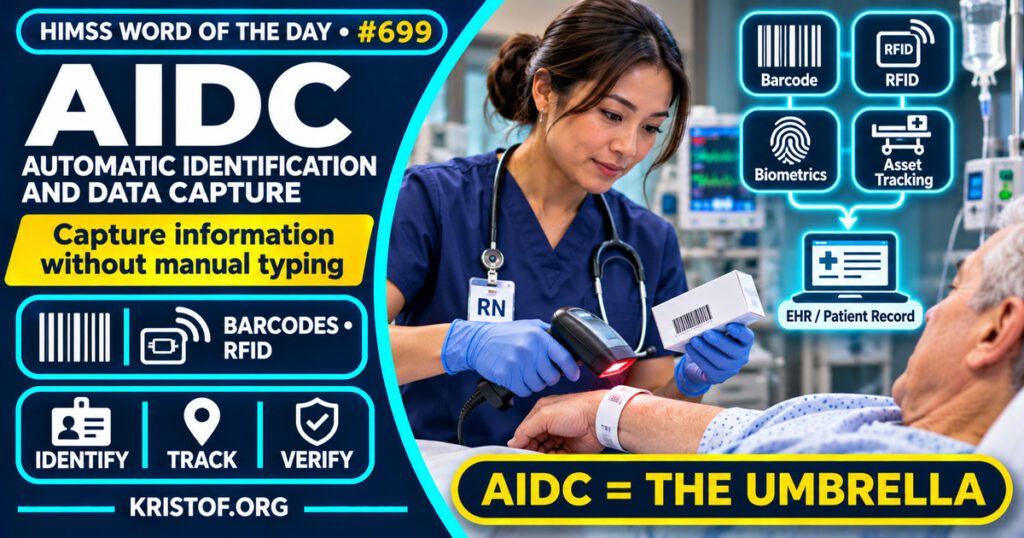
The HIMSS Dictionary describes automatic identification and data capture (AIDC) as a broad group of technologies that gather information from a person, object, image, or sound without someone typing it in. The dictionary says AIDC systems serve inventory, delivery, assets, security, and documents, across sectors from retail to medicine, and that applications generally fall into three groups: checking an identity or value where it is captured, following items or people, and feeding other systems. Its technology list runs from one-dimensional and two-dimensional bar codes and magnetic stripes to smart cards, text-reading software, RFID, biometrics such as finger scanning, and voice recognition.
AIDC is the category. The studies in this post cover two members of it, bar codes and radio frequency identification (RFID), and one survey of adoption.
| Technology | What it reads or captures | Where it appears in this post |
|---|---|---|
| Bar code | A printed pattern scanned by a reader | Poon et al.; Uy et al. |
| RFID | A tag read by radio waves | Profetto et al.; Ebrahimzadeh et al.; Schnock et al. |
| Biometrics | A body feature such as a fingerprint | Uy et al. (adoption survey) |
| Pharmacy automation | Equipment that supports dispensing | Uy et al. (adoption survey) |
| Smart cards, OCR, voice | Other members of the AIDC family in the dictionary | Not covered by these studies |
⚠️ Exam Alert: AIDC is the umbrella, and bar code medication administration is one bedside use of it. RFID uses radio waves and does not need a line of sight, while a bar code must be scanned. Do not confuse AIDC with electronic data capture, a separate dictionary entry that refers to a different kind of system. Questions may ask which AIDC technology fits a given task, such as reading a patient wristband, tracking a device, or confirming a person’s identity.
🌐 Why It Matters: Real-World Healthcare IT Context
Where it shows up. AIDC is behind the scanning that links a patient, a medication, a specimen, or a device to the record without retyping an identifier. Its main appeal is fewer manual steps and fewer transcription mistakes. The five sources below were read as abstracts only.
Adoption in US hospitals. Uy et al. (2015) analyzed survey data from the HIMSS Analytics Database to examine adoption trends of AIDC methods and pharmacy automation in US hospitals. They describe optimistic growth in the adoption of these patient safety solutions. The abstract gives no adoption figures, and the data are from before 2015.
Bar-code medication administration. Poon et al. (2010) ran a before-and-after, quasi-experimental study at an academic medical center implementing a bar-code electronic medication administration record. They observed 14,041 administrations and reviewed 3,082 order transcriptions. Non-timing errors in administration fell from 11.5% to 6.8%, a 41.4% relative reduction, and potential adverse drug events other than timing-related ones fell from 3.1% to 1.6%. Timing errors fell by 27.3%, but potential adverse drug events tied to timing errors did not change significantly. Transcription errors were 6.1% on units without the system and were eliminated on units with it. The authors say the technology reduced errors but did not eliminate them. It is a single-center study, and the same paper is a source for other posts in this series on medication administration.
RFID overall. Profetto et al. (2022) did a scoping review of RFID in health care for 2017 to 2022, including articles that described technologies implemented in a real environment or as prototypes. Their search returned 366 results, and 11 articles were reviewed after screening. They report six areas the technology could affect, including improved patient safety by reducing medical errors in operating rooms and addressing counterfeit drugs. They say more research is needed on data management, security, and privacy.
RFID for patient tracking. Ebrahimzadeh et al. (2021) systematically reviewed studies of RFID real-time locating systems used to track patients in hospitals, searching PubMed and Embase through August 2015. They included 17 of 652 studies. Of the seven that evaluated accuracy in crowded and unattended areas, five were satisfied. All six that evaluated reliability found the systems reliable, all six that evaluated time savings reported them time effective, and both studies of cost of care found them cost effective. The authors conclude there is insufficient good evidence that RFID systems can accurately localize patients in crowded settings.
RFID for retained surgical instruments. Schnock et al. (2021) reviewed the effect of RFID tracking on retained surgical instrument errors. After screening 385 articles, they included 5 and report rapid detection through body tissue with high accuracy, reduced counting errors, and improved workflow. They state that the body of evidence is limited and that better designed studies are needed.
What I could not confirm. I did not find a study that evaluates AIDC as a whole, so the evidence here comes from bar codes and RFID individually. Several of the review conclusions rest on small numbers of studies, and the patient-tracking review searched only through August 2015. The adoption survey abstract gives no figures, so I do not state adoption rates. I did not review evidence on biometrics, smart cards, optical character recognition, or voice recognition for this post.
Common AIDC problems:
- Labels that are damaged, missing, or will not scan
- Tags and readers that perform poorly in crowded or unattended areas
- Evidence based on a few small or single-site studies
- Data management, security, and privacy questions that are not settled
- Adoption that varies across hospitals, as the survey notes
What supports AIDC:
- A before-and-after study showing fewer administration and transcription errors with bar-code eMAR
- Reports of reliability and time savings in RFID patient-tracking studies
- Rapid, accurate detection of retained surgical instruments in a small set of studies
- Growth in adoption of these technologies in US hospitals
- Less manual entry, which removes one source of transcription error
🏥 The Nurse’s Perspective: Clinical, Bedside, & Workflow
None of the abstracts examines nurses as participants, so this section is workflow context and not evidence.
At the Bedside
AIDC is most visible at the bedside as the scan of a patient wristband and a medication package before the dose is given. That scan is what the bar-code eMAR study tested, and the observed errors were in order transcription and administration. The tool checks the match, and the nurse still decides what to do when it does not match.
In Clinical Workflow
AIDC works when the label, the scanner, the network, and the record all agree. A damaged label, a dead battery, or a missing order breaks the chain, and the work stops until someone fixes it. The reviews of RFID tracking describe reliability and accuracy as measured qualities, not as givens.
In EHR Implementation (Go-Live Perspective)
During an Epic Go-Live, analysts and at-the-elbow support staff field scanner and label questions every shift, such as what to do when an item will not scan and who fixes a wristband error. Preparing scanners, labels, and a clear escalation path before go-live is a workflow preparation task. That observation is context only, and none of the studies reviewed examines go-lives.
🎓 CAHIMS / CPHIMS & HIMSS Perspective
CAHIMS Exam Domain Mapping
AIDC appears in questions about identification, medication safety, and device technology:
| CAHIMS Domain | How AIDC Appears |
|---|---|
| Healthcare & Technology Environments | Identification technologies and supply tracking |
| Clinical Informatics | Bedside scanning and medication safety |
| Healthcare Information & Systems Management | Scanners, tags, labels, and device support |
| Management & Leadership | Adoption, cost, and patient safety programs |
Key Terms to Know Alongside AIDC
- Bar Code Medication Administration — scanning a patient and medication to check a match before giving a dose
- RFID — identification of tagged items or people using radio waves
- Biometrics — identification based on a body feature such as a fingerprint
- Smartcard — a card with an embedded chip used for identification or access
- Optical Character Recognition — converting images of text into machine-readable text
- QR codes — two-dimensional codes that store data and are read by a camera
HIMSS Organizational Position
HIMSS offers education and research on health information and technology topics through its Resource Center. Members can find related information on the HIMSS Resource Center page.
🧭 More HIMSS Word of The Day Terms
Related terms in the Clinical Informatics series:
Browse all Clinical Informatics terms or the A–Z glossary.
🔗 Explore Further: External References
- Uy et al. (2015), AMIA Annual Symposium Proceedings — The State and Trends of Barcode, RFID, Biometric and Pharmacy Automation Technologies in US Hospitals. https://pubmed.ncbi.nlm.nih.gov/26958264/
- Poon et al. (2010), New England Journal of Medicine — Effect of bar-code technology on the safety of medication administration. https://pubmed.ncbi.nlm.nih.gov/20445181/
- Profetto et al. (2022), Health and Technology — Radio Frequency Identification (RFID) in health care: where are we? A scoping review. https://pubmed.ncbi.nlm.nih.gov/36035521/
- Ebrahimzadeh et al. (2021), Journal of Patient Safety — Evaluation of the Effects of Radio-Frequency Identification Technology on Patient Tracking in Hospitals: A Systematic Review. https://pubmed.ncbi.nlm.nih.gov/29252967/
- Schnock et al. (2021), Journal of Patient Safety — Evaluating the Impact of Radio Frequency Identification Retained Surgical Instruments Tracking on Patient Safety: Literature Review. https://pubmed.ncbi.nlm.nih.gov/28230583/
- HIMSS — Resource Center https://www.himss.org/resource-center
Term source: HIMSS Dictionary of Health Information and Technology Terms, Acronyms, and Organizations, 6th Edition (2025). All definitions in this series are paraphrased for editorial purposes. Readers are encouraged to consult the primary source for exact language.
Eric Andrew Kristof, RN, CAHIMS is a Healthcare IT professional and HIMSS Arkansas Chapter member based in Hot Springs Village, AR, with hands-on Epic Go-Live experience and a diverse healthcare and IT background. He writes at kristof.org at the intersection of clinical care and healthcare technology.
Leave a Reply