By Eric Andrew Kristof, RN, CAHIMS | Healthcare IT Professional | HIMSS Arkansas Chapter Member
About This Series: The HIMSS Word of The Day is a running blog series drawing from the HIMSS Dictionary of Health Information and Technology Terms, Acronyms, and Organizations, 6th Edition (2025) — the authoritative reference for healthcare IT professionals and the primary study resource for CAHIMS and CPHIMS certification. Each post paraphrases the term in plain language, grounds it in real-world healthcare IT context, and adds a bedside nursing perspective you won’t find in a textbook.
📖 The Term: eLTSS (Electronic Long-Term Services and Supports)
Source: HIMSS Dictionary of Health Information and Technology Terms, Acronyms, and Organizations, 6th Edition (2025)
🔍 Plain-Language Definition
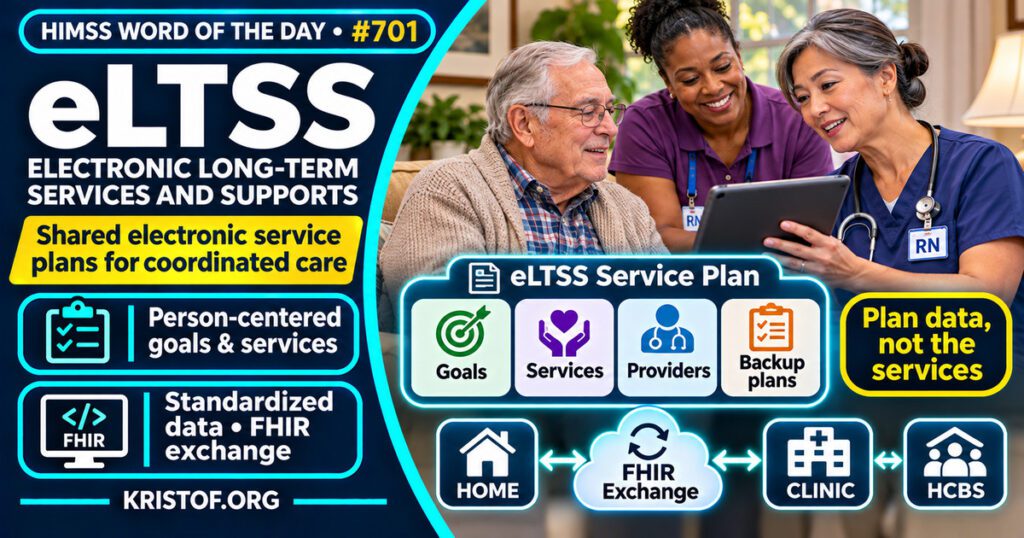
The HIMSS Dictionary describes eLTSS as an initiative within the Office of the National Coordinator for Health IT (ONC) to develop the basic elements that electronic standards need, so that beneficiaries, community-based long-term services and supports providers, payers, healthcare providers, and the people they serve can create, exchange, and reuse interoperable service plans. The HL7 guide and CMS describe it as a joint CMS and ONC effort, so the dictionary’s wording leaves out CMS.
A service plan is the document that says what services and supports a person receives, with what goals, from whom, and with what back-up arrangements. eLTSS does not replace the plan. It defines the data inside it.
| Item | Detail |
|---|---|
| Started | 2014, as one of four parts of the CMS Testing Experience and Functional Tools (TEFT) demonstration |
| Partners | CMS and ONC, with six TEFT states taking part in the eLTSS pilots |
| Core output | The eLTSS Dataset, 56 core data elements (36 more non-core elements in the CMS evaluation report) |
| Standard | HL7 FHIR implementation guide, version 2.0.0, trial use, maturity level 2 |
| Closest FHIR resource | CarePlan, which the guide calls a good fit for the service plan |
| Actors in the guide | Beneficiary, support planner, home and community-based service (HCBS) providers, clinical and institutional providers |
⚠️ Exam Alert: LTSS is the care and support a person receives, while eLTSS is the standardized electronic data for the plan that organizes it. HCBS is the community-based part of LTSS. FASI, the Functional Assessment Standardized Items, was a separate TEFT tool for assessments, and a personal health record was a separate TEFT pilot. FHIR is the exchange standard, and the eLTSS guide is a set of rules for using FHIR with a service plan. Questions may ask which standard supports exchange of non-clinical service plans.
🌐 Why It Matters: Real-World Healthcare IT Context
Because eLTSS is a standards project, this section draws on the HL7 guide, CMS pages, CMS’s final TEFT evaluation report, and one peer-reviewed interview study. I found no study that tests whether using eLTSS improves care or outcomes, so the evidence describes how the dataset was built and what barriers states reported.
Why a standard was needed. CMS says Medicaid is the main payer for long-term services and supports and that these services reach people of all ages with disabling conditions or chronic illness. The HL7 guide says its focus is exchanging plan data, including social needs such as housing, education, and transportation, alongside medical care information. It lists gaps the effort aims to address, including inconsistent terminology, weak incentives for providers to adopt health IT, minimal quality measurement standards, and unclear relationships among care, service, and support plans.
How the dataset was built. CMS’s final TEFT evaluation says the effort began in 2014 aiming for an electronic record that would work like an EHR and include social service providers and beneficiaries. In Round 1 (2015 to 2016) the scope narrowed to a harmonized dataset that could populate a care plan. In Round 2 (2016 to 2017) states validated the core dataset with HCBS providers through surveys, focus groups, and interviews. Six states took part in the eLTSS pilots: Colorado, Connecticut, Georgia, Kentucky, Maryland, and Minnesota. The report describes a final dataset of 56 core and 36 non-core elements across categories such as demographics, goals and strengths, person-centered planning, signatures, risks, and service and provider information. The HL7 guide says its work covers the 56 elements.
What the pilots reported. Providers in several states said the dataset was relevant and useful, and Colorado participants wanted a fuller, maintainable record and not only a dataset. Challenges included data domains that lived in functional assessments, some of them proprietary, so states could not disclose everything, and eLTSS capabilities in states that were limited and not integrated, with most providers working from paper. Most exchange in Kentucky and Maryland was still by mail, fax, phone, or secure email, while Minnesota providers pulled data from their EHRs into PDF plans and shared them through a community health information exchange. Georgia found one field confusing to providers, and the report concludes that standard definitions are essential. These are findings from a CMS-contracted evaluation, not from a controlled study.
Barriers beyond the pilots. Ahluwalia et al. (2021) interviewed 30 Medicaid administrators, service agency providers, and consumer advocates about health IT in home and community-based services. Participants saw several benefits but described barriers: limited expertise with health IT, limited reach among rural and disabled beneficiaries, burdensome procurement, and the ongoing resources needed to keep solutions current. The study looked at the Medicaid Balancing Incentive Program, not eLTSS, so it is context.
The FHIR guide. The HL7 guide says version 2.0.0 is built on FHIR R4 and US Core 6.1.0, is labeled trial use, and has maturity level 2. It currently covers only data commonly found on LTSS service plans, and it says implementers should know FHIR R4, US Core, and the eLTSS use case before reading it.
What I could not confirm. I did not find evidence that any state or vendor uses the FHIR guide in production, or that eLTSS changed outcomes, costs, or workload. I read the sections of the CMS evaluation report that cover eLTSS, not the whole report, and its ballot dates differ slightly from the HL7 pages, so I cite the HL7 guide for standards status. The CMS TEFT overview page was read through search text only.
Common eLTSS problems:
- Treating eLTSS as a software product instead of a dataset and standard
- Assuming trial-use status means widespread production use
- Confusing a clinical care plan with a person-centered service plan
- Using one field definition across states that read it differently
- Assuming providers who work on paper can send structured plans
What supports eLTSS:
- A consensus dataset drawn from real state service plans
- Validation with HCBS providers through surveys, focus groups, and interviews
- Mapping to FHIR and US Core, which many EHR vendors already support
- An actor model that includes the beneficiary and the support planner
- Room for social needs alongside medical information
🏥 The Nurse’s Perspective: Clinical, Bedside, & Workflow
No study reviewed measured nurses’ experience with eLTSS, so this section is workflow context and not evidence.
At the Bedside
A nurse preparing a discharge to home for a person who receives community-based services often needs to know what services are already in place, who coordinates them, and what the back-up arrangements are. A standardized plan that travels with the person could make those answers easier to find. That is an expectation, not a finding from the sources reviewed, and the pilots reported that most exchange was still by phone, mail, or fax.
In Clinical Workflow
Nurses work as case managers, care coordinators, and waiver program assessors, so they are among the people who write and use service plans. Shared definitions matter in that work, and the Georgia example shows how one unclear field can confuse providers. Nurse informaticists can help by testing whether a field means the same thing to a hospital team, a home care agency, and a case manager.
In EHR Implementation (Go-Live Perspective)
During an Epic Go-Live, analysts and at-the-elbow support staff see where outside information lands in the chart, such as a scanned plan or an outside document. A structured service plan would need a place to be received, viewed, and reconciled, and that depends on local build choices. The sources reviewed do not examine go-lives, so this is context only.
🎓 CAHIMS / CPHIMS & HIMSS Perspective
CAHIMS Exam Domain Mapping
eLTSS connects standards, care coordination, and the community-based side of care:
| CAHIMS Domain | How eLTSS Appears |
|---|---|
| Healthcare & Technology Environments | Medicaid, LTSS, and the role of CMS and ONC |
| Clinical Informatics | Care plans, social needs data, and plan content |
| Healthcare Information & Systems Management | Datasets, FHIR profiles, and exchange between systems |
| Management & Leadership | Stakeholder engagement and state-level program governance |
Key Terms to Know Alongside eLTSS
- LTSS — long-term services and supports, the care and assistance people need because of disabling conditions or chronic illness
- FHIR — HL7’s standard built around resources and web-based exchange
- Care coordination — organizing services across providers so that the person’s needs are met
- Social determinants of health — the conditions where people live and work that affect health
- Personal health record — a record a person manages about their own health
- Interoperability — the ability of systems to exchange and use information
HIMSS Organizational Position
HIMSS offers education and research on health information and technology topics through its Resource Center. Members can find related information on the HIMSS Resource Center page.
🧭 More HIMSS Word of The Day Terms
Related terms in the Interoperability and Standards series:
- Application Programming Interface (API)
- QDM (Quality Data Model)
- DAF (Data Access Framework)
- Application Integration
Browse all Interoperability and Standards terms or the A–Z glossary.
🔗 Explore Further: External References
- HL7 — Electronic Long-Term Services and Supports (eLTSS) Release 1 – US Realm: Project Background (v2.0.0, STU2). https://hl7.org/fhir/us/eltss/background.html
- HL7 — Electronic Long-Term Services and Supports (eLTSS) Release 1 – US Realm: Introduction (v2.0.0, STU2). https://hl7.org/fhir/us/eltss/index.html
- CMS — Electronic Long-Term Services and Supports Standard (TEFT program). https://www.medicaid.gov/medicaid/long-term-services-supports/teft-program/electronic-long-term-services-supports-standard
- CMS — Testing Experience and Functional Tools in Home and Community-Based Services: Final Evaluation Report. https://medicaid.gov/medicaid/ltss/downloads/teft-program/teft-evaluation-final-report.pdf
- CMS — Long-Term Services and Supports. https://www.medicaid.gov/medicaid/long-term-services-supports/index.html
- Ahluwalia et al. (2021), Journal of Applied Gerontology — Promises and Pitfalls of Health Information Technology for Home- and Community-Based Services. https://pubmed.ncbi.nlm.nih.gov/32723124/
- HIMSS — Resource Center https://www.himss.org/resource-center
Term source: HIMSS Dictionary of Health Information and Technology Terms, Acronyms, and Organizations, 6th Edition (2025). All definitions in this series are paraphrased for editorial purposes. Readers are encouraged to consult the primary source for exact language.
Eric Andrew Kristof, RN, CAHIMS is a Healthcare IT professional and HIMSS Arkansas Chapter member based in Hot Springs Village, AR, with hands-on Epic Go-Live experience and a diverse healthcare and IT background. He writes at kristof.org at the intersection of clinical care and healthcare technology.
Leave a Reply