By Eric Andrew Kristof, RN, CAHIMS | Healthcare IT Professional | HIMSS Arkansas Chapter Member
About This Series: The HIMSS Word of the Day is a running blog series drawing from the HIMSS Dictionary of Health Information and Technology Terms, Acronyms, and Organizations, 6th Edition (2025) — the authoritative reference for healthcare IT professionals and the primary study resource for CAHIMS and CPHIMS certification. Each post paraphrases the term in plain language, grounds it in real-world healthcare IT context, and adds a bedside nursing perspective you won’t find in a textbook.
📖 The Term: Radio Frequency Identification (RFID)
Source: HIMSS Dictionary of Health Information and Technology Terms, Acronyms, and Organizations, 6th Edition (2025)
🔍 Plain-Language Definition
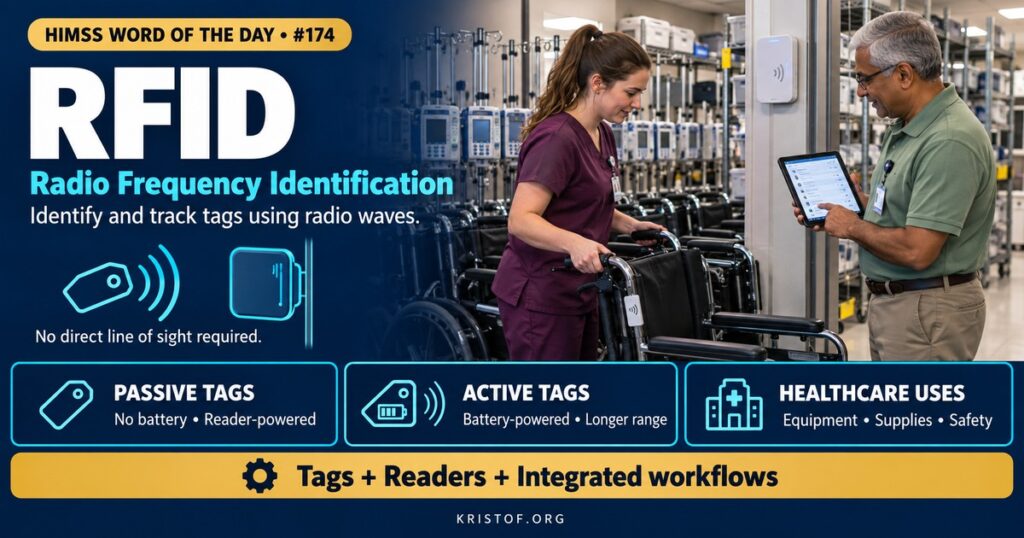
Radio frequency identification (RFID) is a technology that uses radio waves to automatically identify and track tags attached to objects, animals, or people. A reader communicates with a tag wirelessly, without requiring direct line of sight.
The HIMSS Dictionary describes RFID as technologies that use wireless communication between a tag and a reader to automatically identify and track objects. It notes that tags can typically be read only within a few meters of a reader and that a clear line of sight between reader and tag is not necessarily required.
| RFID Concept | What It Means | Healthcare Example |
|---|---|---|
| Passive Tag | No battery; powered by the reader’s signal | Tags on supplies or implant packaging |
| Active Tag | Battery-powered; transmits its own signal | Tags on pumps or wheelchairs for location tracking |
| Reader | Sends and receives radio signals | Ceiling or doorway readers |
| Real-Time Location System (RTLS) | Tracks location continuously using RFID or other technologies | Showing where every infusion pump is on a map |
| Barcode | Optical code that requires line-of-sight scanning | Medication barcodes scanned at the bedside |
⚠️ Exam Alert: Barcodes require line of sight and are read one at a time; RFID can read many tags at once without line of sight. Passive tags have no battery and shorter range; active tags have batteries and longer range. RTLS may use RFID, infrared, Bluetooth, Wi-Fi, or ultrasound.
🌐 Why It Matters: Real-World Healthcare IT Context
Hospitals own thousands of mobile assets, such as infusion pumps, monitors, wheelchairs, and specialty beds, that move constantly. Staff spend valuable time searching for equipment, and organizations often overbuy to compensate. RFID and real-time location systems help locate assets, track utilization, and improve maintenance.
Safety applications are significant. Infant security systems use tags that alarm if an infant is moved near an exit without authorization. Wander management systems protect patients at risk of elopement. Some surgical programs use RFID-tagged sponges with detection wands to help prevent retained surgical items.
Supply chain management benefits too. RFID can track high-value supplies and implants, support automated inventory in supply rooms, and capture usage for charging and reordering. Unique device identifiers can be encoded in automatic identification technologies, including RFID, supporting traceability and recalls.
Workflow analysis is another use. Location data from staff and patient tags can show how long patients wait, how often nurses visit rooms, and where bottlenecks occur. Some organizations use location systems for hand hygiene monitoring or staff duress alerts.
RFID differs from barcodes in important ways. Barcodes are inexpensive and require deliberate scanning, which supports intentional verification, as in barcode medication administration. RFID reads passively and in bulk, which is convenient but can produce ambiguous reads when many tags are nearby. Many organizations use both.
Interference is a known concern. The FDA notes that it is not aware of adverse events associated with RFID, but it has expressed concern about potential electromagnetic interference with electronic medical devices, such as pacemakers and implantable defibrillators, and encourages testing and awareness. Hospitals evaluate RFID deployments alongside clinical engineering.
Privacy matters when people are tracked. Staff location data can feel intrusive if used for performance monitoring, and patient tracking requires clear purposes and policies. Organizations should define what is collected, who can see it, and how long it is kept.
Specimen and medication tracking are growing uses. Some laboratories tag specimen containers so their location and handling time can be followed from collection to analysis, and some pharmacies use RFID-tagged kits, such as anesthesia or crash cart trays, so a reader can confirm contents and expiration dates in seconds instead of manual counts. These applications show how RFID can reduce routine checking work while improving accuracy.
Implementation requires planning. Infrastructure costs, tag management, battery replacement, accuracy needs, and integration with asset management, EHR, and nurse call systems all affect success.
Security is part of planning. RFID readers and location servers are networked devices that need patching, access control, and monitoring like other connected systems, and tag data linked to patients is protected health information.
Common RFID and RTLS challenges:
- Infrastructure and tag costs
- Location accuracy limits in complex buildings
- Battery replacement for active tags
- Integration with other hospital systems
- Potential electromagnetic interference
- Staff privacy concerns about tracking
Practices for successful RFID programs:
- Clear goals tied to safety or efficiency problems
- Clinical engineering involvement in testing
- Defined policies for location data use
- Integration with asset management and workflows
- Ongoing tag and battery management
- Measurement of time saved and utilization improvements
🏥 The Nurse’s Perspective: Clinical, Bedside, & Workflow
Nurses benefit directly when equipment can be found quickly and safety systems work reliably.
At the Bedside
Real-time location systems can show nurses where the nearest available pump, bladder scanner, or wheelchair is, saving time that would otherwise be spent searching. Returning equipment to designated areas and reporting missing tags keeps the system accurate.
Infant security and wander management tags protect vulnerable patients. Nurses apply tags, check them regularly, respond to alarms, and educate families about how the systems work.
In Clinical Workflow
Location data may support nurse call integration, such as automatically recording when a nurse enters a room. Understanding how these systems work helps nurses trust and use the data appropriately.
Staff duress badges with location capability can summon help quickly during workplace violence events, an important safety feature on high-risk units.
Patients with implanted cardiac devices may ask about tracking systems. Nurses can explain that hospitals evaluate such systems with clinical engineering and report any device problems.
Concerns about how staff location data is used should be raised through leadership and governance so policies are transparent.
Tags on equipment sent for cleaning or repair should stay attached. Missing tags make equipment invisible to the system and recreate the searching problem RFID was meant to solve.
In EHR Implementation (Go-Live Perspective)
During an Epic Go-Live, integrations with location systems, supply cabinets, and nurse call may be configured or rebuilt. Testing confirms that location events and supply usage flow correctly into the new system.
At-the-elbow support analysts may help nurses understand new dashboards showing equipment or patient locations and route integration problems to technical teams.
🎓 CAHIMS / CPHIMS & HIMSS Perspective
CAHIMS Exam Domain Mapping
RFID appears in technology, supply chain, and safety questions:
| CAHIMS Domain | How RFID Appears |
|---|---|
| Healthcare & Technology Environments | Connected health trends; UDI; FDA interference concerns |
| Clinical Informatics | Equipment availability, infant security, workflow analysis |
| Healthcare Information & Systems Management | Tags, readers, RTLS infrastructure, integration |
| Management & Leadership | Asset utilization, return on investment, privacy policy |
Key Terms to Know Alongside RFID
- Real-Time Location System (RTLS) — technology that tracks the location of assets or people continuously
- Passive and Active Tags — RFID tags without and with their own power source
- Barcode — an optical, machine-readable code requiring line-of-sight scanning
- Unique Device Identifier (UDI) — a code identifying medical devices through distribution and use
- Electromagnetic Interference (EMI) — disruption of electronic devices by electromagnetic signals
- Asset Management — tracking and maintaining organizational equipment
HIMSS Organizational Position
HIMSS addresses RFID and location technologies within its connected health and supply chain education, emphasizing integration, safety, and measurable value. Members can find related education and research through the HIMSS Resource Center.
🔗 Explore Further: External References
- FDA — Radio Frequency Identification (RFID) https://www.fda.gov/radiation-emitting-products/electromagnetic-compatibility-emc/radio-frequency-identification-rfid
- FDA — Unique Device Identification System (UDI) https://www.fda.gov/medical-devices/device-advice-comprehensive-regulatory-assistance/unique-device-identification-system-udi-system
- GS1 US https://www.gs1us.org/
- NIST — Cybersecurity for IoT Program https://www.nist.gov/itl/applied-cybersecurity/nist-cybersecurity-iot-program
- FDA — Medical Device Cybersecurity https://www.fda.gov/medical-devices/digital-health-center-excellence/cybersecurity
- HIMSS — Nursing Informatics Community https://www.himss.org/networking/communities/nursing-informatics/
Term source: HIMSS Dictionary of Health Information and Technology Terms, Acronyms, and Organizations, 6th Edition (2025). All definitions in this series are paraphrased for editorial purposes. Readers are encouraged to consult the primary source for exact language.
Eric Andrew Kristof, RN, CAHIMS is a Healthcare IT professional and HIMSS Arkansas Chapter member based in Hot Springs Village, AR, with hands-on Epic Go-Live experience and a diverse healthcare and IT background. He writes at kristof.org at the intersection of clinical care and healthcare technology.
Leave a Reply