By Eric Andrew Kristof, RN, CAHIMS | Healthcare IT Professional | HIMSS Arkansas Chapter Member
About This Series: The HIMSS Word of The Day is a running blog series drawing from the HIMSS Dictionary of Health Information and Technology Terms, Acronyms, and Organizations, 6th Edition (2025) — the authoritative reference for healthcare IT professionals and the primary study resource for CAHIMS and CPHIMS certification. Each post paraphrases the term in plain language, grounds it in real-world healthcare IT context, and adds a bedside nursing perspective you won’t find in a textbook.
📖 The Term: HL7 (Health Level Seven)
Source: HIMSS Dictionary of Health Information and Technology Terms, Acronyms, and Organizations, 6th Edition (2025)
🔍 Plain-Language Definition
The HIMSS Dictionary lists HL7 (Health Level Seven) in its organizations appendix. It describes a not-for-profit standards developer, accredited by the American National Standards Institute (ANSI), whose framework and related standards cover how electronic health information is exchanged, integrated, shared, and retrieved. The dictionary adds that the standards serve clinical practice and also how health services are run, delivered, and assessed.
HL7 International describes itself, on its information site, as a member-driven nonprofit that creates and maintains healthcare interoperability standards and calls itself the home of the FHIR standard. Its media backgrounder says HL7 was founded in 1987 and that “Level Seven” refers to the top layer of the OSI communications model, the application layer. These are HL7’s own statements. The main hl7.org website could not be retrieved by my automated fetch tool, so I did not use it, and I did not try to get around that.
An independent source, ANSI’s list of accredited standards developers dated June 4, 2025, shows an entry for Health Level Seven with an accreditation date of June 12, 1994.
| Item | Detail |
|---|---|
| Type | Nonprofit, member-driven standards developer (HL7’s description) |
| Founded | 1987 (HL7’s description) |
| ANSI accreditation | June 12, 1994, per ANSI’s June 2025 list |
| Focus | Standards for exchanging health information, including FHIR |
| Main offerings | Standards, certification, training, membership, events (HL7’s description) |
| Relation to HIMSS | Separate organization; HL7 does not issue CAHIMS or CPHIMS |
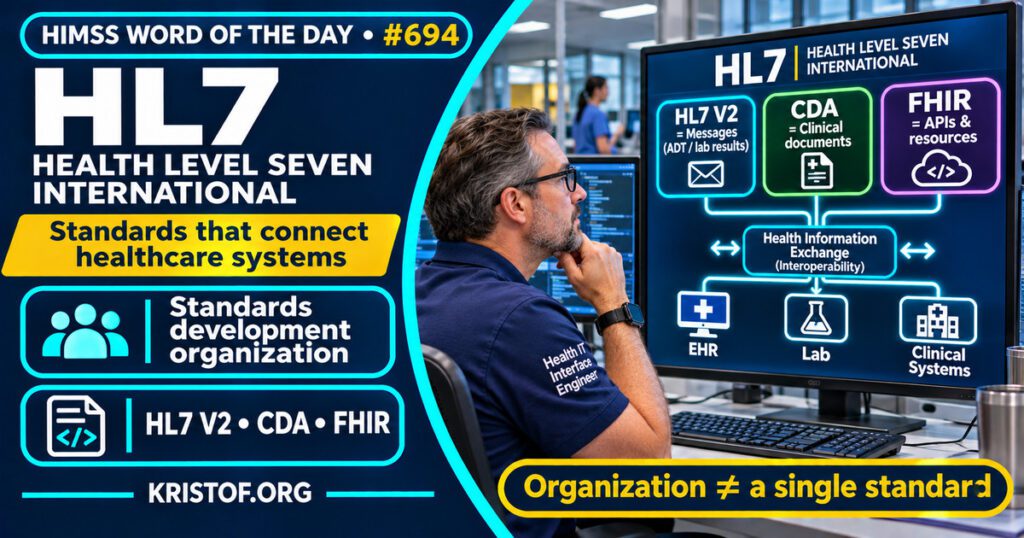
⚠️ Exam Alert: HL7 is the organization. HL7 V2, CDA, and FHIR are standards it develops, so a question about a message format is usually about a standard, not the organization. ANSI accredits standards developers and is not a standard. HIMSS offers CAHIMS and CPHIMS, while HL7 offers its own certification exams on its standards. IHE writes profiles that show how existing standards are used together.
🌐 Why It Matters: Real-World Healthcare IT Context
Because HL7 is an organization and not a research topic, this section draws on HL7’s information and media pages, ANSI, and CMS, plus one peer-reviewed review of FHIR. The HL7 pages show what HL7 says about itself and are not an independent evaluation. None of them carries a date.
Standards. HL7 says it develops and maintains standards for electronic health information exchange. Its media backgrounder says HL7 has an agreement with ISO under which it submits its ANSI-approved standards and draft standards for trial use directly to ISO for approval, and that HL7 is a founding member of the Joint Initiative Council on global health informatics standardization. The same page says HL7 Version 2 was published as an ISO standard in 2009. CMS’s page on standard-setting and related organizations lists HL7 under the Designated Standard Maintenance Organizations, a group the page defines as organizations HHS has named to maintain adopted standards and process requests to adopt or modify them. I did not check whether that designation is current beyond the page as retrieved.
FHIR in the literature. Ayaz et al. (2021) performed a systematic review of FHIR, searching literature from January 2012 to December 2019. They found 8,181 articles, 80 of which met their inclusion criteria, and reviewed open questions, challenges, implementation models, resources, and applications. They describe FHIR as then in an early stage of development and conclude the review highlights its important role in health care in the near future. This is a review of studies through 2019, so it says nothing about later adoption.
Certification and training. HL7’s information site says it offers certification for four HL7 standards, including FHIR, with exams taken online with a proctor or at authorized testing centers, along with classes, webinars, and practice exams. The certifications page I read lists three: FHIR, CDA, and V2, each tied to a named exam. The two pages do not explain the difference, so I cannot say which is current.
Membership and community. HL7 says its members can vote on standards and receive discounts on education, certification, and events. It states it has more than 1,600 members from over 50 countries, including more than 500 corporate members, and lists events such as working group meetings, FHIR Connectathons, and FHIR DevDays. These are HL7’s own figures from an undated page.
What I could not confirm. I could not read hl7.org, so I did not review its About, standards list, or governance pages. I found no independent source on HL7’s finances or governance. The membership counts and certification list come from undated HL7 pages and may have changed. The ANSI list shows the accreditation entry but does not describe HL7’s current standards.
Common HL7 mix-ups:
- Treating HL7 as a single standard instead of an organization
- Assuming “HL7” always means HL7 V2 messages
- Confusing HL7 with HIMSS, or its exams with CAHIMS and CPHIMS
- Assuming ANSI accreditation means a standard is required by law
- Repeating membership figures without checking the date
What HL7 offers:
- Standards, including V2, CDA, and FHIR
- Certification exams on its standards
- Classes, webinars, and practice exams
- Membership with a vote on standards
- Events such as working group meetings and Connectathons
🏥 The Nurse’s Perspective: Clinical, Bedside, & Workflow
Nurses rarely see HL7 by name, but they see its effects whenever data move between systems.
At the Bedside
An admission shows up in a unit census, a lab result appears in the flowsheet, and a medication order reaches the pharmacy. Interfaces built on HL7 standards are a common way those handoffs happen. When a result is late or a patient appears in the wrong place, the cause is often in the interface, though the bedside nurse sees only the symptom.
In Clinical Workflow
Nurses and nurse informaticists help decide what data move and when, including what a transfer summary contains and which results should post to the chart. Those choices shape which standard and which version a project uses. Knowing that HL7 is the organization and V2, CDA, and FHIR are different standards makes those conversations clearer.
In EHR Implementation (Go-Live Perspective)
During an Epic Go-Live, analysts and at-the-elbow support staff hear interface problems in plain terms: a result that did not file, a patient who did not appear, or a field that mapped to the wrong place. Interface testing before go-live catches many of these. This is context from workflow experience, and the sources reviewed do not examine go-lives.
🎓 CAHIMS / CPHIMS & HIMSS Perspective
CAHIMS Exam Domain Mapping
HL7 connects standards, interoperability, and the systems that exchange data:
| CAHIMS Domain | How HL7 Appears |
|---|---|
| Healthcare & Technology Environments | Standards organizations and how they relate |
| Clinical Informatics | Messages and documents that carry clinical data |
| Healthcare Information & Systems Management | Interfaces, testing, and standards selection |
| Management & Leadership | Governance of standards and vendor requirements |
Key Terms to Know Alongside HL7
- HL7 V2 — a widely used messaging standard from HL7 for exchanging clinical and administrative data
- FHIR — HL7’s standard built around resources and web-based exchange
- CDA — HL7’s markup standard for clinical documents
- Reference Information Model — an HL7 model of health information that underlies some of its standards
- Standards Development Organization — a body that develops and maintains standards through a consensus process
- ANSI — the American National Standards Institute, which accredits standards developers
HIMSS Organizational Position
HIMSS offers education and research on health information and technology topics through its Resource Center. Members can find related information on the HIMSS Resource Center page.
🧭 More HIMSS Word of The Day Terms
Related terms in the Interoperability and Standards series:
- Application Programming Interface (API)
- CQL (Clinical Quality Language)
- Argonaut Project
- Da Vinci Project
Browse all Interoperability and Standards terms or the A–Z glossary.
🔗 Explore Further: External References
- HL7 International — Learn More (information site) https://info.hl7.org/learn-more
- HL7 International — Certifications (information site) https://info.hl7.org/member-toolkit/certifications
- HL7 Media Center — HL7 Backgrounder Brief https://media.hl7.org/hl7-backgrounder-brief/
- ANSI — Accredited Standards Developers (dated June 4, 2025) https://share.ansi.org/Shared%20Documents/Standards%20Activities/American%20National%20Standards/ANSI%20Accredited%20Standards%20Developers/JUNE2025ASD.pdf
- CMS — Standard-Setting and Related Organizations https://www.cms.gov/priorities/key-initiatives/burden-reduction/administrative-simplification/hipaa/standard-setting-related-organizations
- Ayaz et al. (2021), JMIR Medical Informatics — The Fast Health Interoperability Resources (FHIR) Standard: Systematic Literature Review of Implementations, Applications, Challenges and Opportunities. https://pubmed.ncbi.nlm.nih.gov/34328424/
- HIMSS — Resource Center https://www.himss.org/resource-center
Term source: HIMSS Dictionary of Health Information and Technology Terms, Acronyms, and Organizations, 6th Edition (2025). All definitions in this series are paraphrased for editorial purposes. Readers are encouraged to consult the primary source for exact language.
Eric Andrew Kristof, RN, CAHIMS is a Healthcare IT professional and HIMSS Arkansas Chapter member based in Hot Springs Village, AR, with hands-on Epic Go-Live experience and a diverse healthcare and IT background. He writes at kristof.org at the intersection of clinical care and healthcare technology.
Leave a Reply