By Eric Andrew Kristof, RN, CAHIMS | Healthcare IT Professional | HIMSS Arkansas Chapter Member
About This Series: The HIMSS Word of The Day is a running blog series drawing from the HIMSS Dictionary of Health Information and Technology Terms, Acronyms, and Organizations, 6th Edition (2025) — the authoritative reference for healthcare IT professionals and the primary study resource for CAHIMS and CPHIMS certification. Each post paraphrases the term in plain language, grounds it in real-world healthcare IT context, and adds a bedside nursing perspective you won’t find in a textbook.
📖 The Term: Scanner
Source: HIMSS Dictionary of Health Information and Technology Terms, Acronyms, and Organizations, 6th Edition (2025)
🔍 Plain-Language Definition
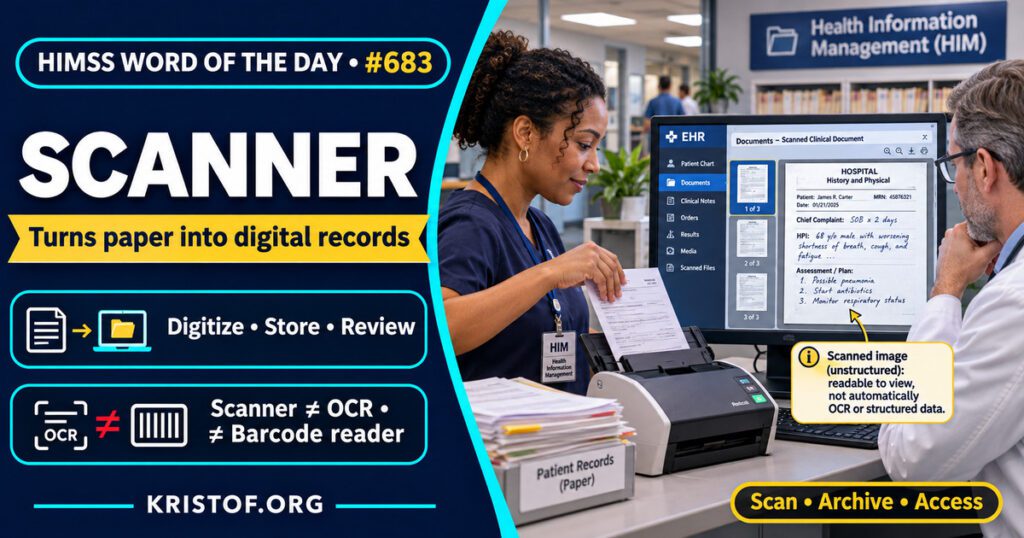
The HIMSS Dictionary describes a scanner as an electronic device that reads a physical item and produces a digital version of it. The digital file can then be kept on a computer and opened, or changed, by software.
In the studies below, the physical items are paper chart pages, documents sent from other facilities, and paper assessment forms. One study uses a different sense of the word, a barcode reader that scanned a patient armband, and it is flagged as such.
| Item scanned | What results | Study in this post |
|---|---|---|
| Paper hospital record | A digitized (scanned) record viewed on a computer | Scott et al. |
| Outside documents from other facilities | Scanned outside documents inside the EHR | Zhao et al. |
| Hospital paper documents | Scanned documents managed by a document management system | Kuwata et al. |
| Paper assessment forms | Scanned images read by recognition software | White-Dzuro et al. |
| Patient wristband (related sense) | A barcode read at the bedside | Spain et al. |
⚠️ Exam Alert: A scanner captures an image. It is not the same as optical character recognition (OCR), which is software that reads text or marks from an image, and it is not the same as a barcode reader, which reads a printed code. A scanned page is also not automatically structured data: Zhao et al. describe scanned documents as one of the unstructured formats that make secondary use of EHR data hard.
🌐 Why It Matters: Real-World Healthcare IT Context
Where it shows up. The dictionary sense is about devices that digitize paper. In my searches, I found no study of scanner hardware itself, such as image quality or speed. The studies I found are about what happens to the content after it is scanned. The five studies below are mostly small, single-site, or observational, and I read abstracts only.
Scanned outside documents in the EHR. Zhao et al. (2023) ran two independent EHR data abstractions of 30 variables commonly used in oncology research for 125 patients with advanced non-small-cell lung cancer at one comprehensive cancer center, with and without considering scanned outside documents. Overall completeness was 77.6% with the scanned documents and 54.3% without them. The difference was driven by biomarker test data, which were more likely to be available only in the scanned documents and were prone to being missing for patients diagnosed externally. This is a study of data abstraction in one cancer type at one center, and it does not test a scanner.
Digitized records in outpatient clinics. Scott et al. (2016) observed 406 follow-up outpatient consultations in two NHS hospitals using a work sampling approach, and held a focus group with clinicians. Once outliers were excluded, there was no significant difference in consultation times between digitized and paper records in the same hospital. At one site, two of three specialties spent significantly more time searching computer records, and at the other site direct patient care time increased. Clinicians in the focus group raised concerns about consistency of scanning practice, which left uncertainty about what could be relied upon to exist in the digitized record. Benefits they named included access from multiple locations and better prepared ward rounds. Limitations included display of specialised content such as hand-drawn diagrams and the inability to flick quickly through pages. The authors conclude that digitized records can be implemented without detrimental operational impact and that clear, consistent operational processes are vital. The abstract does not give the focus group size.
Paper that does not go away. Kuwata et al. (2011) analysed use of a document management system over time at one university-affiliated hospital in Japan that already had an electronic patient record. The number of electronic documents and of scanned documents circulating in the hospital tended to increase. The authors take this to mean that paper documents were not being replaced by electronic documents, and they expect the need for such systems to keep growing. It is one hospital, and the study is more than a decade old.
Turning scanned forms into data. White-Dzuro et al. (2021) built an optical mark recognition and optical character recognition system to extract data from 2,814 paper COVID-19 assessment forms, each with 141 fields, at a large medical center. Compared with crowd validation results, the software extracted fields with an average accuracy of 70% and a median accuracy of 78%. Crowd participants validated scanned forms at a mean of 157 seconds per document and about 108 documents per day, and agreement between participants was 97% for documents including narrative text fields and 98% for Boolean and multiple-choice fields only. The authors note that health care workers wearing personal protective equipment may find it hard to interact with EHRs. Accuracy was measured against the crowd-validated results, not an independent standard, and it is one center.
A related sense: a barcode armband scanner. Spain et al. (2015) ran a prospective before-and-after study in a regional emergency department in Queensland, Australia, of interventions to improve patient identification when collecting pathology samples. One intervention was education alone, and the other was education plus an armband scanner that voice-prompted the collector. Across 282 collections (115 before, 95 after education, 72 after education plus scanner), the abstract reports increases in applying the armband before sample collection (36% versus 90%), asking the patient to state their name (25% versus 93%), and asking for date of birth (22% versus 93%), and says education alone gave similar but less pronounced results. No primary patient misidentification was detected in this small study. Annual costs of adopting the program were given as $104,045 with the scanner and $5,330 without it. This is a barcode reader, not the document scanner the dictionary describes.
What I could not confirm. I did not find a study comparing scanner models or scan settings, and none of the studies reviewed measures image quality, legibility, or scan errors. I did not review guidance on retention, legal acceptance of scanned records, or privacy risks of scanning devices. The Spain abstract does not name the currency of its cost figures or label which groups each pair of percentages compares. I did not find outcome evidence, such as safety or cost savings, for document scanning itself.
Common scanner problems:
- Inconsistent scanning practice, which leaves uncertainty about what is in the digitized record
- Scanned content that stays unstructured and is hard to use for secondary purposes
- Specialised content such as hand-drawn diagrams that display poorly
- Paper that continues to circulate alongside electronic documents
- Software that reads scanned forms with imperfect accuracy, so people still check the results
What supports scanner use:
- Access to scanned records from multiple locations
- Information from other facilities that would otherwise be missing, as in the oncology study
- Document management systems that keep paper-based records usable alongside an EHR
- Recognition software combined with human validation for large batches of forms
- Clear and consistent operational processes for scanning
🏥 The Nurse’s Perspective: Clinical, Bedside, & Workflow
Nurses often complete or handle paper forms and records, which is general workflow context. The abstracts reviewed do not say who performed the scanning.
At the Bedside
In the COVID-19 form study, the authors note that wearing personal protective equipment can make it challenging to interact with EHRs, and they give this as context for the paper form work. In the armband study, the scanner voice-prompted the person collecting the sample, and the behaviours measured included applying the armband before collection and asking the patient to state a name and date of birth. That is a barcode example and not document scanning.
In Clinical Workflow
The outpatient study found that clinicians were unsure what they could rely on to exist in a digitized record because scanning practice was inconsistent. For nurses preparing a handover or a ward round, the same question about what is in the record is a reasonable one to ask, though that is an inference, since the focus group was described as clinicians and not nurses specifically.
In EHR Implementation (Go-Live Perspective)
Kuwata et al. found scanned documents increasing at a hospital that already had an electronic record, which suggests analysts and at-the-elbow support staff may still field questions about where scanned paper appears. That is an inference from one Japanese hospital, and none of the studies reviewed examines go-lives.
🎓 CAHIMS / CPHIMS & HIMSS Perspective
CAHIMS Exam Domain Mapping
Scanner appears in questions about hardware, records conversion, and data quality:
| CAHIMS Domain | How Scanner Appears |
|---|---|
| Healthcare & Technology Environments | Input hardware that turns paper into digital images |
| Clinical Informatics | Scanned documents in the record and what clinicians can find in them |
| Healthcare Information & Systems Management | Document management, recognition software, and data extraction |
| Management & Leadership | Scanning processes, consistency, and cost |
Key Terms to Know Alongside Scanner
- Optical character recognition — software that reads text from an image, as used on the scanned forms in one study
- Document management — managing electronic and scanned documents, as in the Japanese hospital study
- Bar code — a printed code read by a scanner, as in the armband study
- Unstructured data — data not held in defined fields, such as scanned documents
- Digitize — to convert physical material into a digital form
HIMSS Organizational Position
HIMSS offers education and research on health information and technology topics through its Resource Center. Members can find related information on the HIMSS Resource Center page.
🧭 More HIMSS Word of The Day Terms
Related terms in the IT Infrastructure series:
Browse all IT Infrastructure terms or the A–Z glossary.
🔗 Explore Further: External References
- Zhao et al. (2023), JCO Clinical Cancer Informatics — Assessing the Contribution of Scanned Outside Documents to the Completeness of Real-World Data Abstraction. https://pubmed.ncbi.nlm.nih.gov/36791386/
- Scott et al. (2016), BMC Medical Informatics and Decision Making — Measuring the operational impact of digitized hospital records: a mixed methods study. https://pubmed.ncbi.nlm.nih.gov/27829453/
- Kuwata et al. (2011), Studies in Health Technology and Informatics — Longitudinal analysis on utilization of medical document management system in a hospital with EPR implementation. https://pubmed.ncbi.nlm.nih.gov/21335697/
- White-Dzuro et al. (2021), Applied Clinical Informatics — Extracting Medical Information from Paper COVID-19 Assessment Forms. https://pubmed.ncbi.nlm.nih.gov/33694142/
- Spain et al. (2015), Emergency Medicine Australasia — Can a barcode scanner for blood collection improve patient identification integrity in the emergency department? A prospective before-and-after study. https://pubmed.ncbi.nlm.nih.gov/25594877/
- HIMSS — Resource Center https://www.himss.org/resource-center
Term source: HIMSS Dictionary of Health Information and Technology Terms, Acronyms, and Organizations, 6th Edition (2025). All definitions in this series are paraphrased for editorial purposes. Readers are encouraged to consult the primary source for exact language.
Eric Andrew Kristof, RN, CAHIMS is a Healthcare IT professional and HIMSS Arkansas Chapter member based in Hot Springs Village, AR, with hands-on Epic Go-Live experience and a diverse healthcare and IT background. He writes at kristof.org at the intersection of clinical care and healthcare technology.
Leave a Reply