By Eric Andrew Kristof, RN, CAHIMS | Healthcare IT Professional | HIMSS Arkansas Chapter Member
About This Series: The HIMSS Word of The Day is a running blog series drawing from the HIMSS Dictionary of Health Information and Technology Terms, Acronyms, and Organizations, 6th Edition (2025) — the authoritative reference for healthcare IT professionals and the primary study resource for CAHIMS and CPHIMS certification. Each post paraphrases the term in plain language, grounds it in real-world healthcare IT context, and adds a bedside nursing perspective you won’t find in a textbook.
📖 The Term: Threshold
Source: HIMSS Dictionary of Health Information and Technology Terms, Acronyms, and Organizations, 6th Edition (2025)
🔍 Plain-Language Definition
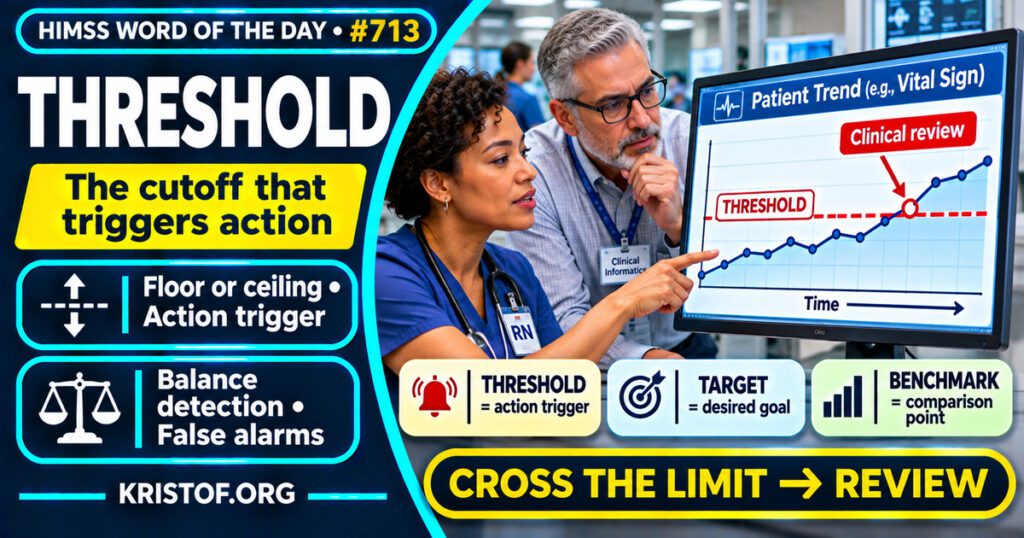
The HIMSS Dictionary describes a threshold as a limit, either a floor or a ceiling, set for some property or measured quantity and used as a benchmark for comparison or guidance. It adds that crossing the limit may prompt a thorough review of the situation or a redesign of a system.
In health IT, the word often means the line that turns a number into an action. A bedside monitor sounds an alarm when a vital sign crosses a set limit, and an early warning score prompts a clinical review when the total reaches a chosen value.
| Kind of threshold | Example | What happens when it is crossed |
|---|---|---|
| Score trigger | An aggregate early warning score at or above a chosen value | A clinical review is prompted |
| Alarm limit | A high or low limit set for a vital sign on a monitor | An alarm sounds |
| Policy limit | A value in a policy or standard that signals a problem | A review or redesign is called for (the dictionary’s wording) |
⚠️ Exam Alert: A threshold is a cutoff that triggers action, a target is a goal people want to reach, and a benchmark is a reference value used for comparison. Moving a threshold trades sensitivity against specificity: a lower line catches more true events and raises more false alarms. Alarm fatigue is the result when too many alerts are not actionable. A default setting is the value a device or system ships with, and it is not automatically the right threshold for a given unit.
🌐 Why It Matters: Real-World Healthcare IT Context
Because a threshold is a general concept, this section draws on four peer-reviewed papers, a Royal College of Physicians (RCP) page, and a Joint Commission document, all about clinical alerts and alarms. The studies use different settings and outcomes, so their numbers should not be set side by side as if they answered one question.
Early warning scores. The RCP says it produced the National Early Warning Score (NEWS), first published in 2012, and that NEWS2 is its December 2017 update. The page says six physiological measures are scored: respiration rate, oxygen saturation, systolic blood pressure, pulse rate, level of consciousness or new confusion, and temperature. Each is scored by how far it departs from the norm, the scores are summed, and 2 points are added for patients on supplemental oxygen. The page copy I read did not give the score bands or response levels, which are in charts the page links to.
Where to set the line on a ward. Haegdorens et al. (2020) validated NEWS retrospectively in six Belgian hospitals, using 1,523 patients in a cross-sectional sample and 390 in a serious adverse event sample. A NEWS of 5 or higher had a predictive value of 6.8% and a negative predictive value of 99.5% for unexpected death, cardiac arrest with resuscitation, or unplanned ICU admission, with an area under the curve of 0.841. The authors name 5 as the optimal threshold on general wards. They also note the significant number of false positives at that level and say hospitals should create workable guidelines.
Where to set it in the emergency department. Masson and Stephenson (2022) studied 91,871 valid patient episodes from 64,760 patients in two emergency departments in northern England in 2019. NEWS2 predicted mortality at 2, 7, and 30 days, with areas under the curve of 0.963, 0.946, and 0.915. The best likelihood ratios were at a trigger of 4 points, and the authors suggest a maximum NEWS2 of 4 or more may be the best escalation trigger in that setting. The two studies used different settings and outcomes, so the difference between 5 and 4 is not a contradiction, and I read it as a reason for local review. That reading is my inference.
The limits of a number. Grant and Crimmons (2018), in a nursing journal, discuss track and trigger systems including NEWS. They say these tools can be too sensitive for some patients and, for others, detect only late deterioration, and that they focus on one set of observations and so ignore trends. They advise that nurses not rely on the tools alone, and use them with physiological knowledge and clinical assessment. This is a narrative article, not a study.
Alarm settings in the ICU. Carencotte et al. (2024) analyzed 57,667 ICU stays from the MIMIC-IV database. They report that alarm threshold values and how often thresholds were changed followed the vital sign being monitored and almost never followed the patient’s overall health status. They conclude that settings were rarely adapted as patients changed and that a different approach might improve care and working life for staff. This is an exploratory, retrospective analysis of a database.
What the rules require. The Joint Commission’s National Performance Goals document, effective January 2026 for the hospital program, lists NPG.01.05.01, which says a hospital improves the safety of clinical alarm systems. It requires the hospital to identify its most important alarm signals using staff input, the risk to patients if an alarm is missed or fails, whether an alarm is needed or adds noise and alarm fatigue, its own incident history, and published best practices. Policies must at least cover clinically appropriate settings, when alarms may be disabled, when parameters may be changed, who may set, change, or turn off parameters, how alarms are monitored and answered, and how settings are checked. Documentation is required. Summaries from law firms and training vendors that I read, but did not cite, say these goals replaced the National Patient Safety Goals, where the alarm goal was numbered NPSG.06.01.01.
What I could not confirm. I did not find a single recommended threshold, and these sources suggest it depends on the setting and the outcome. I did not verify the NEWS2 score bands or response levels, which were not on the RCP page copy I read. I read abstracts for the four papers, not full texts. The Haegdorens abstract words its 6.8% figure as a predictive value, so check the full paper before quoting it as a positive predictive value. I did not find a trial showing that changing thresholds improves patient outcomes. The Joint Commission numbering reflects the document I read, and requirements can change.
Common threshold problems:
- Treating one threshold as right for every unit and patient group
- Leaving a default setting in place without review
- Setting a threshold once and never checking how it performs
- Letting a single score below the line hide a worsening trend
- Allowing a score to replace clinical judgment
What supports sound thresholds:
- Local data on false alerts and missed events, as the ward study suggests
- Clear policy on who may set and change alarm parameters
- Pairing scores with clinical assessment, as Grant and Crimmons advise
- Periodic review as patients and units change
- A documented reason for each setting
🏥 The Nurse’s Perspective: Clinical, Bedside, & Workflow
No study reviewed for this post measured nurses’ responses directly, so the points below are workflow context and not research findings.
At the Bedside
Nurses are the ones who meet a threshold crossing as an alarm, a flashing score, or a page. A score under the line does not rule out a patient who is getting worse, and Grant and Crimmons say scores should be used with clinical assessment and attention to trends. A patient whose observations drift over several hours without crossing the line is the case that makes a nurse’s own concern important. That reading is an inference from the article.
In Clinical Workflow
The Joint Commission goal asks hospitals to decide who may set, change, or turn off alarm parameters. In practice that is a question nursing leaders, biomedical engineering, and informatics often answer together. When a unit says it gets too many alarms, a useful first step is to look at how the thresholds were set and by whom. The ICU analysis found settings changed little with the patient’s condition, which suggests defaults may deserve a second look.
In EHR Implementation (Go-Live Perspective)
During an Epic Go-Live, analysts and at-the-elbow support staff hear complaints about too many or too few alerts within days. Knowing which thresholds are defaults and which were chosen locally saves time in deciding what to change. A change log that records who adjusted a limit, and why, supports the policy the Joint Commission describes. This is context from workflow experience, and the sources reviewed do not examine go-lives.
🎓 CAHIMS / CPHIMS & HIMSS Perspective
CAHIMS Exam Domain Mapping
Thresholds connect clinical risk, alert design, and the policies that govern them:
| CAHIMS Domain | How Threshold Appears |
|---|---|
| Healthcare & Technology Environments | Regulatory expectations for alarm and alert safety |
| Clinical Informatics | Score triggers and decision support rules built on cutoffs |
| Healthcare Information & Systems Management | Configuring, testing, and changing alert and alarm settings |
| Management & Leadership | Deciding who may change a threshold and how it is reviewed |
Key Terms to Know Alongside Threshold
- Clinical Decision Support System — software that alerts or advises at the point of care, often driven by thresholds
- Alarm Fatigue — desensitization to frequent alarms that need no action
- Early Warning Score — an aggregate score of vital signs used to prompt review of a patient
- Run Chart — a measure plotted over time whose rules give a statistical way to judge change
- Control Chart — a chart with control limits calculated from the data, a statistical use of limits
- Benchmark — a reference value used for comparison
HIMSS Organizational Position
HIMSS offers education and research on health information and technology topics through its Resource Center. Members can find related information on the HIMSS Resource Center page.
🧭 More HIMSS Word of The Day Terms
Related terms in the Clinical Informatics series:
- Free Text
- LIP (Licensed Independent Practitioner)
- Clinical Pathways (CPWs)
- APACHE (Acute Physiology and Chronic Health Evaluation)
Browse all Clinical Informatics terms or the A–Z glossary.
🔗 Explore Further: External References
- Royal College of Physicians — National Early Warning Score (NEWS) 2 https://www.rcp.ac.uk/resources/national-early-warning-score-news-2/
- Haegdorens et al. (2020), Journal of Clinical Nursing — The optimal threshold for prompt clinical review: An external validation study of the national early warning score. https://pubmed.ncbi.nlm.nih.gov/32920891/
- Masson and Stephenson (2022), Emergency Medicine Journal — Investigation into the predictive capability for mortality and the trigger points of the National Early Warning Score 2 (NEWS2) in emergency department patients. https://pubmed.ncbi.nlm.nih.gov/34108195/
- Grant and Crimmons (2018), British Journal of Nursing — Limitations of track and trigger systems and the National Early Warning Score. Part 2: sensitivity versus specificity. https://pubmed.ncbi.nlm.nih.gov/29953281/
- Carencotte et al. (2024), Journal of Medical Systems — Exploring Clinical Practices of Critical Alarm Settings in Intensive Care Units: A Retrospective Study of 60,000 Patient Stays from the MIMIC-IV Database. https://pubmed.ncbi.nlm.nih.gov/39279014/
- The Joint Commission — National Performance Goals, Hospital Program (effective January 2026) https://digitalassets.jointcommission.org/api/public/content/9ca80055182b4274842a5780a94f2c82
- HIMSS — Resource Center https://www.himss.org/resource-center
Term source: HIMSS Dictionary of Health Information and Technology Terms, Acronyms, and Organizations, 6th Edition (2025). All definitions in this series are paraphrased for editorial purposes. Readers are encouraged to consult the primary source for exact language.
Eric Andrew Kristof, RN, CAHIMS is a Healthcare IT professional and HIMSS Arkansas Chapter member based in Hot Springs Village, AR, with hands-on Epic Go-Live experience and a diverse healthcare and IT background. He writes at kristof.org at the intersection of clinical care and healthcare technology.
Leave a Reply