By Eric Andrew Kristof, RN, CAHIMS | Healthcare IT Professional | HIMSS Arkansas Chapter Member
About This Series: The HIMSS Word of The Day is a running blog series drawing from the HIMSS Dictionary of Health Information and Technology Terms, Acronyms, and Organizations, 6th Edition (2025) — the authoritative reference for healthcare IT professionals and the primary study resource for CAHIMS and CPHIMS certification. Each post paraphrases the term in plain language, grounds it in real-world healthcare IT context, and adds a bedside nursing perspective you won’t find in a textbook.
📖 The Term: CHV (Consumer Health Vocabulary Initiative)
Source: HIMSS Dictionary of Health Information and Technology Terms, Acronyms, and Organizations, 6th Edition (2025)
🔍 Plain-Language Definition
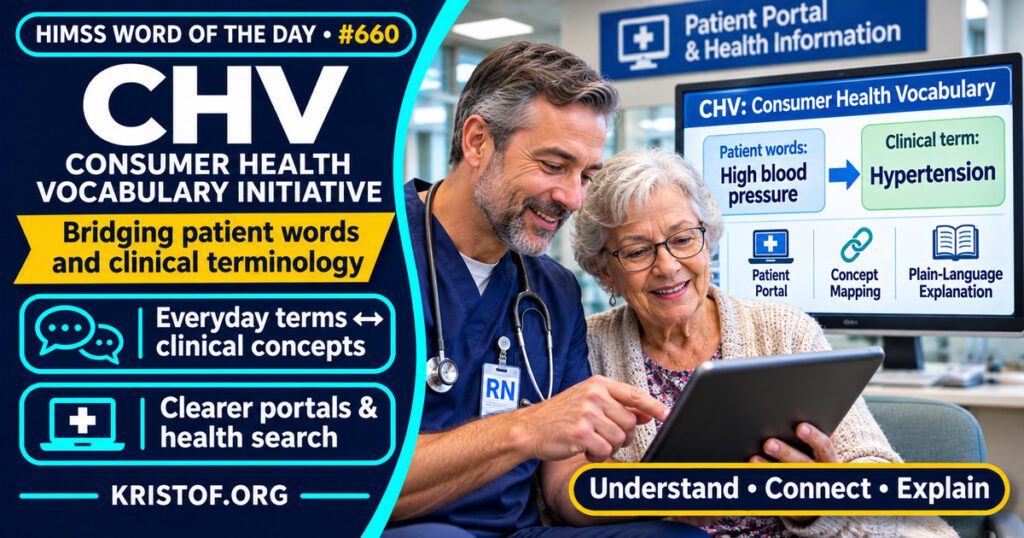
The HIMSS Dictionary describes the CHV (Consumer Health Vocabulary) initiative as an open-access, collaborative effort that connects the everyday words and phrases people use about health to the technical terms health professionals use.
Zeng and Tse (2006) set out the idea in the Journal of the American Medical Informatics Association. They argue that laypeople often struggle to find, understand, and act on health information because of gaps in domain knowledge, and that vocabularies reflecting how consumers express health topics could help bridge those gaps. They describe a distributed, bottom-up approach to build an open-access, preliminary, first-generation CHV.
| Layer | Example idea | Why it matters |
|---|---|---|
| Consumer term | A phrase a patient might type into a search box | Matches how people actually talk |
| Professional concept | The technical term used in records and literature | Matches how clinicians document |
| The link between them | A mapping from the lay term to the concept | Lets tools translate in either direction |
⚠️ Exam Alert: CHV is a resource for linking lay and professional language. It is not a clinical coding system such as ICD-10-CM or SNOMED CT, and it is not a billing classification. It also does not replace patient education by a clinician.
🌐 Why It Matters: Real-World Healthcare IT Context
Plain-language health content is a practical need, since patients can read notes and results through portals. The studies below test how far consumer vocabularies and similar tools get with real text. Most are small or specific, so treat them as examples, not as general proof.
The founding argument. Zeng and Tse (2006) present a point of view, not a trial. They say CHV development is practical and necessary and acknowledge limits such as not addressing psychosocial and cultural factors. Their paper dates from 2006, and later work has built on the resource.
Coverage on radiology reports. Qenam and colleagues (2017) used MetaMap to link terms from radiology reports to CHV concepts, then swapped in CHV-preferred terms using the UMLS Metathesaurus. Of 792 selected terms, 695 mapped to CHV concepts, a content coverage of 88.5 percent. Among the 97 unmapped concepts, 51 (53 percent) were names of anatomical structures and regions, and 28 (29 percent) were anatomical descriptions and pathological variations. Lexical similarity between CHV-preferred terms and the report terms was about 72.6 percent. The authors warn that many CHV terms still resemble medical jargon and may not suit lay consumers, and they call for further patient-centered changes. This was a study of report text, and it did not test whether patients understood the simplified versions.
Usage patterns. Hong and colleagues (2010) identified 340 unique diagnosis and patient-friendly term pairs in an ambulatory electronic medical record and patient portal. They compared how often consumers used each term in search queries from a consumer health information portal. Patient-friendly terms could help bridge the gap, but not always: in some cases the professional diagnosis term was used more often, typically when it was simpler or more common than the patient-friendly one. The study is from 2010 and examined one record system.
Clarification in a portal. Van Mens and colleagues (2020) tested lexical clarification, which adds synonyms and definitions from a Dutch medical terminology system, in a Dutch university medical center’s patient portal. Fifteen patient panel participants read their own notes. They marked a median of 21 terms as difficult, and the tool clarified a median of 2 of them. Median precision was 6.5 percent and median recall 8.3 percent. Participants still rated the tool very easy to use (median 98 of 100) and useful (median 79). Some easy terms were clarified unnecessarily, and some clarifications were difficult or wrong. This is a small study using a Dutch terminology system, not the CHV, but it shows the same practical challenge.
A format change. Amith and colleagues (2019) report building a SKOS-based ontology of the CHV dataset, which was distributed as a flat file. They say an ontology form lets the vocabulary be linked to other resources. The abstract describes a plan to expand the terminology and does not report an evaluation.
What I could not confirm. I did not find current usage figures for the CHV or confirmation of how actively it is maintained, and I did not review where it is distributed today. I read abstracts only. The abstracts do not report whether simplified wording improved patient understanding or outcomes.
Common consumer vocabulary problems:
- Gaps in coverage, especially for anatomy and specialty terms
- Lay-term lists that still contain jargon
- Substituting a “friendly” term that patients actually use less than the clinical one
- Clarification tools that explain easy words and miss hard ones
- Treating translation of terms as the same as understanding
What supports usable plain-language tools:
- Terms drawn from how consumers actually express health topics
- Open, linkable formats so vocabularies connect to other resources
- Testing with real patients reading their own notes
- Keeping the professional term where it is already the simpler word
- Ongoing expansion of terms and review of errors
🏥 The Nurse’s Perspective: Clinical, Bedside, & Workflow
Nurses regularly translate between clinical and everyday language, which is the problem CHV tries to address in software.
At the Bedside
A nurse who explains a diagnosis or a test result in plain words is doing the same translation a CHV supports. The studies show that automated help covers only part of what patients find difficult, so verbal explanation and checking understanding still matter. The studies above did not test bedside teaching.
In Clinical Workflow
When results and notes appear in a patient portal, patients may read them before a nurse calls. In the Dutch study, participants marked a median of 21 terms as difficult in their own notes. Nurses and nurse informaticists can use that kind of finding to prioritize which results and instructions need a plain-language explanation ready.
In EHR Implementation (Go-Live Perspective)
During an Epic Go-Live, decisions about what patients see in the portal are made alongside clinical teams. Hong and colleagues studied patient-friendly diagnosis terms in an ambulatory record and portal, so analysts and nurse leaders can ask whether such terms are in use and whether patients seem to understand them. This is a workflow question, not a recommendation drawn from the studies.
🎓 CAHIMS / CPHIMS & HIMSS Perspective
CAHIMS Exam Domain Mapping
CHV appears where terminology meets patient-facing tools:
| CAHIMS Domain | How CHV Appears |
|---|---|
| Healthcare & Technology Environments | Terminology resources and patient-facing portals |
| Clinical Informatics | Plain-language access to records and health information |
| Healthcare Information & Systems Management | Vocabulary mapping, UMLS tools, and data formats |
| Management & Leadership | Health literacy goals and patient engagement strategy |
Key Terms to Know Alongside CHV
- Unified Medical Language System (UMLS) — a set of resources that links health vocabularies and terms
- Health literacy — the ability to find, understand, and use health information
- Patient portal — a secure website that lets patients view parts of their record and message their care team
- Controlled vocabulary — a standard list of terms used to describe concepts consistently
- Ontology — a formal representation of concepts and the relationships among them
- Natural language processing (NLP) — computer methods for analyzing human language
HIMSS Organizational Position
HIMSS offers education and research on health information and technology topics through its Resource Center. Members can find related information on the HIMSS Resource Center page.
🧭 More HIMSS Word of The Day Terms
Related terms in the Interoperability and Standards series:
- Application Programming Interface (API)
- UMDNS (Universal Medical Device Nomenclature System)
- MeSH (Medical Subject Headings)
- NLM (National Library of Medicine)
Browse all Interoperability and Standards terms or the A–Z glossary.
🔗 Explore Further: External References
- Zeng and Tse (2006), Journal of the American Medical Informatics Association — Exploring and developing consumer health vocabularies https://pubmed.ncbi.nlm.nih.gov/16221948/
- Qenam et al. (2017), Journal of Medical Internet Research — Text Simplification Using Consumer Health Vocabulary to Generate Patient-Centered Radiology Reporting: Translation and Evaluation https://pubmed.ncbi.nlm.nih.gov/29254915/
- Hong et al. (2010), Studies in Health Technology and Informatics — A usability study of patient-friendly terminology in an EMR system https://pubmed.ncbi.nlm.nih.gov/20841665/
- van Mens et al. (2020), BMC Medical Informatics and Decision Making — Evaluation of lexical clarification by patients reading their clinical notes: a quasi-experimental interview study https://pubmed.ncbi.nlm.nih.gov/33319706/
- Amith et al. (2019), IEEE International Conference on Bioinformatics and Biomedicine — Ontology of Consumer Health Vocabulary: providing a formal and interoperable semantic resource for linking lay language and medical terminology https://pubmed.ncbi.nlm.nih.gov/38125584/
- HIMSS — Resource Center https://www.himss.org/resource-center
Term source: HIMSS Dictionary of Health Information and Technology Terms, Acronyms, and Organizations, 6th Edition (2025). All definitions in this series are paraphrased for editorial purposes. Readers are encouraged to consult the primary source for exact language.
Eric Andrew Kristof, RN, CAHIMS is a Healthcare IT professional and HIMSS Arkansas Chapter member based in Hot Springs Village, AR, with hands-on Epic Go-Live experience and a diverse healthcare and IT background. He writes at kristof.org at the intersection of clinical care and healthcare technology.
Leave a Reply