By Eric Andrew Kristof, RN, CAHIMS | Healthcare IT Professional | HIMSS Arkansas Chapter Member
About This Series: The HIMSS Word of The Day is a running blog series drawing from the HIMSS Dictionary of Health Information and Technology Terms, Acronyms, and Organizations, 6th Edition (2025) — the authoritative reference for healthcare IT professionals and the primary study resource for CAHIMS and CPHIMS certification. Each post paraphrases the term in plain language, grounds it in real-world healthcare IT context, and adds a bedside nursing perspective you won’t find in a textbook.
📖 The Term: Analog-to-Digital Conversion
Source: HIMSS Dictionary of Health Information and Technology Terms, Acronyms, and Organizations, 6th Edition (2025)
🔍 Plain-Language Definition
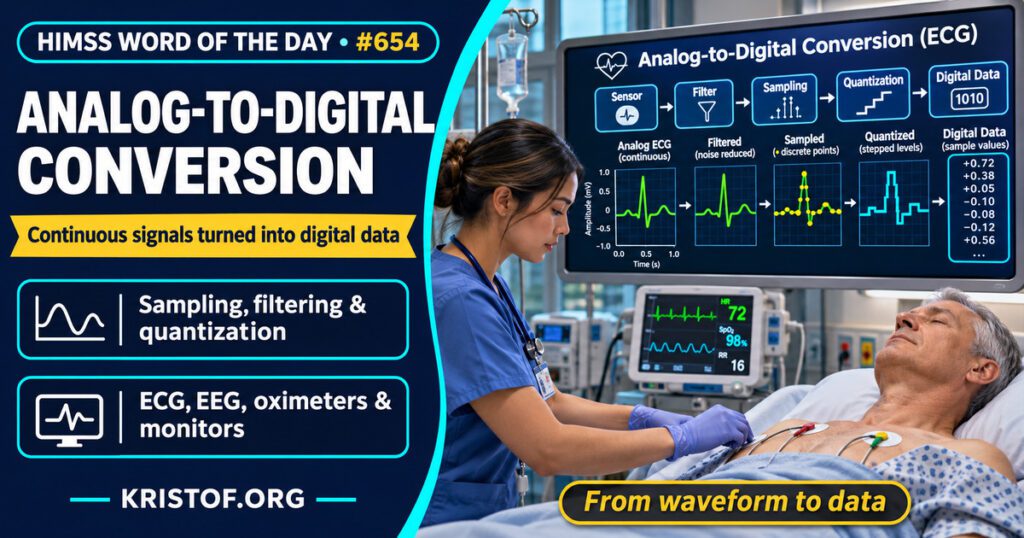
The HIMSS Dictionary describes analog-to-digital conversion as an electronic process that changes a continuously variable signal into a signal made of discrete levels, while preserving the content that matters. The device that does this is an analog-to-digital converter (ADC).
In health IT, the signals are body and equipment signals: the voltage an ECG electrode picks up, the output of a pulse oximeter sensor, or the potentials recorded in an EEG. The converter measures the signal many times per second and records each measurement as a number. Software can then store, display, transmit, and analyze it.
| Step | What happens | Why it matters |
|---|---|---|
| Sensing | A sensor produces a continuous electrical signal | The raw signal also carries noise |
| Filtering | Unwanted frequencies are reduced before conversion | Burgess (2019) notes an antialiasing filter is always needed before digital sampling |
| Sampling | The signal is measured repeatedly | Too few samples can miss fast features |
| Quantization | Each measurement is rounded to a numeric level | Finer levels preserve more detail |
| Storage and use | The numbers are processed, displayed, and saved | Everything downstream depends on the quality of this step |
⚠️ Exam Alert: Analog-to-digital conversion is not the same as digitization in the records sense, such as scanning a paper form. It is also the opposite direction from digital-to-analog conversion, which turns numbers back into a continuous signal, as a speaker or an analog display requires.
🌐 Why It Matters: Real-World Healthcare IT Context
Most clinical measurements that end up in an electronic record passed through an ADC first. The sources below show what specialists say about doing it well and where the limits are. I found no peer-reviewed study in this search that measures ADC quality as a patient outcome, so these are technical and validation sources.
Standards for the ECG. Kligfield and colleagues (2007) wrote an American Heart Association scientific statement on the ECG and its technology, prepared with the American College of Cardiology Foundation and the Heart Rhythm Society and endorsed by the International Society for Computerized Electrocardiology. Its stated purpose is to explain how the modern ECG is derived and displayed and to set standards that improve its accuracy and usefulness. The abstract says special emphasis is placed on digital signal acquisition and computer-based signal processing, including automated measurements that lead to computer-generated diagnostic statements. It is a consensus statement, not a trial, and it is from 2007.
Bandwidth matters. Rijnbeek and colleagues (2001) recorded 12-lead ECGs at 1,200 Hz in 2,169 children aged 1 day to 16 years. They passed the averaged beats through digital filters with different cutoffs and measured errors in maximum QRS amplitude. They found that a bandwidth of 250 Hz kept amplitude errors under 25 microvolts in more than 95 percent of children under 1 year, and they recommended a minimum of 250 Hz for pediatric ECGs. The abstract says this is considerably higher than the American Heart Association’s earlier recommendation of 150 Hz. This is a single study from 2001, and I did not confirm whether later guidance changed the recommendation.
Filtering changes the signal. Burgess (2019), in a chapter on neurophysiologic signals, explains that filters emphasize waveforms of interest and can remove mains interference and electrode offset. For digital instruments, an antialiasing filter set below the Nyquist limit is always needed before sampling by the analog-to-digital converter. The chapter also cautions that the clinician must keep in mind how filtering affects the physiological waveform. It is a review chapter written about neurophysiology, and the principle is the same one that applies elsewhere.
Wearables bring the converter closer to the patient. Alimbayeva and colleagues (2026) described a wearable 12-lead ECG platform that uses an ADS1298 analog front-end for synchronized multichannel acquisition. They compared its automated PR, QRS, QT, and QTc measurements with a reference clinical electrocardiograph in 30 paired recordings and reported correlations of 0.756 to 0.820, with mean absolute errors from 2.53 milliseconds for QRS duration to 10.40 milliseconds for the QT interval. This is a small, device-development study, and the abstract does not report outcomes in patients with arrhythmias.
Patch monitors. Lobodzinski (2013) reviewed ECG patch monitors for long-term rhythm monitoring and notes that the 12-lead Holter remains the gold standard for assessing rhythm abnormalities. The review says clinical validation data for the newer patches were still growing. It is a single-author narrative review from 2013, so newer devices were not covered.
What I could not confirm. I did not find a current sampling rate or resolution standard for every device type. I did not confirm whether the 2007 statement or later guidance replaced the 2001 pediatric recommendation, and I did not review the full text of any source, only the abstracts.
Common analog-to-digital conversion problems:
- Sampling or bandwidth too low for the signal, which distorts or hides fast features
- Missing or poorly set antialiasing filters
- Noise from mains interference or poor electrode contact that is captured faithfully along with the signal
- Filtering that changes the waveform that clinicians interpret
- Trusting automated measurements from a new device without a comparison against a reference
What supports good analog-to-digital conversion:
- Standards for recording, such as professional society statements
- Bandwidth and sampling chosen for the patient group, as the pediatric study illustrates
- Documented filter settings on recordings
- Validation of new devices against a reference instrument
- Training for staff on electrode placement and artifact recognition
🏥 The Nurse’s Perspective: Clinical, Bedside, & Workflow
Nurses place the electrodes and sensors that start this process, so what they do shapes the signal before any converter sees it.
At the Bedside
A loose lead or a patient who is moving adds noise that the converter records along with the heartbeat. Skin preparation, secure electrode contact, and recognizing artifact are bedside steps that protect signal quality. The bedside monitor display is already the output of conversion and processing, so a clean-looking tracing depends on these early steps.
In Clinical Workflow
Telemetry, pulse oximetry, and wearable monitors all send digital values onward. Nurses who understand that a displayed value is a processed result can better judge when a reading does not match the patient. Filter settings and monitoring modes can change what a waveform looks like, so documented settings help when a tracing is reviewed later.
In EHR Implementation (Go-Live Perspective)
During an Epic Go-Live, device integration raises questions such as whether values on the monitor match what flows into the chart, and how often. Analysts and nurse super users can compare a monitor display with the charted value for a test patient before go-live. This is a workflow suggestion rather than a finding from the sources above.
🎓 CAHIMS / CPHIMS & HIMSS Perspective
CAHIMS Exam Domain Mapping
Analog-to-digital conversion appears wherever device signals enter information systems:
| CAHIMS Domain | How Analog-to-Digital Conversion Appears |
|---|---|
| Healthcare & Technology Environments | Medical devices, monitors, and sensors that feed digital systems |
| Clinical Informatics | Signal quality and the trustworthiness of device-derived data |
| Healthcare Information & Systems Management | Device integration, data transmission, and storage of waveforms |
| Management & Leadership | Device selection, validation, and vendor evaluation |
Key Terms to Know Alongside Analog-to-Digital Conversion
- Sampling rate — how many times per second a signal is measured
- Bandwidth — the range of frequencies a recording captures
- Telemetry — the transmission of monitoring data from a patient to a remote display
- Medical device integration — the flow of device data into clinical information systems
- Wearable — a worn sensor device that collects health data
HIMSS Organizational Position
HIMSS offers education and research on health information and technology topics through its Resource Center. Members can find related information on the HIMSS Resource Center page.
🧭 More HIMSS Word of The Day Terms
Related terms in the Connected Health series:
Browse all Connected Health terms or the A–Z glossary.
🔗 Explore Further: External References
- Kligfield et al. (2007), Circulation — Recommendations for the standardization and interpretation of the electrocardiogram: part I: The electrocardiogram and its technology: a scientific statement from the American Heart Association Electrocardiography and Arrhythmias Committee, Council on Clinical Cardiology; the American College of Cardiology Foundation; and the Heart Rhythm Society: endorsed by the International Society for Computerized Electrocardiology https://pubmed.ncbi.nlm.nih.gov/17322457/
- Rijnbeek et al. (2001), Circulation — Minimum bandwidth requirements for recording of pediatric electrocardiograms https://pubmed.ncbi.nlm.nih.gov/11748105/
- Burgess (2019), Handbook of Clinical Neurology — Filtering of neurophysiologic signals https://pubmed.ncbi.nlm.nih.gov/31277873/
- Alimbayeva et al. (2026), Sensors — Development and Clinical Evaluation of a Wearable 12-Lead Electrocardiographic Platform with Automated ECG Analysis for Telemedicine Applications https://pubmed.ncbi.nlm.nih.gov/42740130/
- Lobodzinski (2013), Progress in Cardiovascular Diseases — ECG patch monitors for assessment of cardiac rhythm abnormalities https://pubmed.ncbi.nlm.nih.gov/24215754/
- HIMSS — Resource Center https://www.himss.org/resource-center
Term source: HIMSS Dictionary of Health Information and Technology Terms, Acronyms, and Organizations, 6th Edition (2025). All definitions in this series are paraphrased for editorial purposes. Readers are encouraged to consult the primary source for exact language.
Eric Andrew Kristof, RN, CAHIMS is a Healthcare IT professional and HIMSS Arkansas Chapter member based in Hot Springs Village, AR, with hands-on Epic Go-Live experience and a diverse healthcare and IT background. He writes at kristof.org at the intersection of clinical care and healthcare technology.
Leave a Reply