By Eric Andrew Kristof, RN, CAHIMS | Healthcare IT Professional | HIMSS Arkansas Chapter Member
About This Series: The HIMSS Word of The Day is a running blog series drawing from the HIMSS Dictionary of Health Information and Technology Terms, Acronyms, and Organizations, 6th Edition (2025) — the authoritative reference for healthcare IT professionals and the primary study resource for CAHIMS and CPHIMS certification. Each post paraphrases the term in plain language, grounds it in real-world healthcare IT context, and adds a bedside nursing perspective you won’t find in a textbook.
📖 The Term: MBDS (Minimum Basic Data Set)
Source: HIMSS Dictionary of Health Information and Technology Terms, Acronyms, and Organizations, 6th Edition (2025)
🔍 Plain-Language Definition
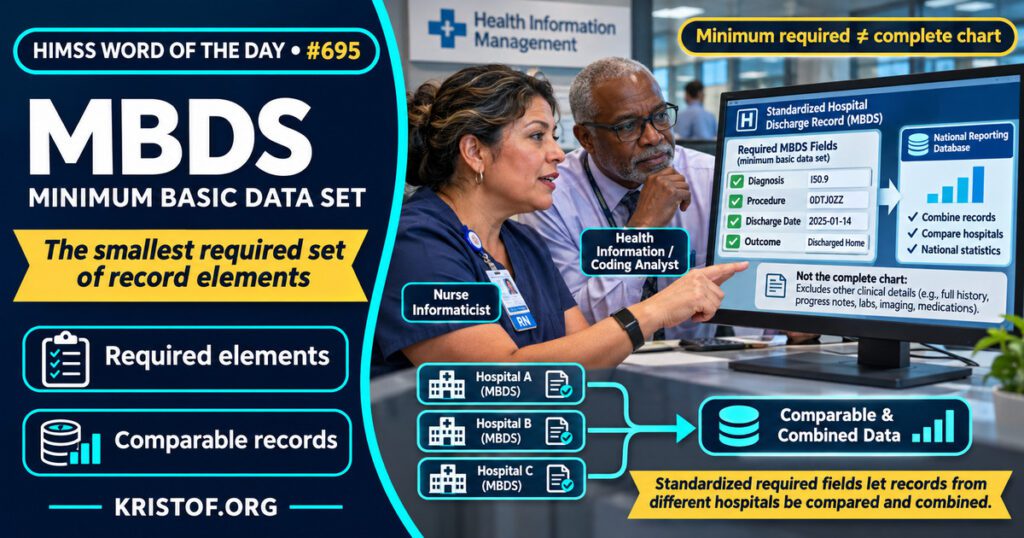
The HIMSS Dictionary describes a minimum basic data set (MBDS) as the smallest set of data that a healthcare record must contain to conform to a given standard. The idea is a floor, not a ceiling. Every record that meets the standard carries the same required elements, so records from different sources can be compared and combined.
The studies in this post all use one specific example, Spain’s national hospital discharge data set, known in Spanish as the Conjunto Mínimo Básico de Datos (CMBD). The dictionary’s meaning is general, while the studies describe a single national implementation, so the two should not be treated as identical.
| Piece | What it describes | Where it appears in this post |
|---|---|---|
| Required elements | The minimum a record must hold to meet the standard | Dictionary definition |
| National implementation | Spain’s CMBD, implemented in 1987 | Rodríguez-Alonso et al. |
| Validation | Agreement between the data set and a surveillance registry | Quirós-González et al. |
| Surveillance use | Counting cases and deaths for one disease | Sánchez-Trujillo et al. |
| Trend analysis | Admissions, treatments, and mortality over several years | Garrido-Hernández et al.; López Herrero et al. |
⚠️ Exam Alert: Do not confuse a minimum basic data set with the Minimum Data Set (MDS), which in the United States is the assessment data collected on nursing home residents, or with the Nursing Minimum Data Set, which defines nursing-specific elements. “Minimum” describes the least required, not everything a record should hold. A minimum data set is also not a registry, which collects data on a defined group of patients, and not a data quality program, which checks whether the data are accurate and complete.
🌐 Why It Matters: Real-World Healthcare IT Context
Where it shows up. Required data elements are what make administrative and clinical data usable beyond one hospital. A national discharge data set lets researchers and health departments count admissions, procedures, and outcomes across every hospital that reports to it. The cost is that the data were collected to meet a reporting standard and not to answer a particular research question. The five studies below were read as abstracts only.
A national set in use for three decades. Rodríguez-Alonso et al. (2026) conducted a scoping review of research using the CMBD for infectious diseases. They report that the CMBD was implemented in 1987, provides near-universal coverage of acute-care hospitalizations, and has been widely used in infectious disease epidemiology. After searching four databases through 25 November 2024, they included 359 studies published from 1996 to 2024, mostly retrospective observational analyses. Infectious diseases were the primary focus in 225 of them (62.7%). More than 80% of the limitations reported in those studies reflected intrinsic features of the CMBD. The authors conclude that limits in clinical detail, microbiological confirmation, and coding consistency restrict specific causes and causal inference, and they call for data validation and linkage with other sources.
How well it finds cases. Quirós-González et al. (2023) compared the Hospital Care Activity Record version of the data set (RAE-CMBD) with an influenza surveillance registry treated as the gold standard, in adults admitted to one tertiary hospital in the 2017/2018 and 2018/2019 seasons. They matched 907 records (97.74%), with high inter-observer agreement (kappa 0.828). The data set showed 79.87% sensitivity, 99.72% specificity, 86.71% positive predictive value, and 99.54% negative predictive value. The authors conclude it is a valid source for studying the impact of influenza on hospital care. A sensitivity near 80% means about one in five registry cases was not flagged, and the study covers one hospital over two seasons.
Surveillance of a rare cancer. Sánchez-Trujillo et al. (2021) used the data set for 2016 and 2017 to estimate mesothelioma prevalence, incidence, and mortality in the Community of Madrid, and compared it with national statistics institute mortality data. Mortality estimated from the two sources for 2016 was similar, and the geographic patterns of risk correlated highly (r = 0.86). The authors say the data set had been validated for mesothelioma incidence in Italy but not in Spain, and they conclude it is a good resource for monitoring the risk.
Trends in treatment and outcomes. Garrido-Hernández et al. (2026) used the Spanish data set to study 20,533 admissions for ischemic stroke in adults aged 18 to 50 between 2016 and 2022. Mechanical thrombectomy rates nearly doubled, from 6.3% to 12.1%, while in-hospital mortality remained low and stable at 2.8%. Malignant neoplasm was the strongest independent predictor of death. The authors say the expansion of reperfusion therapies was not associated with lower in-hospital mortality and call for multicenter clinical research. López Herrero et al. (2026) used it to describe sepsis from 2017 to 2022, identifying cases by combined infection and organ dysfunction codes. Annual hospitalizations rose from 183,971 in 2017 to 226,884 in 2022, and in-hospital mortality rose from 19.4% to a peak of 23.7% in 2020 before settling at 20.8% in 2022.
What I could not confirm. I read abstracts only, so I cannot list the exact elements the CMBD requires, and I did not find them in the abstracts. All five studies describe Spain, so they say little about US hospital discharge data or about any other country’s minimum data set. These are observational analyses of coded administrative records. They show trends and associations, not causes, and the stroke authors call for further research into causes of death instead of drawing a conclusion about treatment. I did not verify the total sepsis hospitalization count, because the abstract’s figure appears garbled.
Common minimum data set problems:
- Too little clinical detail to explain why an outcome occurred
- Coding that differs between hospitals or over time
- Case identification that misses some patients, as in the influenza comparison
- Treating a reporting data set as if it answered a research question it was not built for
- Confusing “minimum required” with “everything the record holds”
What supports a minimum data set:
- Near-universal coverage of hospitalizations in the Spanish example
- Comparable records across hospitals and regions
- Usable national trend analysis over several years
- Agreement with a surveillance registry in the influenza comparison
- A long enough history to study change, such as thrombectomy use and sepsis counts
🏥 The Nurse’s Perspective: Clinical, Bedside, & Workflow
None of the five studies measured nurses or nursing documentation, so this section is workflow context and not evidence.
At the Bedside
A discharge data set starts with what clinicians record during a stay. In general, the diagnoses, procedures, and complications that appear in the chart are what coders later turn into the required elements. Nurses do not assign those codes, but nursing documentation of events such as an intubation, a change in level of consciousness, or a complication can support the clinical record that coders read.
In Clinical Workflow
A record that meets a minimum standard can still be thin. The Spanish review names limits in clinical detail and coding consistency, which is the same gap nurses see between a short coded summary and a full chart. Structured fields that capture the same facts the same way across units make that summary easier to produce and compare.
In EHR Implementation (Go-Live Perspective)
During an Epic Go-Live, analysts and at-the-elbow support staff see how a required field gets filled in at the point of care. A required element that is hard to find or poorly named is more likely to be skipped or filled inconsistently. That is an observation about workflow and not a finding from the studies reviewed.
🎓 CAHIMS / CPHIMS & HIMSS Perspective
CAHIMS Exam Domain Mapping
Minimum basic data set appears in questions about data standards and secondary use of data:
| CAHIMS Domain | How MBDS Appears |
|---|---|
| Healthcare & Technology Environments | National reporting standards and administrative data |
| Clinical Informatics | Required data elements and the documentation behind them |
| Healthcare Information & Systems Management | Data collection, coding consistency, and validation |
| Management & Leadership | Reporting obligations and how data are used for planning |
Key Terms to Know Alongside MBDS
- Minimum Data Set (MDS) — the US assessment data collected on nursing home residents, a different entry from MBDS
- Nursing Minimum Data Set — a standard set of nursing data elements
- Data set — a defined collection of data elements used together
- Diagnosis Related Group — a classification that groups hospital stays by diagnosis and resource use
- International Classification of Diseases — the code system used to record diagnoses and procedures
- Data quality — whether data are accurate, complete, and consistent enough for their use
HIMSS Organizational Position
HIMSS offers education and research on health information and technology topics through its Resource Center. Members can find related information on the HIMSS Resource Center page.
🧭 More HIMSS Word of The Day Terms
Related terms in the Data and Analytics series:
- Data Visualization
- Atomic Data
- EAV (Entity-Attribute-Value) Model
- Geographic Information Science (GISci)
Browse all Data and Analytics terms or the A–Z glossary.
🔗 Explore Further: External References
- Rodríguez-Alonso et al. (2026), Tropical Medicine and Infectious Disease — Three Decades of Use of the Minimum Basic Data Set in Infectious Disease Research in Spain: A Scoping Review with an Evidence-Mapping Approach. https://pubmed.ncbi.nlm.nih.gov/41746031/
- Quirós-González et al. (2023), Revista Española de Quimioterapia — Validity and usefulness of the RAE-CMBD studying patients hospitalised with influenza. https://pubmed.ncbi.nlm.nih.gov/36651282/
- Sánchez-Trujillo et al. (2021), Anales del Sistema Sanitario de Navarra — Use of the Minimum Basic Data Set as a tool for the epidemiological surveillance of mesothelioma. https://pubmed.ncbi.nlm.nih.gov/34664557/
- Garrido-Hernández et al. (2026), European Journal of Neurology — Stable In-Hospital Mortality Despite Increasing Thrombectomy Use in Young Adults With Ischemic Stroke: A Nationwide Study in Spain (2016-2022). https://pubmed.ncbi.nlm.nih.gov/43059214/
- López Herrero et al. (2026), International Journal of Infectious Diseases — Epidemiological trends in sepsis in Spain: incidence, in-hospital mortality, and healthcare burden (2017-2022). https://pubmed.ncbi.nlm.nih.gov/42749250/
- HIMSS — Resource Center https://www.himss.org/resource-center
Term source: HIMSS Dictionary of Health Information and Technology Terms, Acronyms, and Organizations, 6th Edition (2025). All definitions in this series are paraphrased for editorial purposes. Readers are encouraged to consult the primary source for exact language.
Eric Andrew Kristof, RN, CAHIMS is a Healthcare IT professional and HIMSS Arkansas Chapter member based in Hot Springs Village, AR, with hands-on Epic Go-Live experience and a diverse healthcare and IT background. He writes at kristof.org at the intersection of clinical care and healthcare technology.
Leave a Reply