By Eric Andrew Kristof, RN, CAHIMS | Healthcare IT Professional | HIMSS Arkansas Chapter Member
About This Series: The HIMSS Word of The Day is a running blog series drawing from the HIMSS Dictionary of Health Information and Technology Terms, Acronyms, and Organizations, 6th Edition (2025) — the authoritative reference for healthcare IT professionals and the primary study resource for CAHIMS and CPHIMS certification. Each post paraphrases the term in plain language, grounds it in real-world healthcare IT context, and adds a bedside nursing perspective you won’t find in a textbook.
📖 The Term: Wet Signature
Source: HIMSS Dictionary of Health Information and Technology Terms, Acronyms, and Organizations, 6th Edition (2025)
🔍 Plain-Language Definition
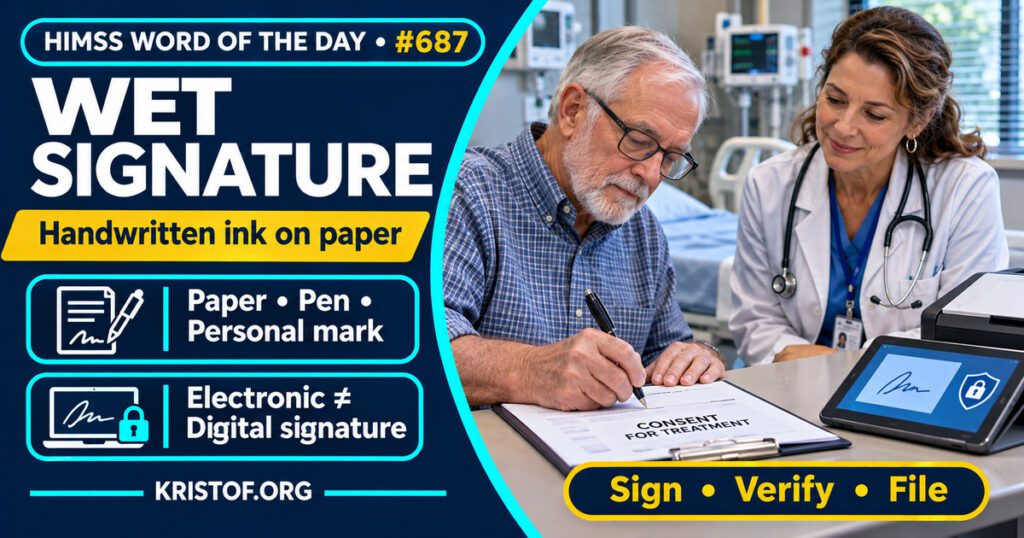
The HIMSS Dictionary describes a wet signature as a signature made when a person marks a paper document by hand, in ink.
The sources below mostly use related words, such as handwritten signature and electronic signature, and not the phrase wet signature itself. The CMS fact sheet I read describes a handwritten signature as a personal mark made by the person responsible, to show awareness of, approval of, or being bound by the document.
| Signature type | How it is made | What the sources say |
|---|---|---|
| Wet signature | By hand, in ink, on paper | Closest CMS term is a handwritten signature, which Medicare accepts |
| Electronic signature | On a screen or through a system | Medicare accepts it with safeguards, and the ESIGN Act limits denying it solely for being electronic |
| Stamped signature | With a stamp | Generally not accepted by Medicare, with a disability exception |
| Signature log | A typed list matched to handwritten signatures | Medicare uses it to identify an illegible signer |
⚠️ Exam Alert: A wet signature is not the same as an electronic signature, a digital signature (a cryptographic method), or a scanned image of a handwritten signature. Whether any of them is acceptable depends on the rule in question, so a question that gives a specific rule should be answered from that rule. This post is general information and not legal advice.
🌐 Why It Matters: Real-World Healthcare IT Context
Where it shows up. In my searches, PubMed returned no study that uses the phrase wet signature. The sources below are federal guidance and law plus three studies that compare electronic consent with paper consent. None of them studies wet signatures as such, and I read abstracts only for the studies.
Medicare signature guidance. The CMS Medicare Learning Network fact sheet MLN905364 (the version I read is dated July 2025) says claims reviewers look for signed and dated documentation from the clinicians responsible for a patient’s care, and that claims may be denied if entries lack the required signatures. A valid signature is handwritten or electronic. For electronic signatures, systems must protect against record changes, organizations should apply administrative safeguards, and the sheet advises providers to consult their attorneys and malpractice insurers. Rubber-stamped signatures are generally not accepted, with an exception for an author with a physical disability who can show they cannot sign. A signature log, an attestation statement, or a printed name on the original record can address an illegible signature, and an attestation can address a missing signature on a medical record, though an attestation cannot be used to backdate a plan of care. When a scribe, including AI technology, documents an entry, the physician or non-physician practitioner must sign it. As I read it, the requirements are written for physicians and non-physician practitioners and for Medicare review.
The ESIGN Act. The federal Electronic Signatures in Global and National Commerce Act, at 15 U.S.C. 7001, says that for transactions in or affecting interstate or foreign commerce, a signature, contract, or other record may not be denied legal effect, validity, or enforceability solely because it is in electronic form. It does not require anyone to accept electronic records or signatures, it adds consumer consent requirements when written information must be given to a consumer, and it covers electronic retention. The summary I read of the statute text does not mention health care, and the statute says it does not change other legal requirements about parties’ rights and duties, except for requirements that records be written, signed, or nonelectronic. I did not read the whole statute, and whether it governs a particular health care document is a legal question.
HIPAA authorizations. The core elements of a valid HIPAA authorization under 45 CFR 164.508(c) include the individual’s signature and date, and a representative who signs must also describe the authority to act for the individual. The regulation text I retrieved does not mention electronic signatures. I did not review HHS guidance on whether an electronic signature satisfies it.
A systematic review of electronic consent. Mazzochi et al. (2023) reviewed studies within randomized controlled trials that evaluated electronic consent, included if any of information provision, comprehension, or signature was electronic. From 9,069 titles, 12 studies with 8,864 participants were analysed. Five studies of high heterogeneity and risk of bias showed mixed results on enrolment, and the data suggested electronic consent could improve comprehension and recall. A meta-analysis could not be done. Because the electronic part could be any of the three components, the review is not specific to signatures.
A survey of biobanks. Simon et al. (2014) surveyed 235 U.S. biobanks and had 65 (28%) fully complete responses. Eight percent reported using electronic consent and 75% were interested. Anticipated benefits were efficiency and increased enrollment, and barriers included funding, human subjects approval, and user uptake. Traditional consent methods continued to be used at biobanks that used electronic consent, and the authors list electronic signature capture among the implementation issues. It is a 2014 survey with a low response rate.
A pilot with paper and electronic consent. Ngoliwa et al. (2024) digitized an approved paper consent form for a controlled human infection study in Blantyre, Malawi, and had healthy literate adult participants complete a self-administered electronic consent with an electronic signature, in addition to paper consent. All 109 participants offered electronic consent accepted. The abstract reports no identifiable documentation errors for electronic consent versus a 43.1% (47 of 109) error rate with paper consent. Challenges included difficult digitization of ethics-stamped documents and infrequent delays retrieving the electronic forms. It is one site, the abstract does not define documentation error, and the comparison is within participants who did both.
What I could not confirm. I did not review state laws, Medicare Conditions of Participation, payer rules, controlled substance prescribing rules, or notarization requirements, and I did not find a source that lists which documents must have a wet signature. I did not find evidence that wet signatures are safer or less safe than electronic ones. The dictionary entry is only one sentence, and the CMS guidance I read covers Medicare review and not all documentation. Anything specific to a document, payer, or state should be checked with the organization’s compliance or legal team.
Common wet signature problems:
- Illegible signatures, which Medicare addresses with a signature log or attestation
- Missing signatures on medical records, which an attestation can address but not for orders
- Missing dates, where reviewers may infer a date from surrounding entries
- Stamped signatures, which Medicare generally does not accept
- Paper forms with documentation errors, such as the 43.1% in the Malawi pilot
- Digitizing and retrieving paper forms, including stamped documents
What supports wet signatures:
- Medicare accepts handwritten signatures alongside electronic ones
- Signature logs identify a signer across a record
- Attestation statements can fix a missing signature on a record
- The ESIGN Act does not require anyone to accept electronic signatures
- Paper consent continued alongside electronic consent in the biobank and Malawi studies
🏥 The Nurse’s Perspective: Clinical, Bedside, & Workflow
Nurses commonly obtain, witness, or file signed consents and forms, which is general workflow context. The CMS fact sheet is written for physicians and non-physician practitioners, and nursing documentation rules vary and were not reviewed here.
At the Bedside
Consent and other forms are often signed at the bedside, on paper or on a device. In the Malawi pilot, research staff gave participants the information and participants then completed the electronic consent themselves, which is research and not routine care.
In Clinical Workflow
A paper form with a wet signature typically needs scanning or filing before it is available in the electronic record, which is general context. The sources point to digitizing and retrieving forms as a challenge, but none measures the effect on nursing time.
In EHR Implementation (Go-Live Perspective)
During an Epic Go-Live, analysts and at-the-elbow support staff may field questions about which forms are signed on paper and which are signed electronically. That is general workflow context, and the sources reviewed do not describe go-lives.
🎓 CAHIMS / CPHIMS & HIMSS Perspective
CAHIMS Exam Domain Mapping
Wet signature appears in questions about documentation, consent, and authentication:
| CAHIMS Domain | How Wet Signature Appears |
|---|---|
| Healthcare & Technology Environments | Paper and electronic documentation in the same organization |
| Clinical Informatics | Consent and record authentication |
| Healthcare Information & Systems Management | Signature capture, scanning, and legal records |
| Management & Leadership | Compliance, policy, and payer documentation rules |
Key Terms to Know Alongside Wet Signature
- Electronic signature — a signature made or applied electronically, as opposed to by hand on paper
- Digital signature — a cryptographic technique for signing data, which is not the same as a handwritten mark on a screen
- Authentication — confirming that a person or record is who or what it claims to be
- Nonrepudiation — assurance that a signer cannot credibly deny having signed
- Consent — a person’s agreement, which a signature often documents
HIMSS Organizational Position
HIMSS offers education and research on health information and technology topics through its Resource Center. Members can find related information on the HIMSS Resource Center page.
🧭 More HIMSS Word of The Day Terms
Related terms in the Healthcare Policy series:
- Covered Entity (HIPAA)
- ECRI Institute (ECRI)
- Public Health Agency
- WEDI (Workgroup for Electronic Data Interchange)
Browse all Healthcare Policy terms or the A–Z glossary.
🔗 Explore Further: External References
- CMS — Complying with Medicare Signature Requirements (MLN905364) https://www.cms.gov/files/document/mln905364-complying-medicare-signature-requirements.pdf
- U.S. Code — 15 U.S.C. 7001, General rule of validity (Electronic Signatures in Global and National Commerce Act) https://www.govinfo.gov/content/pkg/USCODE-2024-title15/html/USCODE-2024-title15-chap96-subchapI-sec7001.htm
- Legal Information Institute — 45 CFR 164.508, Uses and disclosures for which an authorization is required https://www.law.cornell.edu/cfr/text/45/164.508
- Mazzochi et al. (2023), Trials — Electronic informed consent: effects on enrolment, practical and economic benefits, challenges, and drawbacks-a systematic review of studies within randomized controlled trials. https://pubmed.ncbi.nlm.nih.gov/36810093/
- Simon et al. (2014), Biopreservation and Biobanking — Traditional and electronic informed consent for biobanking: a survey of U.S. biobanks. https://pubmed.ncbi.nlm.nih.gov/25496155/
- Ngoliwa et al. (2024), Wellcome Open Research — A pilot study to explore utility of electronic informed consent in a low- income setting; the case of a Controlled human infection study in Blantyre, Malawi. https://pubmed.ncbi.nlm.nih.gov/40012986/
- HIMSS — Resource Center https://www.himss.org/resource-center
Term source: HIMSS Dictionary of Health Information and Technology Terms, Acronyms, and Organizations, 6th Edition (2025). All definitions in this series are paraphrased for editorial purposes. Readers are encouraged to consult the primary source for exact language.
Eric Andrew Kristof, RN, CAHIMS is a Healthcare IT professional and HIMSS Arkansas Chapter member based in Hot Springs Village, AR, with hands-on Epic Go-Live experience and a diverse healthcare and IT background. He writes at kristof.org at the intersection of clinical care and healthcare technology.
Leave a Reply