By Eric Andrew Kristof, RN, CAHIMS | Healthcare IT Professional | HIMSS Arkansas Chapter Member
About This Series: The HIMSS Word of The Day is a running blog series drawing from the HIMSS Dictionary of Health Information and Technology Terms, Acronyms, and Organizations, 6th Edition (2025) — the authoritative reference for healthcare IT professionals and the primary study resource for CAHIMS and CPHIMS certification. Each post paraphrases the term in plain language, grounds it in real-world healthcare IT context, and adds a bedside nursing perspective you won’t find in a textbook.
📖 The Term: Spreadsheet
Source: HIMSS Dictionary of Health Information and Technology Terms, Acronyms, and Organizations, 6th Edition (2025)
🔍 Plain-Language Definition
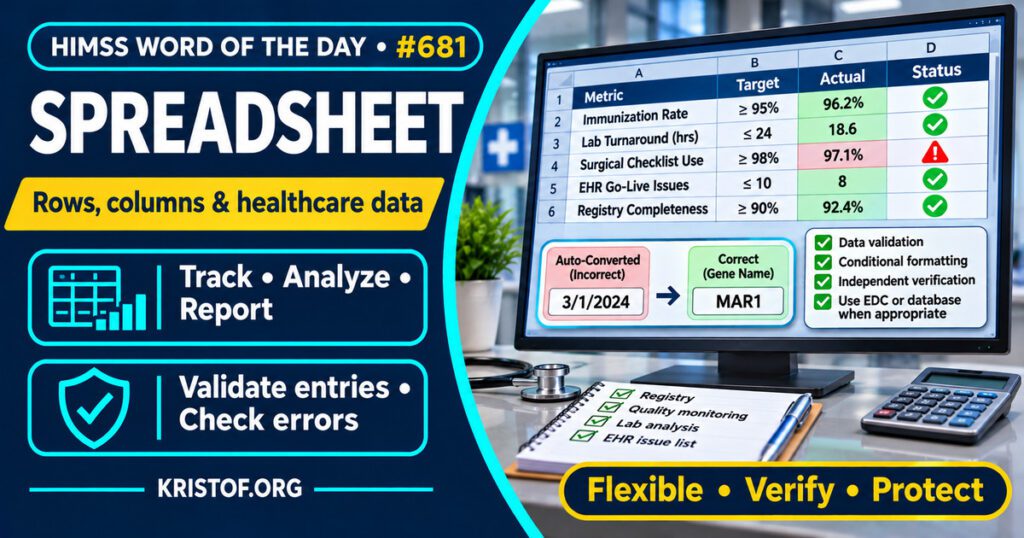
The HIMSS Dictionary describes a spreadsheet as a software application for saving, sorting, and managing data in rows and columns. It stores data as an electronic document in a table, and it follows the model of the paper accounting worksheet. The dictionary gives “worksheet” as another name for it.
In health care, spreadsheets show up wherever someone needs a quick table: registry data, task lists, quality monitoring, and tracking logs. The five studies below touch each of those.
| Use in the studies below | What the spreadsheet did | Source of the finding |
|---|---|---|
| Registry data collection | Held patient data compared with an electronic data capture tool | Crossover study |
| Gene lists in papers | Default settings converted some gene names | Genomics literature scan |
| Laboratory quality control | Hosted an Excel-based analysis tool | Tool description, checked against Python |
| Pandemic pathway tracking | Excel with macros served as a makeshift database | Development report |
| Surgical patient lists | Held lists junior doctors maintained by hand | Quality improvement project |
⚠️ Exam Alert: A spreadsheet is not a database. This is a general distinction and not a finding from these studies: a spreadsheet is a table in a file, while a database system adds structured storage, controls, and multi-user features. Also do not confuse a spreadsheet with electronic data capture, a purpose-built tool for collecting study or registry data, which one study below compared with Excel.
🌐 Why It Matters: Real-World Healthcare IT Context
Why it persists. Staziaki et al. note that spreadsheet programs such as Microsoft Excel are still used to record and organize patient data for research, even though electronic data capture tools exist, and Miller et al. chose Excel to keep the intuitiveness of direct data entry. The research on spreadsheets in health care is thin, and what follows comes from a handful of small studies, mostly single-site, read as abstracts.
Speed versus an electronic data capture tool. Staziaki et al. (2016) ran a crossover study in which two data collectors collected registry data for 61 emergency department patients (122 observations, 55 variables) using REDCap, an electronic data capture tool, and Microsoft Excel. Mean time per patient was 6.2 minutes with REDCap and 8.0 minutes with Excel (p < .001), a difference of about 22%. The authors saw two continuous-variable typos in the spreadsheet, made by one collector, and found no difference in accuracy between the tools. It is a small study at one site with two data collectors.
A conversion problem in default settings. Ziemann et al. (2016) report that Excel, when used with default settings, converts some gene names to dates and floating-point numbers. Their programmatic scan of leading genomics journals found that approximately one-fifth of papers with supplementary Excel gene lists contained erroneous gene name conversions. This is genomics, not health IT, and the abstract is brief, so I cite it only as an example of how default settings can alter data silently.
Replacing manual lists. Khan et al. (2020) describe a quality improvement project at a hospital where junior doctors spent hours daily creating and updating surgical patient lists in Excel, which the authors say allowed human errors, system errors, and patient safety concerns. Adding clinical secretaries cut time on the colorectal list from 99.22 to 43.38 minutes a day but did not help on-call teams. After adapting existing software, the day on-call team’s time fell from 121 to 4.66 minutes a day and the night team’s from 91 to 7.38. The authors state that automation removes the chance of transcription error for blood results, a claim the abstract does not test with error data. It is a before-and-after project, not a controlled study.
Spreadsheets as custom tools. Miller et al. (2021) built a makeshift data management system in Excel 2007 for a pandemic-adapted colorectal cancer pathway. They used Visual Basic for Applications macros to segregate data, plus data validation and conditional formatting to limit entry errors, and the COUNT function for live monitoring. They conclude that large-volume data management in a spreadsheet is possible with appropriate data definition and programmed data segregation. The abstract reports no performance numbers. Low et al. (2025) describe an Excel-based tool for patient-based quality control in laboratories and say they verified its performance against an independent model in Python. That is a tool description, and the abstract reports no outcome data.
What I could not confirm. I found no study in this review that measures spreadsheet error rates in hospitals or the safety of spreadsheet use with patient data. I did not review privacy or security guidance on keeping protected health information in spreadsheets. The Genome Biology finding comes from genomics, and the other studies are single-site, so none establishes how common spreadsheet problems are in health IT.
Common spreadsheet problems:
- Default settings that silently convert values, as with gene names turned into dates
- Manual list maintenance that consumes clinician time
- Typos in manually entered data
- Makeshift builds created under time pressure that depend on their builders’ skills
- Output that benefits from independent verification, as in the laboratory tool study
What supports sound spreadsheet use:
- Data validation and conditional formatting to limit entry errors
- Verifying a spreadsheet tool against an independent model
- Considering purpose-built electronic data capture, which was faster in the crossover study by about 1.8 minutes per patient
- Automating hand-maintained lists when the time cost is high
- Appropriate data definitions before building
🏥 The Nurse’s Perspective: Clinical, Bedside, & Workflow
None of the five studies is about nurses’ own spreadsheet use, so what follows is limited.
At the Bedside
Some units may keep handoff or tracking lists in spreadsheets. The nearest analogue in the studies is the junior doctors’ surgical lists, where hand-maintained Excel lists took hours each day and the authors saw safety concerns. The abstract describes doctors and clinical secretaries, not nurses.
In Clinical Workflow
For nurse leaders who run quality improvement work, the surgical list project shows a before-and-after approach with time as the measure. The same method does not by itself show safety improvement, since the abstract reports time savings and not error data.
In EHR Implementation (Go-Live Perspective)
During an Epic Go-Live, analysts and at-the-elbow support staff may track issues or staffing in spreadsheets. That is general workflow context, and none of the studies reviewed examines go-lives.
🎓 CAHIMS / CPHIMS & HIMSS Perspective
CAHIMS Exam Domain Mapping
Spreadsheets appear in questions about data management, quality, and end-user tools:
| CAHIMS Domain | How Spreadsheets Appear |
|---|---|
| Healthcare & Technology Environments | Software types and where each fits |
| Clinical Informatics | Clinical lists, registries, and data quality |
| Healthcare Information & Systems Management | Validation, governance of end-user tools, and data protection |
| Management & Leadership | Replacing manual processes and managing risk |
Key Terms to Know Alongside Spreadsheet
- Database — a structured data store with controls beyond a table in a file, a general definition
- Electronic data capture — purpose-built software for collecting research or registry data, such as REDCap in the study above
- Data validation — rules that restrict or check what can be entered into a field
- Macro — a stored sequence of actions that automates a task, as with the VBA macros in the pandemic pathway study
- Data quality — how accurate, complete, and consistent data are
- Registry — an organized collection of patient data for a defined purpose
HIMSS Organizational Position
HIMSS offers education and research on health information and technology topics through its Resource Center. Members can find related information on the HIMSS Resource Center page.
🧭 More HIMSS Word of The Day Terms
Related terms in the Data and Analytics series:
Browse all Data and Analytics terms or the A–Z glossary.
🔗 Explore Further: External References
- Staziaki et al. (2016), Journal of Medical Internet Research — Medical Registry Data Collection Efficiency: A Crossover Study Comparing Web-Based Electronic Data Capture and a Standard Spreadsheet. https://pubmed.ncbi.nlm.nih.gov/27277523/
- Ziemann et al. (2016), Genome Biology — Gene name errors are widespread in the scientific literature. https://pubmed.ncbi.nlm.nih.gov/27552985/
- Khan et al. (2020), BMJ Open Quality — ‘I’ve got a little list’-the scourge of a surgical junior. A quality improvement project to change the surgical patient list in a district general hospital. https://pubmed.ncbi.nlm.nih.gov/32546513/
- Miller et al. (2021), BMJ Health & Care Informatics — Development of a customised data management system for a COVID-19-adapted colorectal cancer pathway. https://pubmed.ncbi.nlm.nih.gov/34244178/
- Low et al. (2025), EJIFCC — Spreadsheet for Patient-Based Quality Control Analysis and Evaluation (SPAE). https://pubmed.ncbi.nlm.nih.gov/40061063/
- HIMSS — Resource Center https://www.himss.org/resource-center
Term source: HIMSS Dictionary of Health Information and Technology Terms, Acronyms, and Organizations, 6th Edition (2025). All definitions in this series are paraphrased for editorial purposes. Readers are encouraged to consult the primary source for exact language.
Eric Andrew Kristof, RN, CAHIMS is a Healthcare IT professional and HIMSS Arkansas Chapter member based in Hot Springs Village, AR, with hands-on Epic Go-Live experience and a diverse healthcare and IT background. He writes at kristof.org at the intersection of clinical care and healthcare technology.
Leave a Reply