By Eric Andrew Kristof, RN, CAHIMS | Healthcare IT Professional | HIMSS Arkansas Chapter Member
About This Series: The HIMSS Word of The Day is a running blog series drawing from the HIMSS Dictionary of Health Information and Technology Terms, Acronyms, and Organizations, 6th Edition (2025) — the authoritative reference for healthcare IT professionals and the primary study resource for CAHIMS and CPHIMS certification. Each post paraphrases the term in plain language, grounds it in real-world healthcare IT context, and adds a bedside nursing perspective you won’t find in a textbook.
📖 The Term: QMR (Quick Medical Reference)
Source: HIMSS Dictionary of Health Information and Technology Terms, Acronyms, and Organizations, 6th Edition (2025)
🔍 Plain-Language Definition
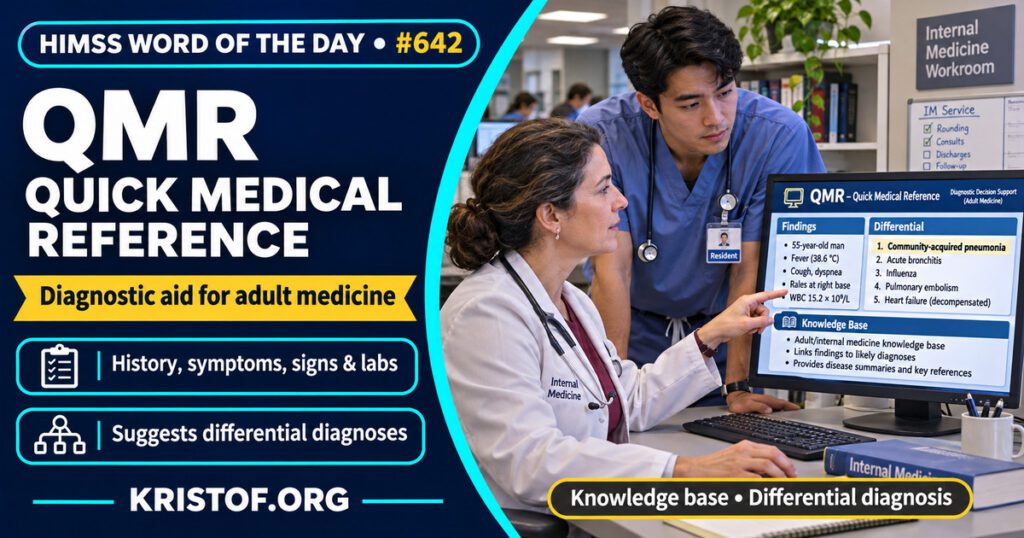
The HIMSS Dictionary describes QMR (Quick Medical Reference) as a diagnostic aid for adult medicine. It gives clinicians access to information on the diseases internists see most often, including histories, symptoms, physical signs, and laboratory findings. The dictionary says it was used by physicians in hospital and office practice and that the National Library of Medicine no longer maintains or updates it.
QMR did not start from nothing. Miller and colleagues (1986) describe it as the successor to INTERNIST-1, and say both rely on the same computerized knowledge base, which they described as covering 570 diseases in internal medicine at that time. They explain that INTERNIST-1 worked as a diagnostic consultant, while QMR acted more like an information tool that let users review and rework diagnostic information, and at its simplest could be viewed as an electronic textbook. Miller (2010) says the combined project spans four decades, beginning in 1971. The dictionary gives a larger figure, over 750 diseases, so the knowledge base evidently grew, but I did not trace the timeline.
| Feature | What the sources describe |
|---|---|
| Purpose | Help clinicians generate and examine diagnostic possibilities in internal medicine |
| Origin | INTERNIST-1, with the project beginning in 1971 per Miller (2010) |
| Inputs | Findings such as history, symptoms, signs, and laboratory results |
| Style | Information tool and hypothesis generator, not only a consultant |
| Knowledge base size | 570 diseases in 1986, over 750 per the dictionary |
| Current status | No longer maintained by the National Library of Medicine, per the dictionary |
The table is a simplified summary of the dictionary and two papers.
⚠️ Exam Alert: QMR is a diagnostic decision support program for physicians. It is not the same as CDS in general, which includes alerts, order sets, and reminders, and it is not the EHR. Do not confuse QMR with quantitative magnetic resonance, which uses the same abbreviation in body-composition research and has nothing to do with this entry.
🌐 Why It Matters: Real-World Healthcare IT Context
QMR matters mainly as a case study. It shows what early diagnostic software could and could not do, and it is a useful reminder that any decision support tool has to earn its place in a clinician’s workflow.
What studies show. Berner and colleagues (1994), in the New England Journal of Medicine, tested four internal medicine diagnostic systems, DXplain, Iliad, Meditel, and QMR, against 105 diagnostically challenging cases that ten expert clinicians created from actual patients. No single program scored better than the others on all measures. Across cases and programs, the proportion of correct diagnoses ranged from 0.52 to 0.71. On average, less than half of the diagnoses on the experts’ original lists appeared in any program’s output, but each program also suggested about two relevant diagnoses per case that the experts had not originally considered. The authors concluded that physicians should use such programs to identify useful information and ignore the rest. This was a test using case summaries, not live practice.
Bacchus and colleagues (1994), in the Journal of General Internal Medicine, ran a randomized crossover trial with 16 interns. Each worked up six diagnostically challenging cases, three with textbooks plus QMR and three with textbooks alone. The mean difference was a 7.2 percent benefit with QMR (95 percent confidence interval 0.05 to 14.4), driven mainly by diagnostic scores, and the benefit grew with case difficulty. The authors cautioned that conditions favored QMR and that the small gain had to be weighed against the time needed to teach the program. This is a small study at one tertiary care teaching hospital.
Arene and colleagues (1998), in M.D. Computing, compared QMR with residents using 40 admitted patients. The diagnostic accuracy of interns and chief residents was significantly greater than that of QMR, although the chief residents said QMR increased their understanding of disease processes. This used a convenience sample, so the result should be read as limited.
Miller and colleagues (1986), in The Western Journal of Medicine, said at that time that QMR had not been formally evaluated as an information tool for practicing physicians, and that a preliminary study suggested its case-analysis capabilities could help in most internal medicine admissions for diagnostic evaluation. Miller (2010), in the IMIA Yearbook of Medical Informatics, wrote a history of the INTERNIST-1 and QMR projects and drew lessons from them. I read only the abstract of the 2010 paper, so I cannot summarize the lessons themselves.
What I could not find. I did not find evaluations of QMR in routine clinical use or any measure of effect on patient outcomes. Every study above is from 1986 to 1998, and the history paper is from 2010, so none speaks to how current diagnostic or AI tools perform. I also did not confirm when or why NLM stopped maintaining QMR beyond the dictionary’s statement.
Common diagnostic decision support problems:
- Treating program output as an answer instead of a list to review
- Missing or mismatched findings entered in the program’s own vocabulary
- Extra time and training needed to use the tool well
- Output that includes irrelevant diagnoses along with relevant ones
- Knowledge bases that need continuing maintenance
- Evaluating tools only on case summaries, not live practice
What supports good diagnostic decision support practice:
- Clinician judgment about which suggestions are relevant
- Suggestions that expand the differential beyond what the clinician first considered
- Teaching and onboarding so users can enter findings accurately
- Evaluation with real cases and clear outcome measures
- Ongoing maintenance of the underlying knowledge base
- Fit with clinical workflow so use does not add time
🏥 The Nurse’s Perspective: Clinical, Bedside, & Workflow
Nurses did not use QMR directly, since the dictionary describes it as a tool for physicians, but its lessons apply to every decision support tool nurses meet.
At the Bedside
Nurses see decision support as alerts, reminders, and order prompts. The Berner findings carry over: output may include useful and irrelevant suggestions, and the clinician has to sort them. A nurse who notices that an alert does not fit the patient is doing the same filtering the authors recommended.
In Clinical Workflow
Nurse informaticists help review and tune decision support so it supports care without adding noise. The QMR studies show why testing with realistic cases and watching the time cost matter. A tool that gives a small benefit at a high time cost is a hard sell on a busy unit.
In EHR Implementation (Go-Live Perspective)
During an Epic Go-Live, decision support questions are common: why did this alert fire, and can it be changed? Analysts at the elbow route those questions to the group that owns the content. This post does not claim that any specific go-live had a diagnostic support problem. It shows why feedback from nurses on usability belongs in the review loop.
🎓 CAHIMS / CPHIMS & HIMSS Perspective
CAHIMS Exam Domain Mapping
QMR connects decision support history, knowledge bases, and evaluation:
| CAHIMS Domain | How QMR Appears |
|---|---|
| Healthcare & Technology Environments | The history of clinical software and knowledge-based systems |
| Clinical Informatics | Diagnostic reasoning, decision support, and clinician judgment |
| Healthcare Information & Systems Management | Knowledge base maintenance, evaluation, and retirement of tools |
| Management & Leadership | Weighing a tool’s benefit against training time and workflow cost |
Key Terms to Know Alongside QMR
- Clinical Decision Support System — software that offers patient-specific guidance to clinicians
- Knowledge base — the structured medical content a program reasons over
- Expert system — a program that applies encoded expertise to a problem
- Differential diagnosis — the list of possible causes for a patient’s findings
- Diagnostic decision support — tools that help generate and refine diagnostic possibilities
- Alert — a prompt that interrupts workflow to flag a possible issue
HIMSS Organizational Position
HIMSS offers education and research on health information and technology topics through its Resource Center. Members can find related information on the HIMSS Resource Center page.
🧭 More HIMSS Word of The Day Terms
Related terms in the Clinical Informatics series:
- Plan of Care (Care Plan)
- Outbreak Management (OM)
- Digital Radiography
- TIGER Initiative (Technology Informatics Guiding Education Reform)
Browse all Clinical Informatics terms or the A–Z glossary.
🔗 Explore Further: External References
- Miller (2010), Yearbook of Medical Informatics — A history of the INTERNIST-1 and Quick Medical Reference (QMR) computer-assisted diagnosis projects, with lessons learned https://pubmed.ncbi.nlm.nih.gov/20938584/
- Miller et al. (1986), The Western Journal of Medicine — The INTERNIST-1/QUICK MEDICAL REFERENCE project–status report https://pubmed.ncbi.nlm.nih.gov/3544509/
- Berner et al. (1994), The New England Journal of Medicine — Performance of four computer-based diagnostic systems https://pubmed.ncbi.nlm.nih.gov/8190157/
- Bacchus et al. (1994), Journal of General Internal Medicine — A randomized crossover trial of Quick Medical Reference (QMR) as a teaching tool for medical interns https://pubmed.ncbi.nlm.nih.gov/7853070/
- Arene et al. (1998), M.D. Computing — Evaluation of quick medical reference (QMR) as a teaching tool https://pubmed.ncbi.nlm.nih.gov/9753979/
- HIMSS — Resource Center https://www.himss.org/resource-center
Term source: HIMSS Dictionary of Health Information and Technology Terms, Acronyms, and Organizations, 6th Edition (2025). All definitions in this series are paraphrased for editorial purposes. Readers are encouraged to consult the primary source for exact language.
Eric Andrew Kristof, RN, CAHIMS is a Healthcare IT professional and HIMSS Arkansas Chapter member based in Hot Springs Village, AR, with hands-on Epic Go-Live experience and a diverse healthcare and IT background. He writes at kristof.org at the intersection of clinical care and healthcare technology.
Leave a Reply