By Eric Andrew Kristof, RN, CAHIMS | Healthcare IT Professional | HIMSS Arkansas Chapter Member
About This Series: The HIMSS Word of The Day is a running blog series drawing from the HIMSS Dictionary of Health Information and Technology Terms, Acronyms, and Organizations, 6th Edition (2025) — the authoritative reference for healthcare IT professionals and the primary study resource for CAHIMS and CPHIMS certification. Each post paraphrases the term in plain language, grounds it in real-world healthcare IT context, and adds a bedside nursing perspective you won’t find in a textbook.
📖 The Term: Error Proofing
Source: HIMSS Dictionary of Health Information and Technology Terms, Acronyms, and Organizations, 6th Edition (2025)
🔍 Plain-Language Definition
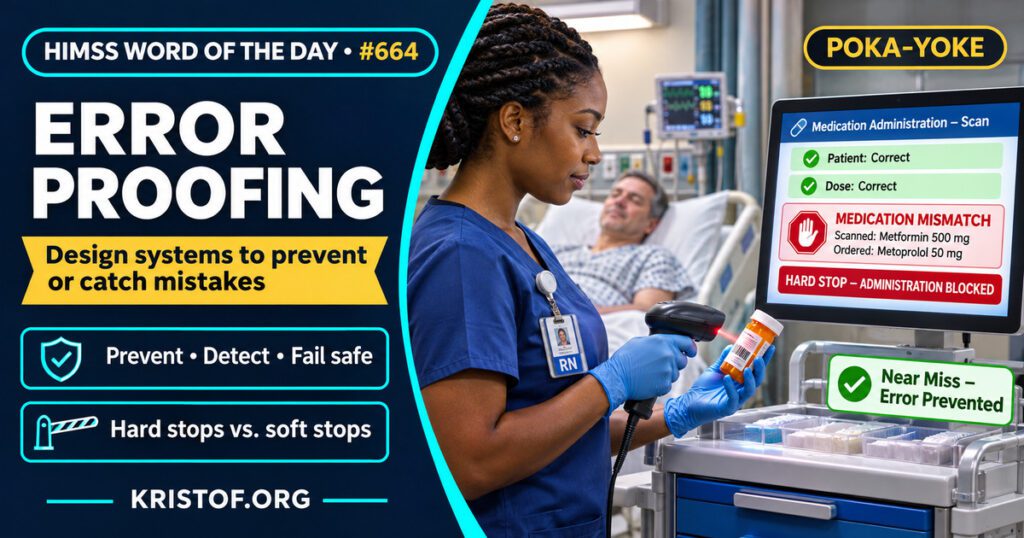
The HIMSS Dictionary describes error proofing, also called mistake proofing or fail-safing, as the English name for the Japanese idea of poka-yoke. Earlier names were fool-proofing and idiot-proofing. The idea is to use an automatic device or method that makes an error impossible, or at least makes it visible as soon as possible so it can be corrected. The dictionary uses everyday illustrations, such as a picture drawn on a table to show where the TV remote belongs, or a washing machine that will not start until its water supply and door are in the right state.
Grout (2006) describes mistake proofing as changing the physical design of processes to reduce human error, in four ways: preventing the error, detecting it before harm occurs, letting the process fail safely, or changing the work environment to make errors less likely.
| Approach | What it does | Illustrative health IT example (not from a source) |
|---|---|---|
| Prevent | Makes the error impossible | A field that accepts only valid values |
| Detect | Catches the error before harm | A check that compares a scanned item to an order |
| Fail safe | Makes the failure harmless | A system that stops instead of guessing |
| Reduce likelihood | Changes the environment | A screen layout that makes the right choice obvious |
⚠️ Exam Alert: Keep error proofing (designing so errors are prevented or detected) separate from training and reminders, which ask people to be more careful. Also separate a hard stop (the user cannot proceed, or needs an outside override) from a soft stop (a warning that can be overridden).
🌐 Why It Matters: Real-World Healthcare IT Context
Why design matters. Grout (2003) argues that one way to reduce medical errors is to build health care systems that resist human tendencies to err, by creating benign failures, which he notes have been called mistake-proofing devices and forcing functions. He illustrates the method with fault trees and a bathing scenario in which a scald valve turns a harmful failure (“patient scalded”) into a harmless one (“no water”). The paper cautions that fault-tree analysis does not guarantee that the needed changes occur, and that most mistake proofing is used to prevent simple errors and create well-defended processes, although complex errors can also result. Hinckley (2003) takes a stronger view, writing that controlling variation alone cannot reach the highest quality levels, that mistakes are the most common cause of problems in health care, and that mistake-proofing techniques can control “virtually every” mistake at a fraction of the cost of traditional quality control. Those are the author’s claims, and I have not verified them with outcome data.
A pharmacy example. Aboumatar and colleagues (2010) used a fast-paced Lean Sigma workshop, in which frontline staff studied the chemotherapy preparation process on the first two days and developed and began implementing interventions on the second and third days. They found multiple opportunities for error related to workspace layout, distractions, movement around ventilated hood areas, and variation in medication processing and labeling. Mistake-proofing interventions took the form of workspace redesign, process redesign, and standard operating procedures for pharmacy staff. Reported medication errors reaching patients and requiring monitoring decreased, while reported near misses increased, which the authors interpret as better identification of errors before they reach patients. The abstract gives no counts, and it is a single-setting improvement project.
Hard stops in the EHR. Powers and colleagues (2018) systematically reviewed studies of computerized hard-stop alerts, which prevent an action or allow it only with an outside override. Of 32 studies, 15 evaluated health outcomes, 16 evaluated process outcomes only, 10 looked at user experience, and 4 compared hard and soft stops. The review reports improvement in health outcomes in 79 percent of studies and in process outcomes in 88 percent, though the abstract does not give the denominators. Hard stops were superior to soft stops in 3 of 4 comparisons. Eleven studies reported unintended consequences, including avoidance of the hard-stopped workflow, increased alert frequency, and delay to care. Studies with good user experience reported heavy user involvement and iterative design. The authors conclude that hard stops must be implemented judiciously, with continuous user feedback.
What I could not confirm. I did not find a controlled study that tests error proofing as a whole across a health system, and the papers here come from different settings, with the mistake-proofing papers dating from 2003 and 2006. I did not review other commonly cited examples, such as barcode medication administration, so I make no claim about them. I read abstracts only, not full texts.
Common error proofing problems:
- Treating training or reminders as if they were design changes
- Hard stops that block legitimate care and invite workarounds
- Alert volume that rises without a clear benefit
- No user input during design, and no review after go-live
- Not tracking outcomes and unintended effects
What supports error proofing:
- Analyzing how a process can fail before changing it
- Choosing among prevent, detect, and fail-safe designs
- Involving frontline users and iterating on their feedback
- Using hard stops judiciously and comparing them with soft stops
- Reporting outcomes and unintended consequences
🏥 The Nurse’s Perspective: Clinical, Bedside, & Workflow
Nurses work inside designs that either prevent errors or depend on their vigilance.
At the Bedside
A required field, a stop that prevents continuing without an entry, or a check that compares a scanned item with an order can all act as error proofing. Powers and colleagues (2018) report that hard stops sometimes led users to avoid the hard-stopped workflow, and that some studies found delays to care. A nurse who meets a hard stop that blocks appropriate care can report the problem so the design can be reviewed.
In Clinical Workflow
Nurses are well placed to say where a process produces near misses. In the chemotherapy preparation project, staff saw reported near misses rise, which the authors read as better detection. A nurse manager can use the same idea: more reports can mean better visibility, not worse performance.
In EHR Implementation (Go-Live Perspective)
During an Epic Go-Live, analysts and at-the-elbow support staff hear about new stops, required fields, and alerts as soon as users meet them. Staff feedback in the first weeks can show which designs help and which prompt workarounds. This reflects the review’s point that iterative design with user feedback matters, and it is a workflow observation, not a sourced finding.
🎓 CAHIMS / CPHIMS & HIMSS Perspective
CAHIMS Exam Domain Mapping
Error proofing appears across design, workflow, and governance:
| CAHIMS Domain | How Error Proofing Appears |
|---|---|
| Healthcare & Technology Environments | Process design and device and system constraints |
| Clinical Informatics | Decision support, hard stops, and order and documentation design |
| Healthcare Information & Systems Management | Alert governance, monitoring, and iterative improvement |
| Management & Leadership | Patient safety culture and quality improvement |
Key Terms to Know Alongside Error Proofing
- Forcing function — a design feature that requires a step before the process can continue
- Hard stop — an alert or check that prevents an action or requires an outside override
- Soft stop — a warning that the user can override
- Alert fatigue — reduced response to alerts when too many fire
- Near miss — an error caught before it reaches the patient
- Root cause analysis — a structured review to find why an event happened
HIMSS Organizational Position
HIMSS offers education and research on health information and technology topics through its Resource Center. Members can find related information on the HIMSS Resource Center page.
🧭 More HIMSS Word of The Day Terms
Related terms in the Clinical Informatics series:
Browse all Clinical Informatics terms or the A–Z glossary.
🔗 Explore Further: External References
- Grout (2006), Quality and Safety in Health Care — Mistake proofing: changing designs to reduce error https://pubmed.ncbi.nlm.nih.gov/17142609/
- Grout (2003), Joint Commission Journal on Quality and Safety — Preventing medical errors by designing benign failures https://pubmed.ncbi.nlm.nih.gov/12856557/
- Hinckley (2003), Quality and Safety in Health Care — Make no mistake-errors can be controlled https://pubmed.ncbi.nlm.nih.gov/14532368/
- Aboumatar et al. (2010), Joint Commission Journal on Quality and Patient Safety — Applying Lean Sigma solutions to mistake-proof the chemotherapy preparation process https://pubmed.ncbi.nlm.nih.gov/20180440/
- Powers et al. (2018), Journal of the American Medical Informatics Association — Efficacy and unintended consequences of hard-stop alerts in electronic health record systems: a systematic review https://pubmed.ncbi.nlm.nih.gov/30239810/
- HIMSS — Resource Center https://www.himss.org/resource-center
Term source: HIMSS Dictionary of Health Information and Technology Terms, Acronyms, and Organizations, 6th Edition (2025). All definitions in this series are paraphrased for editorial purposes. Readers are encouraged to consult the primary source for exact language.
Eric Andrew Kristof, RN, CAHIMS is a Healthcare IT professional and HIMSS Arkansas Chapter member based in Hot Springs Village, AR, with hands-on Epic Go-Live experience and a diverse healthcare and IT background. He writes at kristof.org at the intersection of clinical care and healthcare technology.
Leave a Reply