By Eric Andrew Kristof, RN, CAHIMS | Healthcare IT Professional | HIMSS Arkansas Chapter Member
About This Series: The HIMSS Word of The Day is a running blog series drawing from the HIMSS Dictionary of Health Information and Technology Terms, Acronyms, and Organizations, 6th Edition (2025) — the authoritative reference for healthcare IT professionals and the primary study resource for CAHIMS and CPHIMS certification. Each post paraphrases the term in plain language, grounds it in real-world healthcare IT context, and adds a bedside nursing perspective you won’t find in a textbook.
📖 The Term: Storyboard
Source: HIMSS Dictionary of Health Information and Technology Terms, Acronyms, and Organizations, 6th Edition (2025)
🔍 Plain-Language Definition
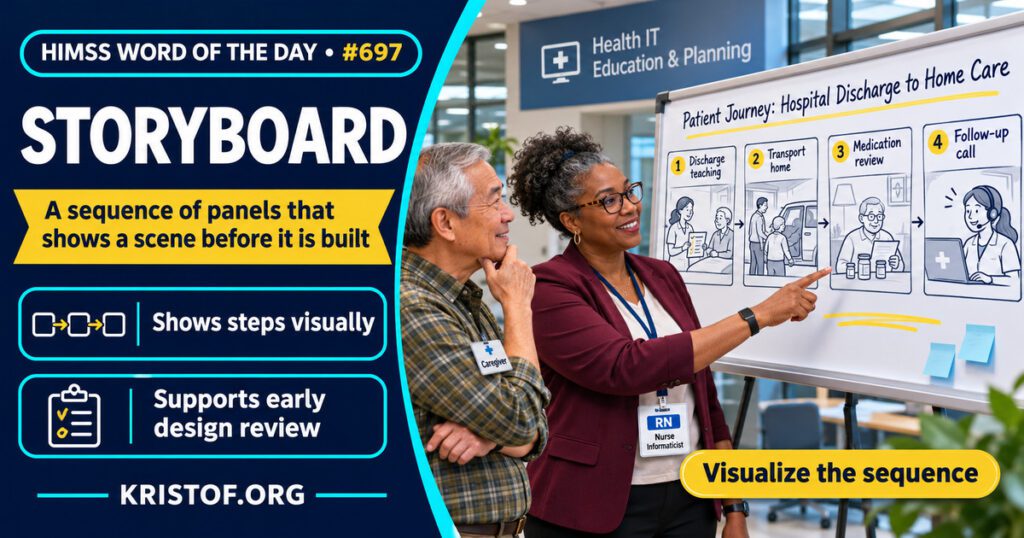
The HIMSS Dictionary describes a storyboard as a panel, or a series of panels, with sketches arranged in order to show the main parts of a scene and its action. It is a way to lay out a sequence visually before the real thing is built, filmed, or written.
In health IT and health education the sequence is usually a patient journey, a workflow, an app screen flow, or an educational message. The five studies below use storyboards for different purposes, so the table sorts them by what the storyboard was doing.
| Purpose | What the storyboard did | Source in this post |
|---|---|---|
| Design | Showed user demands to stakeholders early in app development | Yu et al. |
| Co-design | Turned carers’ accounts into draft scripts for review | Allen et al. |
| Content validation | Gave experts a structured draft of education material to rate | Galiza et al. |
| Engagement | Presented research evidence to community partners | Parnes et al. |
| Data collection | Helped focus groups discuss experiences | Brown et al. |
⚠️ Exam Alert: A storyboard shows a sequence of scenes, while a flowchart or workflow diagram usually shows steps and decision points, a wireframe typically lays out a single screen, and a prototype is a working or clickable model. A storyboard is also not a use case, which describes how a user interacts with a system to reach a goal, and it is not usability testing, which observes people using a product. Questions may ask which tool fits an early design discussion.
🌐 Why It Matters: Real-World Healthcare IT Context
Where it shows up. A storyboard is useful when people need to react to an idea before anything is built. It makes a process visible to people who do not read technical specifications, including patients, carers, and community members. The studies below were read as abstracts only.
Showing user demands in app design. Yu et al. (2025) wrote a systematic literature review synthesis on storyboarding for developing mHealth apps for pregnant women. They found potential in using a storyboard strategy to visualize pregnant women’s demands in the early design phase and propose a conceptual framework for cartoon-like storyboarding. The authors recommend future studies to determine the characteristics of storyboarding in this setting. It is a conceptual framework, so it has not been tested with users in this paper.
Co-designing scripts for carers. Allen et al. (2026) used a modified experience-based co-design method with Greek, Italian, and Chinese (Cantonese- and Mandarin-speaking) Australian carers of older adults and advocates from community aged-care organizations. Twenty-nine participants took part from June 2023 to April 2024 in two rounds that included 2 workshops, 9 small group interviews, and 11 individual interviews. The first round informed four draft storyboards of the carer and patient journey during care transitions, and the second round asked the same participants whether the drafts were acceptable. A 10-person Carer Advisory Group guided the work, and certified interpreters and translators were used throughout. The authors expect the storyboards and scripts to improve access to information, but the abstract reports that as an expectation, not a measured result.
Rating education content. Galiza et al. (2023) built storyboards about breast cancer for women deprived of liberty, to be used later for videos and e-books, and tested their validity with 10 expert judges. The overall Content Validity Index was 0.99, suitability was 81%, and readability was 73.2, which the authors say makes the material superior and easy to read. They conclude the educational technology is valid and reliable. This measures agreement among experts about the content, not whether women understood it or changed their behavior.
Translating evidence for policy. Parnes et al. (2024) used storyboards to share findings from a scoping review of non-specialist models of child and adolescent mental health care with community partners in Washington State, to inform behavioral workforce expansion. Community members with lived experience contributed to the design, a broader group responded through an open-ended survey, and listening sessions were held with non-English-speaking refugee and immigrant communities. Responses to the models were mixed, and immigrant and refugee communities said the existing models would not fit their context. The authors judge that storyboarding helped engage partners and capture community voice, noting that more work is needed on whether such methods increase the use of research evidence in policy. It is a case study.
Supporting group discussion. Brown et al. (2026) ran focus groups with 37 people in under-resourced communities, using storyboarding as a way to support inclusive communication, and applied thematic analysis with a realist lens. The four themes concerned living circumstances, mechanisms of weight management, yo-yo dieting, and intervention needs, including a perceived lack of psychological support. The authors say they believe this is the first study to combine the two methods. The abstract does not compare storyboarding with a method that does not use it.
What I could not confirm. None of the five abstracts tests whether using a storyboard changes health, usability, or implementation outcomes, and none compares storyboards with another design method. Several are qualitative, case-study, or conceptual designs. I did not find a study of storyboards used for EHR workflow design in the abstracts I reviewed, so I make no claim about it. Two of the studies describe small expert or participant groups.
Common storyboard problems:
- Treating a conceptual framework as if it were tested
- Mistaking expert agreement on content for patient understanding
- Showing a workflow that stakeholders have not reviewed or corrected
- Using one version for audiences with different languages and cultural contexts
- Presenting sketches as if they were a finished design
What supports storyboards:
- A visual, low-cost way to show a sequence before it is built
- Reaching people who would not read a technical specification
- A structured draft that carers, experts, or community partners can react to
- Room for participants to shape the draft, as in the co-design and community studies
- A format that can later become a video, an e-book, or a screen design
🏥 The Nurse’s Perspective: Clinical, Bedside, & Workflow
None of the abstracts describes nurses as study participants, although two were published in nursing journals, so this section is workflow context and not evidence.
At the Bedside
Patient and family education is where storyboards are closest to nursing work. A short sequence of pictures showing what happens during a transition from hospital to home can carry the same message a nurse gives verbally at discharge, in a form a carer can review later. The Australian study focused on carers whose first languages were not English, which is a reminder that the same panels may need to differ by language and culture.
In Clinical Workflow
A storyboard can show a workflow as a picture, including who does what and where a handoff occurs. Showing a draft to the people who do the work often reveals a missing step or an extra click before any build begins. That is a practical expectation and not a finding from the studies reviewed.
In EHR Implementation (Go-Live Perspective)
During an Epic Go-Live, analysts and at-the-elbow support staff often explain a new workflow in short visual steps, because a picture of the sequence is easier to follow at the point of care than a long document. The studies reviewed do not examine go-lives, so this is context only.
🎓 CAHIMS / CPHIMS & HIMSS Perspective
CAHIMS Exam Domain Mapping
Storyboard appears in questions about design, requirements, and communication:
| CAHIMS Domain | How Storyboard Appears |
|---|---|
| Healthcare & Technology Environments | Patient education and engagement materials |
| Clinical Informatics | Workflow and user-interface design with clinical users |
| Healthcare Information & Systems Management | Requirements gathering and early design review |
| Management & Leadership | Stakeholder communication and change management |
Key Terms to Know Alongside Storyboard
- Usability — how effectively, efficiently, and satisfactorily people can use a system
- Usability testing — observing representative users as they try to complete tasks with a product
- User experience — a person’s overall experience of using a product or service
- Use case — a description of how a user interacts with a system to reach a goal
- mHealth — health services and information delivered through mobile devices
HIMSS Organizational Position
HIMSS offers education and research on health information and technology topics through its Resource Center. Members can find related information on the HIMSS Resource Center page.
🧭 More HIMSS Word of The Day Terms
Related terms in the Clinical Informatics series:
Browse all Clinical Informatics terms or the A–Z glossary.
🔗 Explore Further: External References
- Yu et al. (2025), mHealth — Visualizing user demands through storyboarding in the mHealth app development for pregnant women: a conceptual framework. https://pubmed.ncbi.nlm.nih.gov/40248756/
- Allen et al. (2026), Journal of Advanced Nursing — Co-Designing Storyboards for Multimedia Resources With Informal Carers to Support Hospital-to-Home Transitions for Older Adults From Culturally Diverse Backgrounds. https://pubmed.ncbi.nlm.nih.gov/41201049/
- Galiza et al. (2023), Revista Brasileira de Enfermagem — Construction and validity of a storyboard about breast cancer for women deprived of liberty. https://pubmed.ncbi.nlm.nih.gov/37970981/
- Parnes et al. (2024), Frontiers in Public Health — Translating research evidence into youth behavioral health policy and action: using a community-engaged storyboard approach. https://pubmed.ncbi.nlm.nih.gov/39234087/
- Brown et al. (2026), Nutrition — Weight management needs in under-resourced communities elicited using storyboarding and a realist lens: a qualitative study. https://pubmed.ncbi.nlm.nih.gov/42341545/
- HIMSS — Resource Center https://www.himss.org/resource-center
Term source: HIMSS Dictionary of Health Information and Technology Terms, Acronyms, and Organizations, 6th Edition (2025). All definitions in this series are paraphrased for editorial purposes. Readers are encouraged to consult the primary source for exact language.
Eric Andrew Kristof, RN, CAHIMS is a Healthcare IT professional and HIMSS Arkansas Chapter member based in Hot Springs Village, AR, with hands-on Epic Go-Live experience and a diverse healthcare and IT background. He writes at kristof.org at the intersection of clinical care and healthcare technology.
Leave a Reply