By Eric Andrew Kristof, RN, CAHIMS | Healthcare IT Professional | HIMSS Arkansas Chapter Member
About This Series: The HIMSS Word of The Day is a running blog series drawing from the HIMSS Dictionary of Health Information and Technology Terms, Acronyms, and Organizations, 6th Edition (2025) — the authoritative reference for healthcare IT professionals and the primary study resource for CAHIMS and CPHIMS certification. Each post paraphrases the term in plain language, grounds it in real-world healthcare IT context, and adds a bedside nursing perspective you won’t find in a textbook.
📖 The Term: Opt-Out
Source: HIMSS Dictionary of Health Information and Technology Terms, Acronyms, and Organizations, 6th Edition (2025)
🔍 Plain-Language Definition
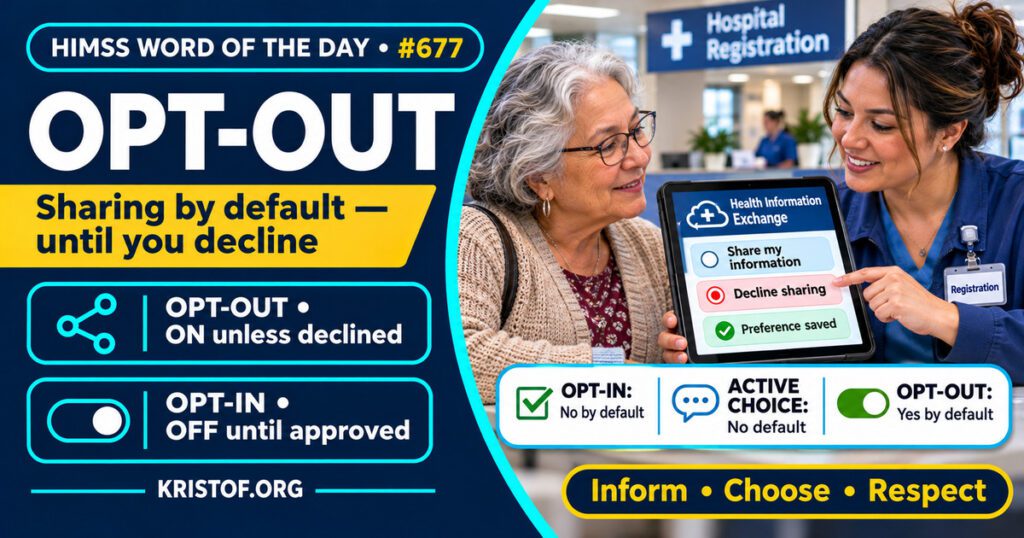
The HIMSS Dictionary describes opt-out as a mechanism that tells people how their data will be collected or used and gives them a choice to decline. In practice, an opt-out approach lets collection or use proceed unless the person says no. An opt-in approach is the reverse: nothing proceeds until the person says yes.
The dictionary’s wording is general. The studies below apply the idea to health information exchange, research contact lists, and test offers, and they use “opt-out” the same way: the default is yes, and the person must act to change it.
| Model | Default | Reported figure in the studies below |
|---|---|---|
| Opt-in | No, until the person agrees | 29.5% consent (Japan survey); 38.0% HIV test acceptance (trial) |
| Active choice | None, the person must pick | 51.3% HIV test acceptance (trial) |
| Opt-out | Yes, unless the person declines | 95.0% consent (Japan survey); 65.9% HIV test acceptance (trial) |
These figures come from different studies, settings, and questions, so they are not comparable across rows from different studies.
⚠️ Exam Alert: Do not confuse opt-out with opt-in, and do not treat either as a legal conclusion. Whether a given approach is permitted depends on the applicable law and the kind of data. A related term in one study is “break the glass”, which I understand as an emergency override of access restrictions, although the abstract does not define it. It is a different mechanism from either default.
🌐 Why It Matters: Real-World Healthcare IT Context
Why the default matters. The research here is about how often people agree under each default, how consent policy relates to hospital exchange activity, and what patients say they prefer. None of it settles which default is right. Most of it concerns stated preferences or associations, and one study is about HIV testing, not data sharing.
A trial of defaults, in a different setting. Montoy et al. (2016) randomized emergency department patients aged 13 to 64 at one urban teaching hospital to opt-in, active choice, or opt-out HIV test offers. Acceptance was 38.0% (611 of 1,607) with opt-in, 51.3% (815 of 1,628) with active choice, and 65.9% (1,031 of 1,565) with opt-out. The authors suggest active choice may best approximate patients’ true preferences. This was a test offer, not data sharing, and it took place at a single hospital, so it shows the power of a default more than the right consent model for health data.
Hypothetical consent rates in Japan. Ito and Nakamura (2025) surveyed 2,000 people online about consent to health information exchange. Consent was 29.5% under opt-in and 95.0% under opt-out, which raised concerns among half of respondents. A “two-step consent model” that the authors propose reached 68.5%. These are stated responses to a survey, not behavior in a live exchange, and the two-step model is the authors’ proposal. They say patient education is crucial.
Laws and hospital exchange. Apathy and Holmgren (2020) analyzed US nonfederal acute care hospitals in 2016. Hospitals in states with opt-in consent policies were 7.8 percentage points more likely than hospitals in opt-out states to report regulatory barriers to exchange (p = 0.03). Among hospitals attesting to Meaningful Use stage 2, they found no relationship between opt-in policies and barriers, or between opt-in policies and exchange volume. Brown-Podgorski et al. (2018) found that three legal provisions, including opt-out consent, were associated with a higher likelihood of hospital engagement in community exchanges, while other provisions lowered it, and the authors say more research is needed to determine causal relationships. Both are associations in observational data.
What patients say they prefer. Turvey et al. (2020) surveyed 19,567 veterans in 2016. The share preferring an opt-out policy was 56.8% of White respondents, 40.3% of Black respondents, 44.9% of Hispanic Latino respondents, 48.3% of Asian and Pacific Islander respondents, and 38.3% of Native American respondents (p < .001). It is one health system’s enrollees, and the authors say the differences should inform implementation with cultural sensitivity. Tosoni et al. (2021) surveyed 222 patients at an academic institution about using personal health information outside the circle of care. In that survey, 56% preferred broad consent and 38% preferred specific consent, and 63% preferred to be asked for permission before entry into a contact pool, with younger patients leaning toward more specific options. That is a single-institution survey.
What I could not confirm. I did not review any law or regulation, so I make no statement about what consent approach is required for any kind of data. The dictionary’s wording covers data collection and use in general, and I did not look for studies outside health. The studies measure consent rates, preferences, and associations, not harms or benefits to patients. I did not verify how any particular organization implements opt-out.
Common opt-out problems:
- Consent rates that follow the default more than the person’s preference
- Concerns among a large share of people about data used by default
- Preferences that differ across racial, ethnic, and age groups
- Low awareness of what exchange and consent options mean
- Evidence that rests mostly on stated preferences and associations, not observed outcomes
What supports sound opt-out practice:
- Clear patient education, which the Japan survey’s authors call crucial
- Comparing defaults against what patients say they prefer, as the trial and surveys do
- Cultural sensitivity in implementation, as the veterans survey recommends
- Attention to administrative burden in policy design, as the hospital study suggests
🏥 The Nurse’s Perspective: Clinical, Bedside, & Workflow
Nurses often take part in patient education, so consent defaults can reach them in practice.
At the Bedside
The Japan survey’s authors say patient education is crucial for understanding exchange and its consent options. Nurses are often involved in patient education, which is general context and not a finding of that study. In the HIV test trial, the abstract does not say who delivered the offers.
In Clinical Workflow
The veterans survey found different preferences by race and ethnicity, and the patient survey found younger patients preferring more specific consent. Both suggest that a single default may not fit every patient, and that nurses who handle consent conversations may meet a range of views. That is an inference, not a finding.
In EHR Implementation (Go-Live Perspective)
During an Epic Go-Live, analysts and at-the-elbow support staff may see how a patient’s data-sharing choice is captured in registration or the record. The studies reviewed do not address build or go-live, so how any given organization handles it is a local question.
🎓 CAHIMS / CPHIMS & HIMSS Perspective
CAHIMS Exam Domain Mapping
Opt-out appears in questions about privacy, consent, and health information exchange:
| CAHIMS Domain | How Opt-Out Appears |
|---|---|
| Healthcare & Technology Environments | Consent models in health information exchange |
| Clinical Informatics | Capturing and honoring patient preferences |
| Healthcare Information & Systems Management | Privacy controls and policy configuration |
| Management & Leadership | Governance, patient trust, and policy tradeoffs |
Key Terms to Know Alongside Opt-Out
- Opt-in — a consent approach in which nothing proceeds until the person agrees
- Active choice — an approach that requires the person to choose, with no default
- Health information exchange — the sharing of patient information across organizations
- Consent — a person’s agreement to a use of their information or care
- Break the glass — a consent policy named in the veterans survey, commonly understood as an emergency access override
- Personal health information — information about an individual’s health or care
HIMSS Organizational Position
HIMSS offers education and research on health information and technology topics through its Resource Center. Members can find related information on the HIMSS Resource Center page.
🧭 More HIMSS Word of The Day Terms
Related terms in the Cybersecurity and Privacy series:
- Protected Health Information (PHI)
- DS4P (Data Segmentation for Privacy)
- S/MIME (Secure Multipurpose Internet Mail Extensions)
- Consent Directive
Browse all Cybersecurity and Privacy terms or the A–Z glossary.
🔗 Explore Further: External References
- Montoy et al. (2016), BMJ — Patient choice in opt-in, active choice, and opt-out HIV screening: randomized clinical trial. https://pubmed.ncbi.nlm.nih.gov/26786744/
- Ito and Nakamura (2025), Frontiers in Digital Health — Consent mechanisms and default effects in health information exchange in Japan. https://pubmed.ncbi.nlm.nih.gov/40094152/
- Apathy and Holmgren (2020), American Journal of Managed Care — Opt-in consent policies: potential barriers to hospital health information exchange. https://pubmed.ncbi.nlm.nih.gov/31951362/
- Brown-Podgorski et al. (2018), AMIA Annual Symposium Proceedings — The Association Between State-Level Health Information Exchange Laws and Hospital Participation in Community Health Information Organizations. https://pubmed.ncbi.nlm.nih.gov/30815070/
- Turvey et al. (2020), Journal of the American Medical Informatics Association — Racial differences in patient consent policy preferences for electronic health information exchange. https://pubmed.ncbi.nlm.nih.gov/32150259/
- Tosoni et al. (2021), BMC Medical Ethics — The use of personal health information outside the circle of care: consent preferences of patients from an academic health care institution. https://pubmed.ncbi.nlm.nih.gov/33761938/
- HIMSS — Resource Center https://www.himss.org/resource-center
Term source: HIMSS Dictionary of Health Information and Technology Terms, Acronyms, and Organizations, 6th Edition (2025). All definitions in this series are paraphrased for editorial purposes. Readers are encouraged to consult the primary source for exact language.
Eric Andrew Kristof, RN, CAHIMS is a Healthcare IT professional and HIMSS Arkansas Chapter member based in Hot Springs Village, AR, with hands-on Epic Go-Live experience and a diverse healthcare and IT background. He writes at kristof.org at the intersection of clinical care and healthcare technology.
Leave a Reply