By Eric Andrew Kristof, RN, CAHIMS | Healthcare IT Professional | HIMSS Arkansas Chapter Member
About This Series: The HIMSS Word of The Day is a running blog series drawing from the HIMSS Dictionary of Health Information and Technology Terms, Acronyms, and Organizations, 6th Edition (2025) — the authoritative reference for healthcare IT professionals and the primary study resource for CAHIMS and CPHIMS certification. Each post paraphrases the term in plain language, grounds it in real-world healthcare IT context, and adds a bedside nursing perspective you won’t find in a textbook.
📖 The Term: BAN (Body Area Network)
Source: HIMSS Dictionary of Health Information and Technology Terms, Acronyms, and Organizations, 6th Edition (2025)
🔍 Plain-Language Definition
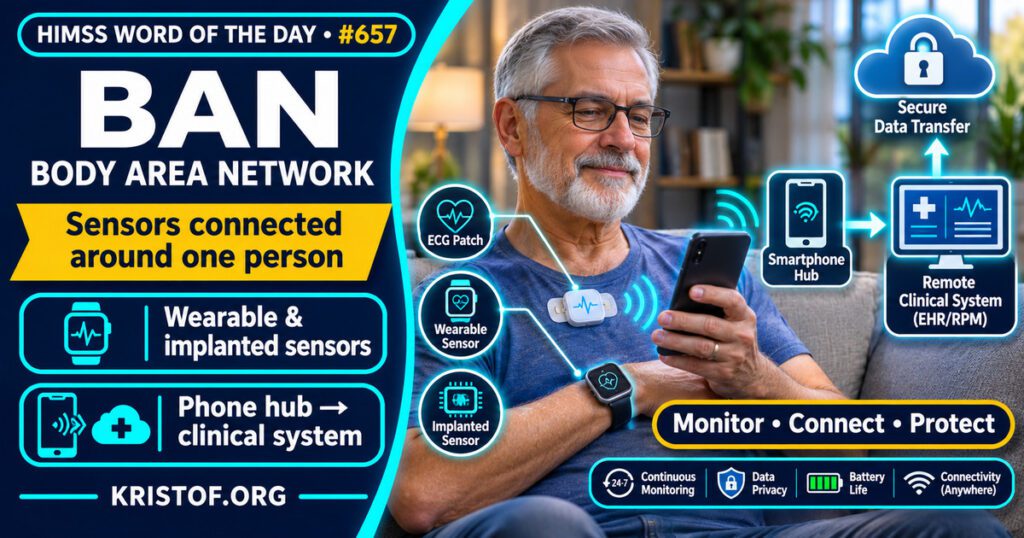
The HIMSS Dictionary describes a BAN (body area network) as a connected set of computing devices that a person wears, attaches, or has implanted. A smartphone carried in a pocket or bag typically acts as the mobile data hub, collecting the readings and sending them on to a remote database or other system. The dictionary lists “Body Area Network” as a second entry with the same meaning.
The research literature usually calls the wireless version a WBAN (wireless body area network). Zhong and colleagues (2022) describe it as a technology that collects physical parameters through medical sensors in or around the body to allow real-time, continuous remote monitoring.
| Layer | What it does | Example |
|---|---|---|
| Sensors | Measure body signals | Wearable patch, implanted sensor |
| Hub | Gathers readings from the sensors | Smartphone carried by the person |
| Remote system | Stores and analyzes the data | Database, clinical system, or cloud service |
⚠️ Exam Alert: A body area network sits on or in one person, while a local area network (LAN) connects devices in a building. Do not confuse the hub in a BAN, which collects data from a person’s sensors, with a hospital network server.
🌐 Why It Matters: Real-World Healthcare IT Context
Body area networks are an engineering topic, and most of the literature consists of technical reviews and surveys. I found five and read their abstracts. All are reviews or surveys, so none reports patient outcomes, and their conclusions reflect their authors’ judgments.
Stricter requirements. Zhong and colleagues (2022) surveyed WBANs for health monitoring and say they have more stringent technical requirements than other wireless transmission technologies in power efficiency, security and privacy, and quality of service. Their survey covers sensors, frequency bands, channel models, medium access control, and networking protocols, and it presents an application-specific integrated circuit (ASIC) scheme to improve security and privacy while lowering energy use. The abstract describes the scheme as a proposal, and it does not report clinical testing.
Data security. Jian and colleagues (2024) wrote a systematic survey of WBAN data protection. The abstract argues that most techniques in the literature cannot meet the requirements and gives an example in which an unauthorized person alters stored data, so that a diagnosis in the database changes and a clinician prescribes based on manipulated data. That example is illustrative, not a documented incident. Salehi Shahraki and colleagues (2023) reviewed access control, key management, and trust in WBANs, and say that although current schemes offer some security, several serious challenges remain. Their stated aim is to point toward future best practices for protecting healthcare data, including monitoring, access control, key management, and trust management.
Power. Wang and colleagues (2020) reviewed power sources for body sensor networks. They say these networks need micro power sources with high energy density, long lifetime, and good biocompatibility. Batteries are the most mature option, but that gains in energy density have been slow, that micro fuel cells and energy harvesters are alternatives, and that a hybrid power supply is more reliable than a single type. For implanted devices, they describe fuel cells that use glucose in body fluid. Most of those options are described as research directions.
Where the phone fits. The dictionary’s smartphone hub puts the phone’s security, battery, and connectivity into the data path. The reviews I read discuss security and power mainly at the level of sensors and network design, and I did not see a phone-based hub discussed in any of the five abstracts. That gap is a reason to treat the hub as a separate item in any risk review, and it is not a finding from the sources.
Market and regulation. Bhatti and colleagues (2022) surveyed technology and economy issues for wearable WBANs, including growth rates, regulation across regions, and security. They note that regulations for these devices differ by region and country. The abstract gives no figures for market growth, so I cannot report any.
What I could not confirm. I did not find a standard definition of how many devices must be linked to count as a BAN. I did not find clinical outcome studies in this search that compare patients monitored through a BAN with usual care. I read abstracts only, so I cannot say how well each review handled the evidence it covers.
Common body area network problems:
- Weak security or privacy at the sensor, hub, or remote system
- Batteries that limit how long a sensor can run
- Dependence on a smartphone hub that the patient must carry and charge
- Differences in regulation and standards across regions
- Unclear responsibility for reviewing the data that arrives
What supports reliable body area networks:
- Access control and key management designed for small, low-power devices
- Power planning, including hybrid supplies where suitable
- Clear data flow from sensor to hub to remote system
- Awareness of regulation for the device type and region
- Defined ownership of alerts and data review
🏥 The Nurse’s Perspective: Clinical, Bedside, & Workflow
Nurses are often the people who explain wearable and implanted monitoring devices to patients.
At the Bedside
A nurse who applies a wearable patch or reviews an implanted device with a patient may also explain the hub: the patient’s smartphone or a supplied hub must stay nearby and charged for data to move onward. Teaching patients how the pieces fit together is a practical task, though the reviews above do not study patient education.
In Clinical Workflow
Remote data from a BAN arrives outside the usual bedside routine. Programs that use it need a defined plan for who reviews the data, how alerts are routed, and what triggers a call to the patient. The reviews describe security and power problems and do not address staffing, so this is a workflow question for each organization to answer.
In EHR Implementation (Go-Live Perspective)
During an Epic Go-Live, device integration questions center on where remote readings appear in the chart and who sees them. Analysts can map the path from sensor to hub to remote system to record, and nurse super users can confirm that the data shown to clinicians matches what the device reports. The path has several handoffs, and the security literature suggests each one is a place to check access and data integrity.
🎓 CAHIMS / CPHIMS & HIMSS Perspective
CAHIMS Exam Domain Mapping
BAN appears where wearables and implanted devices meet information systems:
| CAHIMS Domain | How BAN Appears |
|---|---|
| Healthcare & Technology Environments | Wearable sensors, hubs, and wireless technologies |
| Clinical Informatics | Remote monitoring data and its use in care |
| Healthcare Information & Systems Management | Data flow, integration, security, and device management |
| Management & Leadership | Policy on remote monitoring, regulation, and risk |
Key Terms to Know Alongside BAN
- Wearable — a worn sensor device that collects health data
- Internet of Things (IoT) — networked everyday and medical devices that exchange data
- Remote patient monitoring — collecting patient data outside a clinical setting and sending it to a care team
- mHealth — the use of mobile devices and apps in health care
- Encryption — encoding data so only authorized parties can read it
- Interoperability — the ability of systems to exchange and use data
HIMSS Organizational Position
HIMSS offers education and research on health information and technology topics through its Resource Center. Members can find related information on the HIMSS Resource Center page.
🧭 More HIMSS Word of The Day Terms
Related terms in the Connected Health series:
Browse all Connected Health terms or the A–Z glossary.
🔗 Explore Further: External References
- Zhong et al. (2022), Sensors — Technological Requirements and Challenges in Wireless Body Area Networks for Health Monitoring: A Comprehensive Survey https://pubmed.ncbi.nlm.nih.gov/35591234/
- Jian et al. (2024), Frontiers in Medicine — Systematic survey on data security in wireless body area networks in IoT healthcare system https://pubmed.ncbi.nlm.nih.gov/39139786/
- Salehi Shahraki et al. (2023), Sensors — Access Control, Key Management, and Trust for Emerging Wireless Body Area Networks https://pubmed.ncbi.nlm.nih.gov/38139702/
- Wang et al. (2020), Biosensors and Bioelectronics — Powering future body sensor network systems: A review of power sources https://pubmed.ncbi.nlm.nih.gov/32692667/
- Bhatti et al. (2022), Sensors — A Survey on Wireless Wearable Body Area Networks: A Perspective of Technology and Economy https://pubmed.ncbi.nlm.nih.gov/36298073/
- HIMSS — Resource Center https://www.himss.org/resource-center
Term source: HIMSS Dictionary of Health Information and Technology Terms, Acronyms, and Organizations, 6th Edition (2025). All definitions in this series are paraphrased for editorial purposes. Readers are encouraged to consult the primary source for exact language.
Eric Andrew Kristof, RN, CAHIMS is a Healthcare IT professional and HIMSS Arkansas Chapter member based in Hot Springs Village, AR, with hands-on Epic Go-Live experience and a diverse healthcare and IT background. He writes at kristof.org at the intersection of clinical care and healthcare technology.
Leave a Reply