By Eric Andrew Kristof, RN, CAHIMS | Healthcare IT Professional | HIMSS Arkansas Chapter Member
About This Series: The HIMSS Word of The Day is a running blog series drawing from the HIMSS Dictionary of Health Information and Technology Terms, Acronyms, and Organizations, 6th Edition (2025) — the authoritative reference for healthcare IT professionals and the primary study resource for CAHIMS and CPHIMS certification. Each post paraphrases the term in plain language, grounds it in real-world healthcare IT context, and adds a bedside nursing perspective you won’t find in a textbook.
📖 The Term: Star Schema
Source: HIMSS Dictionary of Health Information and Technology Terms, Acronyms, and Organizations, 6th Edition (2025)
🔍 Plain-Language Definition
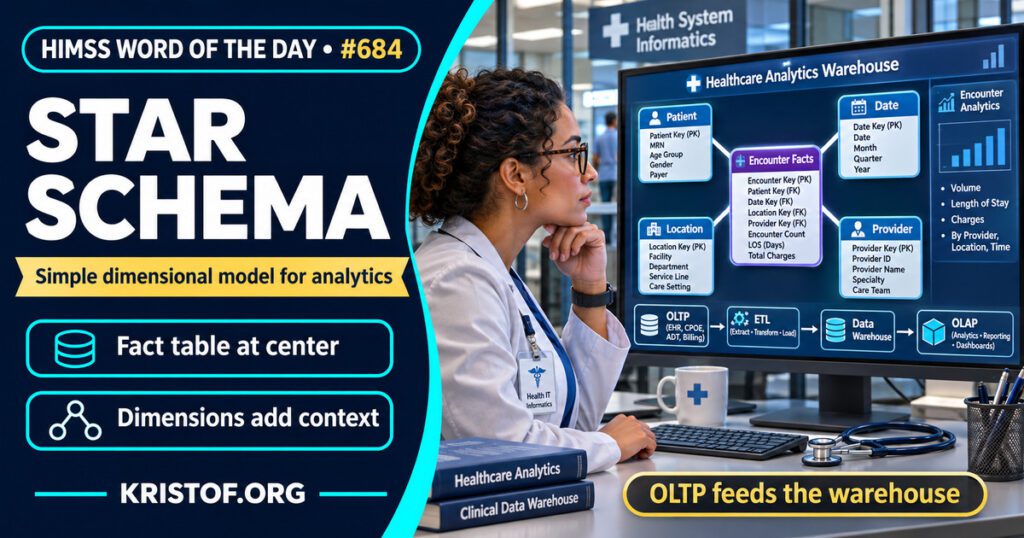
The HIMSS Dictionary describes a star schema as the simplest kind of dimensional model. Each measured item, called a fact, sits at the center of a diagram, and the descriptive details that give it context, called dimensions, are drawn around it like points of a star. The entry sends readers to OLTP, the transaction-processing systems whose data a warehouse is typically built from.
The table below uses plain examples that are my own illustrations and are not drawn from the studies.
| Piece | Role | Illustrative example |
|---|---|---|
| Fact | The measured or recorded item being analysed | A lab result or an encounter |
| Dimension | Descriptive context used to filter and group facts | Patient, date, location, provider |
| Star schema | One central set of facts joined to its dimensions | A warehouse view of encounters by patient and date |
| OLTP | The day-to-day transaction systems that feed the warehouse | The EHR in daily use |
⚠️ Exam Alert: A star schema is a way of designing a data warehouse. It is not a database product, and it is meant for analysis, in contrast to the transaction systems the dictionary points to. Do not confuse it with other warehouse designs: one study below uses a fact constellation schema, and another proposes a new model because the star schema looked too limited.
🌐 Why It Matters: Real-World Healthcare IT Context
Where it shows up. In my searches, star schemas appeared mostly in studies of clinical data warehouses and research data platforms. The six studies below are design reports, a scoping review, and one tool description. I read abstracts only, and none of them compares a star schema head to head with another design.
A scoping review of clinical data warehouses. Lyu et al. (2025) searched four databases for peer-reviewed English-language studies from 2014 through 2024 on data warehousing in healthcare. After removing 1,194 duplicates, 4,864 unique papers remained, and 27 met the inclusion criteria: 17 on general data warehouses and 10 on specialised ones. The authors report that general data warehouses were mainly used to address data integration, particularly for EHR or EMR data, and typically use a star schema architecture with online analytical processing and query analysis capabilities. They say general warehouses integrate disparate sources effectively, but that their flexibility and analytical capabilities need improvement. Specialised warehouses, built around specific diseases or research purposes, face scalability challenges because of their customised nature.
A tool built on a star schema warehouse. Datta et al. (2021) describe FIBER, an open-source Python library built on top of a star schema clinical data warehouse (i2b2) that generates modeling-ready patient cohorts. They state that EHRs stored in star schema warehouses are an approach often adopted in practice and that a gap remained for tools to work with them. FIBER was developed on a star schema EHR database with data from 8 million patients and over 120 million encounters. As an example, the authors built a heart surgery cohort of 12,061 patients, identified 1,005 who developed acute kidney injury, extracted 774 features, and trained machine learning models that reached an area under the curve of up to 0.77. The abstract describes this as an illustration of the tool, so the AUC is not a finding about star schemas.
An argument that the star schema may be too limited. Wang et al. (2005) wrote that conventional models such as the star schema appear to be insufficient for modelling clinical and genomic data, and they proposed a new model called BioStar schema to capture richer semantics and be more extensible. This is a 2005 modelling paper, and the abstract reports no evaluation results.
A different warehouse shape. Atay and Garani (2020) built a clinical data warehouse for lung cancer data provided by the United States National Cancer Institute, and the abstract also mentions ovarian cancer data. They used SQL Server Integration Services for extract, transform, and load, and designed the warehouse with a fact constellation schema model. They report that the model responded to complex queries and supported online analytical processing cubes. The abstract does not compare this design with a star schema or define the fact constellation term.
Dimensions in a research data platform. Wade et al. (2011) noted that many clinical research data integration platforms rely on the Entity-Attribute-Value model for its flexibility, even though it makes queries harder to write and slower to run. They designed an alternative, the Dimensional Bus model, borrowing from Entity-Attribute-Value and enterprise data warehousing, and used it to integrate electronic medical record, sponsored study, and biorepository data. Observational collections each get their own table, linked to a Bus that holds provenance information and links to classificatory dimensions. The authors call it a workable way to manage and query mixed schemas in a data warehouse. The abstract gives no performance measurements.
A dimensional warehouse for trial operations. Farnum et al. (2019) describe a dimensional relational data warehouse for integrating operational data from clinical trials, with extraction, transformation, and loading processes, a metrics engine, and graphical interfaces. The setting is clinical trial operations in the pharmaceutical industry, and the abstract gives no evaluation results.
What I could not confirm. I did not find a study comparing star schemas with other warehouse designs on query speed, accuracy, or clinical outcomes. The abstracts do not say which commercial EHR vendors‘ warehouses use star schemas, and I did not read the scoping review’s full text to see how many of its 17 general warehouses use one. I did not find a study that examines nursing data or nurse users of a star schema warehouse. The definitions of fact and dimension in this post’s table are general descriptions and not taken from a source I retrieved beyond the dictionary entry.
Common star schema problems:
- Flexibility and analytical capability of general warehouses that the review says need improvement
- Clinical and genomic data whose semantics the 2005 authors argued a star schema does not capture well
- Complex queries and preprocessing effort for anyone extracting data, as the FIBER authors note
- Mixed source schemas that need extra design, as in the Dimensional Bus work
- Scalability challenges the review reports for specialised warehouses
What supports star schemas:
- Wide use for EHR and clinical data integration, according to the review
- Support for online analytical processing and query analysis
- A structure that tools such as FIBER can build on to produce cohorts at large scale
- Related dimensional designs that extend the idea, such as the fact constellation and the Dimensional Bus
- The simple structure the dictionary describes
🏥 The Nurse’s Perspective: Clinical, Bedside, & Workflow
Nursing documentation is one source of the EHR data that clinical data warehouses bring together, which is general context. None of the studies reviewed examines nursing data or nurse users of a star schema warehouse.
At the Bedside
How a nurse charts, whether in a defined field or in free text, likely affects what a warehouse can later report. That is a general inference, and the abstracts do not test it.
In Clinical Workflow
The FIBER example built a heart surgery cohort and flagged patients who developed acute kidney injury, which is the kind of cohort a quality or research team might request. Whether nurses on those teams use star schema warehouses directly is not shown in the studies.
In EHR Implementation (Go-Live Perspective)
During an Epic Go-Live, analysts and at-the-elbow support staff may be asked whether data charted in the new system will appear in reports. That is general workflow context, since the studies reviewed do not examine go-lives, and the review says only that general warehouses address data integration.
🎓 CAHIMS / CPHIMS & HIMSS Perspective
CAHIMS Exam Domain Mapping
Star schema appears in questions about data modeling, warehousing, and analytics:
| CAHIMS Domain | How Star Schema Appears |
|---|---|
| Healthcare & Technology Environments | Warehouse design compared with transaction systems |
| Clinical Informatics | Building cohorts and quality data from EHR warehouses |
| Healthcare Information & Systems Management | Modeling, extract-transform-load, and analytical processing |
| Management & Leadership | Flexibility, scalability, and governance of warehouses |
Key Terms to Know Alongside Star Schema
- Data warehouse — a store that brings together data from several source systems for analysis
- Fact table — the central table of a dimensional model that holds the items being measured
- Dimension table — a table of descriptive context that surrounds the facts
- OLAP — online analytical processing, used for analysing multidimensional data
- ETL — extract, transform, and load, the process of moving data into a warehouse
- OLTP — online transaction processing, the daily operational systems that a warehouse draws from
HIMSS Organizational Position
HIMSS offers education and research on health information and technology topics through its Resource Center. Members can find related information on the HIMSS Resource Center page.
🧭 More HIMSS Word of The Day Terms
Related terms in the Data and Analytics series:
Browse all Data and Analytics terms or the A–Z glossary.
🔗 Explore Further: External References
- Lyu et al. (2025), Frontiers in Digital Health — The development and use of data warehousing in clinical settings: a scoping review. https://pubmed.ncbi.nlm.nih.gov/40538572/
- Datta et al. (2021), JAMIA Open — FIBER: enabling flexible retrieval of electronic health records data for clinical predictive modeling. https://pubmed.ncbi.nlm.nih.gov/34350388/
- Wang et al. (2005), International Journal of Bioinformatics Research and Applications — BioStar models of clinical and genomic data for biomedical data warehouse design. https://pubmed.ncbi.nlm.nih.gov/18048122/
- Atay and Garani (2020), Healthcare Informatics Research — Building a Lung and Ovarian Cancer Data Warehouse. https://pubmed.ncbi.nlm.nih.gov/33190464/
- Wade et al. (2011), Journal of the American Medical Informatics Association — A Dimensional Bus model for integrating clinical and research data. https://pubmed.ncbi.nlm.nih.gov/21856687/
- Farnum et al. (2019), Database — A dimensional warehouse for integrating operational data from clinical trials. https://pubmed.ncbi.nlm.nih.gov/30942863/
- HIMSS — Resource Center https://www.himss.org/resource-center
Term source: HIMSS Dictionary of Health Information and Technology Terms, Acronyms, and Organizations, 6th Edition (2025). All definitions in this series are paraphrased for editorial purposes. Readers are encouraged to consult the primary source for exact language.
Eric Andrew Kristof, RN, CAHIMS is a Healthcare IT professional and HIMSS Arkansas Chapter member based in Hot Springs Village, AR, with hands-on Epic Go-Live experience and a diverse healthcare and IT background. He writes at kristof.org at the intersection of clinical care and healthcare technology.
Leave a Reply