By Eric Andrew Kristof, RN, CAHIMS | Healthcare IT Professional | HIMSS Arkansas Chapter Member
About This Series: The HIMSS Word of The Day is a running blog series drawing from the HIMSS Dictionary of Health Information and Technology Terms, Acronyms, and Organizations, 6th Edition (2025) — the authoritative reference for healthcare IT professionals and the primary study resource for CAHIMS and CPHIMS certification. Each post paraphrases the term in plain language, grounds it in real-world healthcare IT context, and adds a bedside nursing perspective you won’t find in a textbook.
📖 The Term: Data Set
Source: HIMSS Dictionary of Health Information and Technology Terms, Acronyms, and Organizations, 6th Edition (2025)
🔍 Plain-Language Definition
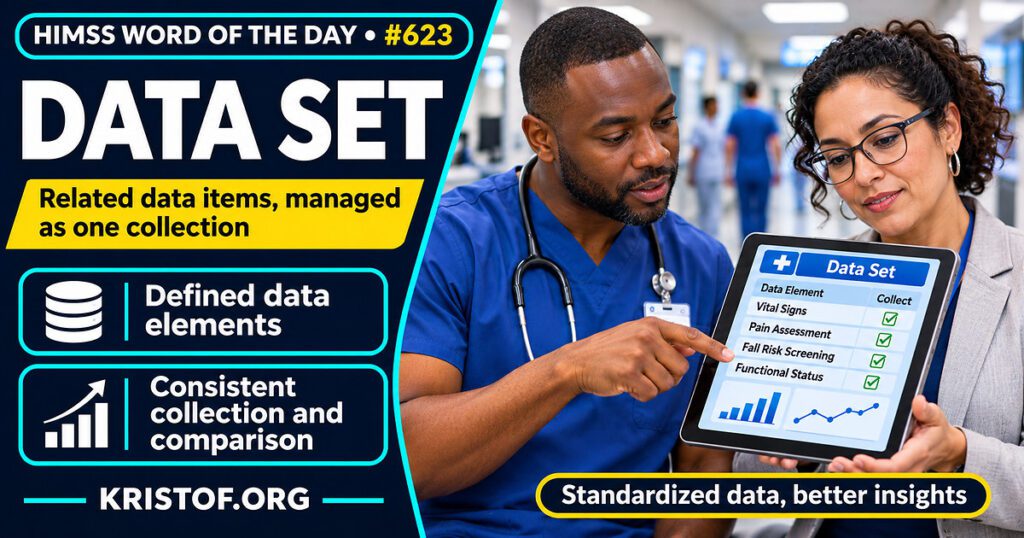
The HIMSS Dictionary describes a data set as a collection of related data items that can be used one at a time, in combination, or managed as a single whole. It names the Uniform Hospital Discharge Data Set (UHDDS) as an example and points readers to the Perioperative Nursing Data Set, the Nursing Minimum Data Set, and the Nursing Management Minimum Data Set. The entry also notes that analyzing data sets through data mining can reveal patterns used to estimate the likelihood of future events.
In everyday use the word has two meanings. One is a defined list of items that organizations agree to collect, such as a minimum data set. The other is a collection of records assembled for analysis, such as the table a data analyst loads for a quality project. Both senses appear in healthcare, and context tells them apart.
| Item | Detail |
|---|---|
| What it is | A defined collection of related data items managed as a unit |
| Named examples | UHDDS, Nursing Minimum Data Set, Nursing Management Minimum Data Set, and OASIS |
| Common purpose | Consistent collection and comparison across settings or over time |
| Related terms | Data element, minimum data set, registry, and database |
| HIPAA use | A limited data set is protected health information with certain direct identifiers removed |
⚠️ Exam Alert: A data set is a group of items, a data element is a single item, and a database is the system that stores data. A limited data set is a HIPAA term and is not the same as a de-identified data set. Under 45 CFR 164.514, a limited data set excludes listed direct identifiers but may be used only for research, public health, or health care operations, and only under a data use agreement.
🌐 Why It Matters: Real-World Healthcare IT Context
Agreeing on what to collect is often harder than collecting it. A shared data set lets organizations compare results, pool data, and avoid reinventing a form for every project.
How named data sets work. The Nursing Minimum Data Set (NMDS) was described by Werley and colleagues in 1991 as the first attempt to standardize collection of essential nursing data, intended to let nurses compare data across populations, settings, and time. That is a 1991 paper, so it describes the original concept and not current practice. The CMS site hosts the Outcome and Assessment Information Set (OASIS) as a library of instrument documents for home health, with draft and final versions, change tables, and effective dates, so users can see exactly which items applied when.
How a limited data set differs. The eCFR text of 45 CFR 164.514 describes a limited data set as protected health information from which direct identifiers such as names, street addresses, and listed record numbers have been removed. It may be used only for research, public health, or health care operations, and the recipient must sign a data use agreement that restricts further use and prohibits identifying the individuals.
How analysts use the other meaning. The dictionary’s mention of data mining points to the second sense of the word, a collection of records assembled for analysis. An analyst building such a set still has to decide which records, which fields, and which time window to include, and each choice shapes what the results can say. A well-documented data set records those decisions so another team can reproduce the work.
What studies show. Two 2026 papers show how minimum data sets are developed and how much they vary.
- Muller and colleagues (2026) ran a scoping review of the Nursing Minimum Data Set. From 1,908 articles identified, 26 met the inclusion criteria. The abstract reports that data sets ranged from 16 to 145 items and that four domains appeared consistently: patient demographics, medical care information, nursing care elements, and institutional or organizational data. It also describes development as typically participatory and multistage, and notes there is no international consensus on core content. This is a scoping review, so it maps the literature and does not judge quality.
- Moulaei and colleagues (2026) developed a minimum data set for total joint arthroplasty registries. A 17-member expert panel used a two-round Delphi survey, with items kept at 80% agreement or higher. The abstract reports that 154 elements found in the literature were narrowed to 136 by expert consensus and then to 111 after validity calculations. This is a single mixed-methods study in one specialty, so the numbers belong to that registry design.
Common data set problems:
- Treating a data set, a data element, and a database as interchangeable
- Assuming two organizations’ minimum data sets contain the same items
- Collecting items that nobody uses
- Using a limited data set without a data use agreement
- Forgetting that instruments such as OASIS change by version and effective date
- Building a data set without input from the clinicians who will record it
What supports good data set practice:
- Agreed definitions for each item, including allowed values
- A participatory development process with clinician review
- Version control and effective dates
- Mapping to standard terminologies where possible
- Governance for who may receive and use the data
🏥 The Nurse’s Perspective: Clinical, Bedside, & Workflow
Nurses fill in data sets all day without calling them that. Every required assessment field belongs to some defined collection.
At the Bedside
Assessments such as home health instruments or admission screens are data sets in practice, with a fixed list of items and allowed answers. Complete and consistent entries are what make later comparison possible. The Werley paper framed the nursing version as a way for nurses to compare data across settings.
In Clinical Workflow
Nurse informaticists help decide which items belong in a set, what each one means, and where it is documented. The Muller review suggests that the best-supported development approaches are participatory, which fits informatics practice of involving staff nurses before a build is final.
In EHR Implementation (Go-Live Perspective)
During an Epic Go-Live, analysts at the elbow hear questions such as why a field is required or why a screen asks for the same fact twice. Many of those answers trace back to a regulatory instrument or registry data set. This post does not claim that any specific build was driven by a particular data set.
🎓 CAHIMS / CPHIMS & HIMSS Perspective
CAHIMS Exam Domain Mapping
Data sets support data management and reporting knowledge:
| CAHIMS Domain | How Data Set Appears |
|---|---|
| Healthcare & Technology Environments | Standard data sets, instruments, and reporting programs |
| Clinical Informatics | Clinical documentation items and minimum data sets |
| Healthcare Information & Systems Management | Data governance, versioning, and data use agreements |
| Management & Leadership | Stakeholder engagement in defining what is collected |
Key Terms to Know Alongside Data Set
- NMDS (Nursing Minimum Data Set) — a standardized set of essential nursing data elements
- NMMDS (Nursing Management Minimum Data Set) — a set of essential data elements about the nursing management environment
- OASIS (Outcome and Assessment Information Set) — an assessment instrument used in home health quality reporting
- Limited data set — protected health information with specified direct identifiers removed, shared under a data use agreement
- USCDI (U.S. Core Data for Interoperability) — a standardized set of health data classes and elements for exchange
- Data element — a single named item of data with a defined meaning
HIMSS Organizational Position
HIMSS offers education and research on health information and technology topics through its Resource Center. Members can find related information on the HIMSS Resource Center page.
🧭 More HIMSS Word of The Day Terms
Related terms in the Data and Analytics series:
Browse all Data and Analytics terms or the A–Z glossary.
🔗 Explore Further: External References
- CMS — OASIS Data Sets https://www.cms.gov/medicare/quality/home-health/oasis-data-sets
- eCFR — 45 CFR 164.514, Other Requirements Relating to Uses and Disclosures https://www.ecfr.gov/current/title-45/subtitle-A/subchapter-C/part-164/subpart-E/section-164.514
- Werley et al. (1991), American journal of public health — The Nursing Minimum Data Set: abstraction tool for standardized, comparable, essential data https://pubmed.ncbi.nlm.nih.gov/2003618/
- Muller et al. (2026), JMIR medical informatics — Core Elements, Development, and Implementation Strategies of the Nursing Minimum Data Set: Scoping Review https://pubmed.ncbi.nlm.nih.gov/41773669/
- Moulaei et al. (2026), BMC musculoskeletal disorders — Development and validation of a minimum data set for total joint arthroplasty registries https://pubmed.ncbi.nlm.nih.gov/42323606/
- HIMSS — Resource Center https://www.himss.org/resource-center
Term source: HIMSS Dictionary of Health Information and Technology Terms, Acronyms, and Organizations, 6th Edition (2025). All definitions in this series are paraphrased for editorial purposes. Readers are encouraged to consult the primary source for exact language.
Eric Andrew Kristof, RN, CAHIMS is a Healthcare IT professional and HIMSS Arkansas Chapter member based in Hot Springs Village, AR, with hands-on Epic Go-Live experience and a diverse healthcare and IT background. He writes at kristof.org at the intersection of clinical care and healthcare technology.
Leave a Reply