By Eric Andrew Kristof, RN, CAHIMS | Healthcare IT Professional | HIMSS Arkansas Chapter Member
About This Series: The HIMSS Word of The Day is a running blog series drawing from the HIMSS Dictionary of Health Information and Technology Terms, Acronyms, and Organizations, 6th Edition (2025) — the authoritative reference for healthcare IT professionals and the primary study resource for CAHIMS and CPHIMS certification. Each post paraphrases the term in plain language, grounds it in real-world healthcare IT context, and adds a bedside nursing perspective you won’t find in a textbook.
📖 The Term: Cost-Effectiveness
Source: HIMSS Dictionary of Health Information and Technology Terms, Acronyms, and Organizations, 6th Edition (2025)
🔍 Plain-Language Definition
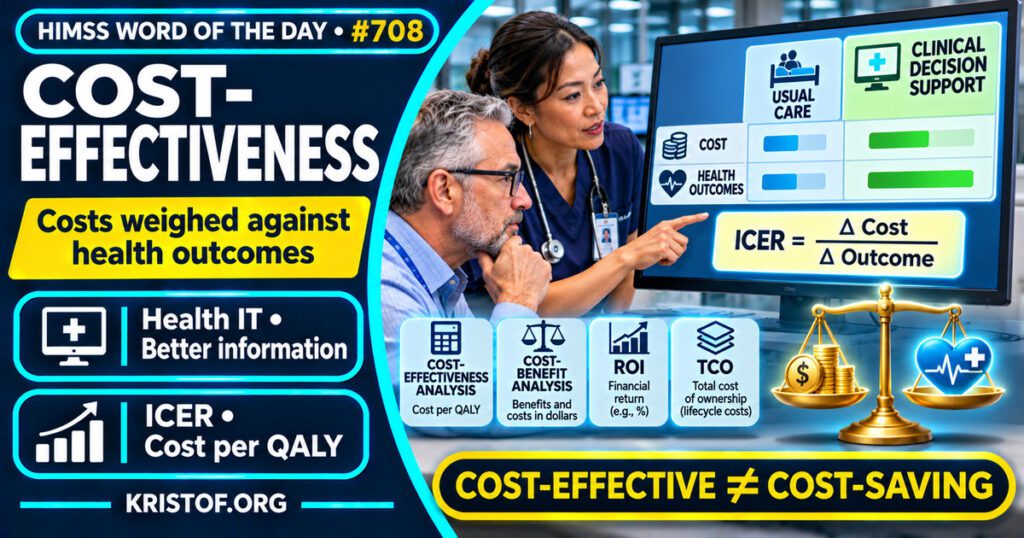
The HIMSS Dictionary uses cost-effectiveness for a health information system that helps lower the cost of care. It says the system does this by collecting, storing, and combining data efficiently and by supplying decision support and timely information that improves practice. That is a description of a system’s contribution, not a calculation.
Health economics uses the same word more narrowly. A cost-effectiveness analysis compares the costs and health results of different options, often as the extra cost for each unit of health gained, such as a quality-adjusted life year (QALY). Both senses appear in health IT conversations, so it helps to know which one a speaker means.
| Term | Question it asks | Typical output |
|---|---|---|
| Cost-effectiveness (dictionary sense) | Does the system help reduce the cost of care? | A description, no formula |
| Cost-effectiveness analysis | How much extra cost buys one unit of health outcome? | A ratio such as cost per QALY |
| Cost-benefit analysis | Do the benefits, counted in money, exceed the costs? | Net benefit or net cost |
| Return on investment | What financial return does the organization get? | A percentage or ratio |
| Total cost of ownership | What does the system cost over its life? | A total cost, no outcome |
⚠️ Exam Alert: Cost-effective is not the same as cost-saving. A cost-effectiveness analysis can find that an option costs somewhat more and is still worth it for the health gained. Cost-benefit analysis puts benefits in dollars, return on investment looks at the organization’s financial return, and total cost of ownership counts costs only. Expect questions that ask which measure fits a scenario.
🌐 Why It Matters: Real-World Healthcare IT Context
This section draws on five studies, mostly reviews and models, and one set of methods recommendations. Most are older and were read as abstracts only, so they show how the question has been studied and not what any one hospital should expect.
Reviews of costs and savings. Chaudhry et al. (2006) reviewed 257 studies of health IT and found benefits in guideline adherence, monitoring, and medication errors. They noted that empirical cost data were limited, that about 25% of studies came from 4 academic institutions with internally developed systems, and that it was unclear whether other institutions could achieve similar benefits and at what cost. Buntin et al. (2011) reported that 92% of recent articles they reviewed reached positive conclusions overall, while noting that provider dissatisfaction with electronic health records remained a barrier. A high share of positive articles is not the same as proof of cost-effectiveness, since the abstract does not say how many studied costs.
Modeled savings. Hillestad et al. (2005) estimated that effective electronic medical record implementation and networking could eventually save more than $81 billion annually, and that health IT-enabled prevention and management of chronic disease could eventually double those savings. They added that this is unlikely without related changes to the health care system. This is a projection from a model, not a measured result, and I did not check whether it has been revised since 2005.
A cost-benefit model with a wide range. Wang et al. (2003) built a cost-benefit model of electronic medical records in primary care from the organization’s perspective, comparing them with paper records, using data from their own institution and the literature. The estimated net benefit was $86,400 per provider over 5 years, driven by drug expenditures, radiology use, charge capture, and billing errors. Under the most pessimistic and optimistic assumptions together, results ranged from a $2,300 net cost to a $330,900 net benefit. The range matters as much as the average. These are 2003 dollars and are not adjusted.
Method guidance. Sanders et al. (2016) reported the Second Panel on Cost-Effectiveness in Health and Medicine’s recommendations. They recommend that analyses report two reference cases, one from a health care sector perspective and one from a societal perspective, and use an impact inventory, a structured table of the consequences counted.
A recent health IT example. Persson Lindell et al. (2025) modelled the cost-effectiveness of a clinical decision support system for atrial fibrillation, using the effect reported in a primary care trial in Östergötland, Sweden. In a simulated lifetime cohort, the system led to fewer ischemic strokes but more bleeding events, with a mean gain of 0.012 QALYs per patient and an incremental cost-effectiveness ratio of €963 per QALY gained, against a threshold of €50,000. A positive ratio of that size implies the strategy cost slightly more than standard care while gaining health, so cost-effective did not mean cost-saving here. That reading is my inference from the reported ratio. The result depends on a model, one trial, and Swedish costs, so it does not transfer directly to other settings.
What I could not confirm. I did not find a source that defines cost-effectiveness the way the HIMSS Dictionary does, and the dictionary’s sense appears to be descriptive. I read abstracts and not full texts. The 2003 and 2005 dollar figures are not adjusted for inflation and should not be quoted as current. I did not review critiques of the RAND-style projections.
Common cost-effectiveness problems:
- Treating cost-effective as a synonym for cheap or cost-saving
- Mixing up cost-effectiveness analysis, cost-benefit analysis, ROI, and total cost of ownership
- Counting license fees and missing implementation, training, and maintenance costs
- Applying one site’s savings estimate to every organization
- Presenting a model’s projection as a measured result
What supports cost-effectiveness claims:
- A clear comparison, such as a paper record or standard care
- A stated perspective, such as the health care sector or society
- Sensitivity analyses that show how results move with assumptions
- Outcome measures such as QALYs where health gains are claimed
- Costs measured empirically, which Chaudhry et al. found were limited
🏥 The Nurse’s Perspective: Clinical, Bedside, & Workflow
No study reviewed here measured nurses, so the points below are workflow context and not research findings.
At the Bedside
The dictionary’s sense of cost-effectiveness points to decision support and timely information, which nurses meet as alerts, reminders, and data at the point of care. Time at the bedside is a cost too, and a tool that adds clicks can shift cost onto nursing time even when it looks efficient on a budget sheet. That concern is an inference, since the studies above did not measure nursing time.
In Clinical Workflow
Nurse informaticists are often asked for the assumptions that drive a business case, such as minutes per task, volumes, and how many units are affected. The sensitivity ranges in the cost-benefit model show why these inputs matter: results swung from a net cost to a large net benefit as assumptions changed. Clear workflow data make an estimate more honest.
In EHR Implementation (Go-Live Perspective)
During an Epic Go-Live, analysts and at-the-elbow support staff see the costs that a license fee does not show: training hours, backfill for classes, extra support staffing, and time lost while users learn new screens. This is context from workflow experience, and the sources reviewed do not itemize go-live costs.
🎓 CAHIMS / CPHIMS & HIMSS Perspective
CAHIMS Exam Domain Mapping
Cost-effectiveness connects health economics, decision support, and the business case for technology:
| CAHIMS Domain | How Cost-Effectiveness Appears |
|---|---|
| Healthcare & Technology Environments | Payment and economic pressures on health care organizations |
| Clinical Informatics | Decision support judged by outcomes and costs |
| Healthcare Information & Systems Management | Business cases, total cost of ownership, and benefits realization |
| Management & Leadership | Budgeting, ROI, and ranking competing investments |
Key Terms to Know Alongside Cost-Effectiveness
- Cost-Benefit Analysis — compares costs and benefits counted in money
- Total Cost of Ownership — the full cost of acquiring and running a system over its life
- Return on Investment — the financial return relative to what was spent
- Clinical Decision Support System — software that supplies clinicians with knowledge and patient-specific information
- Incremental Cost-Effectiveness Ratio — the extra cost per extra unit of health gained compared with an alternative
- Quality-Adjusted Life Year — a unit that combines length and quality of life
HIMSS Organizational Position
HIMSS offers education and research on health information and technology topics through its Resource Center. Members can find related information on the HIMSS Resource Center page.
🧭 More HIMSS Word of The Day Terms
Related terms in the Value-Based Care series:
- Care Coordination
- CQM (Clinical Quality Measures)
- CPC (Comprehensive Primary Care Initiative)
- Underuse (Overuse, Underuse, and Misuse)
Browse all Value-Based Care terms or the A–Z glossary.
🔗 Explore Further: External References
- Chaudhry et al. (2006), Annals of Internal Medicine — Systematic review: impact of health information technology on quality, efficiency, and costs of medical care. https://pubmed.ncbi.nlm.nih.gov/16702590/
- Buntin et al. (2011), Health Affairs — The benefits of health information technology: a review of the recent literature shows predominantly positive results. https://pubmed.ncbi.nlm.nih.gov/21383365/
- Hillestad et al. (2005), Health Affairs — Can electronic medical record systems transform health care? Potential health benefits, savings, and costs. https://pubmed.ncbi.nlm.nih.gov/16162551/
- Wang et al. (2003), The American Journal of Medicine — A cost-benefit analysis of electronic medical records in primary care. https://pubmed.ncbi.nlm.nih.gov/12714130/
- Sanders et al. (2016), JAMA — Recommendations for Conduct, Methodological Practices, and Reporting of Cost-effectiveness Analyses: Second Panel on Cost-Effectiveness in Health and Medicine. https://pubmed.ncbi.nlm.nih.gov/27623463/
- Persson Lindell et al. (2025), European Heart Journal Digital Health — Cost-effectiveness of a clinical decision support system for atrial fibrillation: an RCT-based modelling study. https://pubmed.ncbi.nlm.nih.gov/40984984/
- HIMSS — Resource Center https://www.himss.org/resource-center
Term source: HIMSS Dictionary of Health Information and Technology Terms, Acronyms, and Organizations, 6th Edition (2025). All definitions in this series are paraphrased for editorial purposes. Readers are encouraged to consult the primary source for exact language.
Eric Andrew Kristof, RN, CAHIMS is a Healthcare IT professional and HIMSS Arkansas Chapter member based in Hot Springs Village, AR, with hands-on Epic Go-Live experience and a diverse healthcare and IT background. He writes at kristof.org at the intersection of clinical care and healthcare technology.
Leave a Reply