By Eric Andrew Kristof, RN, CAHIMS | Healthcare IT Professional | HIMSS Arkansas Chapter Member
About This Series: The HIMSS Word of The Day is a running blog series drawing from the HIMSS Dictionary of Health Information and Technology Terms, Acronyms, and Organizations, 6th Edition (2025) — the authoritative reference for healthcare IT professionals and the primary study resource for CAHIMS and CPHIMS certification. Each post paraphrases the term in plain language, grounds it in real-world healthcare IT context, and adds a bedside nursing perspective you won’t find in a textbook.
📖 The Term: Lifecycle
Source: HIMSS Dictionary of Health Information and Technology Terms, Acronyms, and Organizations, 6th Edition (2025)
🔍 Plain-Language Definition
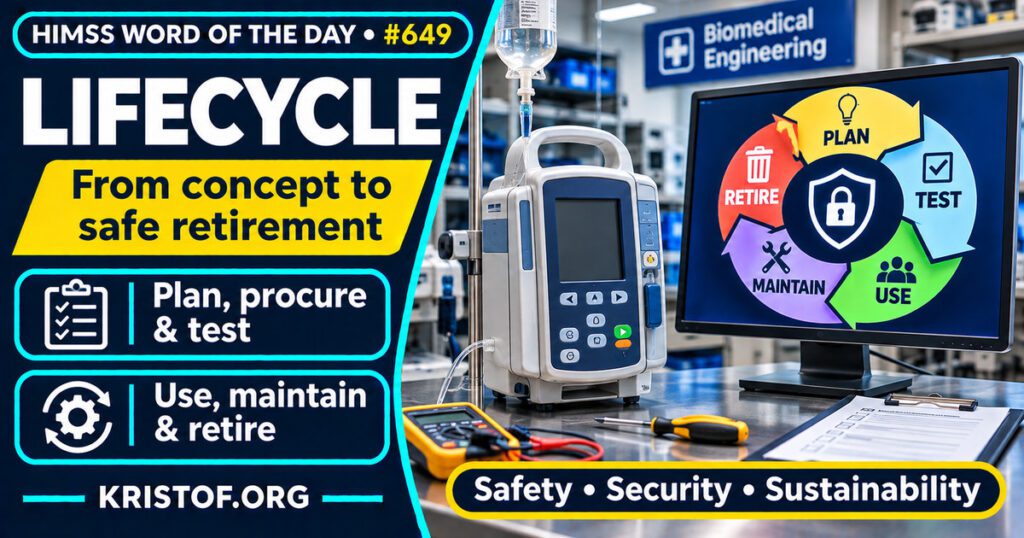
The HIMSS Dictionary uses lifecycle to mean every phase in the existence of a medical device or system, beginning with the original idea and ending when the item is taken out of service and disposed of. The point of the term is that a device or system is a long chain of decisions, not a single purchase.
FDA describes a version of this idea for devices. According to its Total Product Life Cycle page, current as of September 2023, the Total Product Life Cycle (TPLC) approach is an oversight model that covers a device from design and development through real-world use, and it organizes agency staff into teams that handle premarket and postmarket work together. The same page says FDA’s TPLC database combines premarket and postmarket information about devices.
Hospitals manage a different slice of the lifecycle. An EFOMP policy statement (van Asten and colleagues, 2023) lists the stages a healthcare organization works through: establishing requirements with use-case assessment, investment planning, procurement, acceptance testing for safety and performance, quality management, safe and effective use and maintenance, user training, interfacing with IT systems, and safe decommissioning and removal. EFOMP is a European medical physics organization, so the list reflects that field’s view.
This is wider than the Systems Development Life Cycle (SDLC), which concerns how software is built. A lifecycle in the dictionary’s sense also covers buying, testing, using, maintaining, and retiring.
| Stage (grouped for readability) | What EFOMP lists |
|---|---|
| Plan and select | Requirements and use-case assessment, investment planning, procurement |
| Accept and start | Acceptance testing, user training |
| Run and maintain | Quality management, effective and safe use, maintenance |
| Connect | Interfacing with IT systems |
| Retire | Safe decommissioning and removal |
The grouping in the left column is this post’s own, for readability. The stages come from the EFOMP statement.
⚠️ Exam Alert: Lifecycle means all phases from concept to disposal. The SDLC covers how software is developed. TPLC is FDA’s approach to overseeing devices from design through real-world use. Decommissioning is the final stage, not an afterthought.
🌐 Why It Matters: Real-World Healthcare IT Context
Lifecycle thinking matters in health IT because devices and systems affect patients long after the purchase order, and many problems appear in use, maintenance, and retirement.
What studies show. The EFOMP policy statement (van Asten and colleagues, 2023), in Physica Medica, describes lifecycle management as work done by multidisciplinary teams in healthcare organizations and argues that medical physics professionals can play a role at every stage. It says that involving them is likely to improve effective use, safety, and sustainability of the investment. This is a professional body’s policy statement, and the abstract gives no measured results.
Vaezzadeh and colleagues (2026), in Clinical Therapeutics, wrote a narrative review of device safety across the product lifecycle, drawing on a structured literature search of PubMed and ScienceDirect. They say device-related harm may arise from malfunction, device deficiency, use error, operator dependence, procedural factors, environmental conditions, maintenance practices, or workflow failures, so safety oversight needs a broader socio-technical framework. They also describe a shift from retrospective, passive reporting toward more proactive, real-time, and lifecycle-based evidence. A narrative review summarizes and interprets the literature and does not pool data.
Jones and Katzis (2017), in Studies in Health Technology and Informatics, say that protecting connected medical devices from cyber threats needs a continuous lifecycle approach in which cybersecurity is built into the product development lifecycle and reinforces safety risk management. Their short article reviews guidance. Pecoraro and Luzi (2014), in Methods of Information in Medicine, propose a framework that integrates risk management into the lifecycle of medical device software and say it requires both medical and software engineering competence. Their paper compares US and European regulations as they stood in 2014, and this post did not review current rules.
FDA’s own database pages add a caution about the data. They say the TPLC database links premarket and postmarket information by a three-letter product code, and that entries without a code are left out. They also say adverse event reports cannot establish event rates for a product or compare products, and that a report does not mean the device caused the event. The two FDA pages differ slightly in which data sources they list, which suggests the database has changed over time, so check the live pages before relying on a detail.
What I could not find. I did not find hospital-level data on how often devices are retired on schedule, or evidence that formal lifecycle programs improve patient outcomes. I did not read the IEC 62304 software lifecycle standard, which is not freely available, or current FDA premarket cybersecurity guidance. I also did not review how EHR and other IT systems are upgraded and retired in depth.
Common lifecycle problems:
- Treating the lifecycle as ending at purchase or go-live
- Adding cybersecurity late instead of throughout
- Maintenance or workflow failures contributing to device-related harm
- Reading adverse event reports as if they gave event rates
- Leaving IT interfacing until after a device is bought
- Unclear roles across the multidisciplinary teams EFOMP describes
What supports sound lifecycle practice:
- Defining requirements and use cases before procurement
- Acceptance testing for safety and performance before clinical use
- Ongoing maintenance, quality management, and user training
- Planning IT interfacing as a named step
- Planning safe decommissioning and removal from the start
- Building risk management and cybersecurity into every stage
- Using postmarket data with its limits in mind
🏥 The Nurse’s Perspective: Clinical, Bedside, & Workflow
Nurses use devices at every stage after delivery, so lifecycle decisions made earlier shape their daily work.
At the Bedside
Nurses see the effects of earlier lifecycle choices: which device is on the unit, how well users were trained, and whether it is maintained. The EFOMP statement names user training and safe, effective use as lifecycle stages. FDA’s database pages note that an adverse event report does not by itself show that a device caused an event, so the first practical step is to report problems to the right internal team and let them investigate.
In Clinical Workflow
Nurse informaticists can join device selection and testing, where bedside needs, IT interfaces, and training plans meet. The EFOMP list includes interfacing with IT systems as its own stage, which is a reminder to ask early how a device will connect to the chart. Retirement matters as well: removing a device from service is a planned step, not a quiet disappearance from the unit.
In EHR Implementation (Go-Live Perspective)
During an Epic Go-Live, device integration is tested alongside the build. Analysts at the elbow hear device questions as clinical ones, such as why a value is missing or late. This post does not claim that any specific go-live involved a lifecycle failure. It shows why interfaces and training belong in the plan well before launch.
🎓 CAHIMS / CPHIMS & HIMSS Perspective
CAHIMS Exam Domain Mapping
Lifecycle thinking connects planning, safety, and governance:
| CAHIMS Domain | How Lifecycle Appears |
|---|---|
| Healthcare & Technology Environments | Devices and systems in the clinical environment and their regulation |
| Clinical Informatics | Safe use, training, and device-to-chart connections |
| Healthcare Information & Systems Management | Procurement, acceptance testing, maintenance, cybersecurity, and decommissioning |
| Management & Leadership | Governance, multidisciplinary teams, and budgeting for the full lifecycle |
Key Terms to Know Alongside Lifecycle
- Systems Development Life Cycle (SDLC) — the phases used to plan, build, test, and deploy software
- Total Product Life Cycle (TPLC) — FDA’s approach to overseeing a device from design through real-world use
- Decommissioning — taking a device or system out of service safely
- Acceptance testing — checking a device’s safety and performance before it is used with patients
- Postmarket surveillance — monitoring a device after it is available for use
- Risk management — identifying and controlling hazards across the lifecycle
HIMSS Organizational Position
HIMSS offers education and research on health information and technology topics through its Resource Center. Members can find related information on the HIMSS Resource Center page.
🧭 More HIMSS Word of The Day Terms
Related terms in the IT Infrastructure series:
Browse all IT Infrastructure terms or the A–Z glossary.
🔗 Explore Further: External References
- FDA — Total Product Life Cycle for Medical Devices https://www.fda.gov/about-fda/cdrh-transparency/total-product-life-cycle-medical-devices
- FDA — Total Product Life Cycle (TPLC) Data Sources and Disclaimers https://www.fda.gov/about-fda/cdrh-transparency/total-product-life-cycle-tplc-data-sources-and-disclaimers
- van Asten et al. (2023), Physica Medica — EFOMP policy statement 17: The role and competences of medical physicists and medical physics experts in the different stages of a medical device life cycle https://pubmed.ncbi.nlm.nih.gov/36905774/
- Vaezzadeh et al. (2026), Clinical Therapeutics — Medical Device Safety Throughout the Product Lifecycle: Regulatory Frameworks, Digital Transformation, and the Role of Artificial Intelligence in Devices and Monitoring https://pubmed.ncbi.nlm.nih.gov/42749521/
- Jones and Katzis (2017), Studies in Health Technology and Informatics — Cybersecurity and the Medical Device Product Development Lifecycle https://pubmed.ncbi.nlm.nih.gov/28679891/
- Pecoraro and Luzi (2014), Methods of Information in Medicine — The integration of the risk management process with the lifecycle of medical device software https://pubmed.ncbi.nlm.nih.gov/24190098/
- HIMSS — Resource Center https://www.himss.org/resource-center
Term source: HIMSS Dictionary of Health Information and Technology Terms, Acronyms, and Organizations, 6th Edition (2025). All definitions in this series are paraphrased for editorial purposes. Readers are encouraged to consult the primary source for exact language.
Eric Andrew Kristof, RN, CAHIMS is a Healthcare IT professional and HIMSS Arkansas Chapter member based in Hot Springs Village, AR, with hands-on Epic Go-Live experience and a diverse healthcare and IT background. He writes at kristof.org at the intersection of clinical care and healthcare technology.
Leave a Reply