By Eric Andrew Kristof, RN, CAHIMS | Healthcare IT Professional | HIMSS Arkansas Chapter Member
About This Series: The HIMSS Word of The Day is a running blog series drawing from the HIMSS Dictionary of Health Information and Technology Terms, Acronyms, and Organizations, 6th Edition (2025) — the authoritative reference for healthcare IT professionals and the primary study resource for CAHIMS and CPHIMS certification. Each post paraphrases the term in plain language, grounds it in real-world healthcare IT context, and adds a bedside nursing perspective you won’t find in a textbook.
📖 The Term: Leapfrog Group
Source: HIMSS Dictionary of Health Information and Technology Terms, Acronyms, and Organizations, 6th Edition (2025)
🔍 Plain-Language Definition
The HIMSS Dictionary lists the Leapfrog Group in its organizations appendix as a voluntary program that uses the buying power of employers to signal that major gains in safety, quality, and value in health care will be recognized and rewarded.
Leapfrog’s own About page describes it today as a national nonprofit that collects, analyzes, and publishes data on the safety and quality of U.S. health care. The page says Leapfrog was founded in 2000 by large employers and other purchasers, and the page footer describes it as a registered 501(c)(3) nonprofit. These are Leapfrog’s statements about itself, and I did not check them against an independent source.
| Item | Detail |
|---|---|
| Type | Nonprofit that publishes hospital safety and quality data (Leapfrog’s About page) |
| Founded | 2000 (Leapfrog’s About page) |
| Main programs | Hospital Survey, Hospital Safety Grade, Value-Based Purchasing Program, and Ambulatory Surgery Center Survey (About page) |
| Hospital Survey | A voluntary survey on safety, quality, and resource use |
| Hospital Safety Grade | An A, B, C, D, or F letter grade for most general hospitals, updated twice a year (Safety Grade FAQ) |
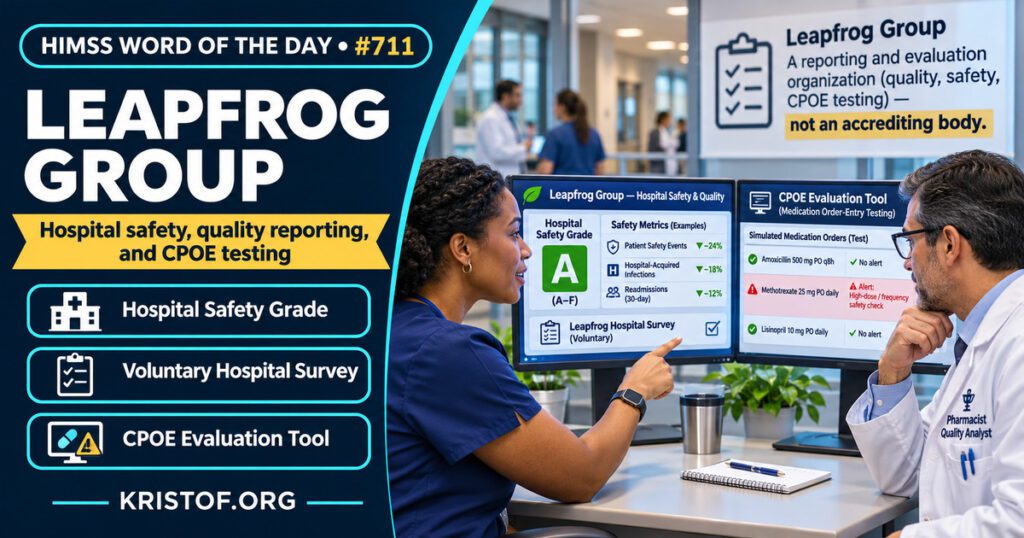
| Health IT link | A CPOE standard and the CPOE Evaluation Tool, a test that uses simulated patients and medication orders |
| Relation to HIMSS | Separate organization |
⚠️ Exam Alert: The Leapfrog Hospital Survey and the Leapfrog Hospital Safety Grade are different programs. The survey is a voluntary questionnaire that hospitals complete, and the Safety Grade is a letter grade that Leapfrog assigns. The CPOE Evaluation Tool is a test inside the survey, and a hospital can have CPOE in place and still score poorly on it. The pages reviewed describe Leapfrog as publishing data, not as an accrediting body, so keep it separate from accreditation and from CMS programs.
🌐 Why It Matters: Real-World Healthcare IT Context
Because Leapfrog is an organization and not a research topic, this section draws on Leapfrog’s own pages and three peer-reviewed studies. Leapfrog’s pages show what it says about itself and are not an independent evaluation.
The Safety Grade. Leapfrog’s Safety Grade FAQ says the grade is assigned to most general U.S. hospitals and updated twice a year, in the fall and spring. It says most of the data come from the Centers for Medicare and Medicaid Services (CMS), with some from the annual Leapfrog Hospital Survey, and that the grade is calculated by experts under the guidance of a National Expert Panel that reviews the method. The same FAQ says that, because of a ruling by a federal court in South Florida that Leapfrog is appealing, Leapfrog is not assigning fall 2026 grades to about 450 hospitals that did not take part in the 2025 or 2026 survey. Those hospitals are shown as Grade Not Assigned. I did not review the ruling or the case, and the status may change.
The CPOE standard and test. Leapfrog’s CPOE fact sheet, last revised April 1, 2026, says a hospital meets the standard when at least 85% of inpatient medication orders are entered through a computer system with prescribing-error prevention software, and when that system alerts prescribers to at least 60% of common, serious prescribing errors on a test. It says the standard applies to adult and general hospitals only, and that the CPOE Evaluation Tool was designed by medication safety experts and researchers at Brigham and Women’s Hospital and the University of Utah. Hospitals download a series of test patients and medication orders, enter them into their own system, and report the alerts their prescribers received. The score is the percentage of correct alerts in specific categories.
What the test shows. Classen et al. (2020) studied hospitals that used the National Quality Forum Health IT Safety Measure CPOE test, which Leapfrog administers, between 2009 and 2018. Across 8,657 hospital-years, the mean overall score rose from 53.9% in 2009 to 65.6% in 2018. Scores for basic decision support categories rose from 69.8% to 85.6%, and for advanced categories from 29.6% to 46.1%. The authors report considerable variation by EHR vendor and conclude that substantial safety risk persists. This is a case series of participating hospitals, so it does not describe every U.S. hospital.
Does public reporting change anything? Holmgren and Bates (2021) studied 1,183 hospitals that took the CPOE test in 2017 and 2018, using a regression discontinuity design. Mean baseline score was 59.3%. Hospitals that received negative feedback improved 8.44 percentage points more the next year than hospitals that received positive feedback on the same test (95% CI 0.09 to 16.80). The gain was driven by basic decision support, and the advanced-category estimate was not distinguishable from zero. The study is described as nonrandomized, and the effect interval is wide.
Do rating systems agree? Hota et al. (2020) compared five hospital rating systems, including the Leapfrog Hospital Safety Grade and the CMS Star Rating, with rank correlations. The highest correlation was between the Safety Grade and the Star Rating, and the authors say a lack of transparency and understanding about the differences complicates use of these measures. They built a composite rank to simplify comparison.
What I could not confirm. I did not verify Leapfrog’s funding, governance, or hospital participation counts, and I read its About page and FAQ through a summarizing tool. I did not check the statistics printed on the CPOE fact sheet against their original studies. One of them, a 55% reduction in error rates from 10.7 to 4.9 per 1,000 patient-days, rounds to about 54% from the sheet’s own numbers, so check any figure before quoting it. The fact sheet copy I read did not name the test’s scoring categories. I read abstracts for the three studies, not full texts. I did not review the South Florida case or its current status.
Common Leapfrog mix-ups:
- Treating the Hospital Survey and the Hospital Safety Grade as one program
- Assuming a hospital with CPOE passes the CPOE test
- Reading a letter grade as a complete measure of care
- Assuming every hospital takes the voluntary survey
- Treating Leapfrog as an accrediting body
What Leapfrog offers:
- Public hospital safety and quality data through the Hospital Survey and the Safety Grade
- A simulated-order test that lets hospitals check their order entry alerts
- A purchaser-focused value-based purchasing program
- A survey for ambulatory surgery centers
🏥 The Nurse’s Perspective: Clinical, Bedside, & Workflow
No study reviewed for this post measured nurses, so the points below are workflow context and not research findings.
At the Bedside
Order entry alerts reach prescribers, but nurses work downstream of them. A medication order that passed through a system with weak decision support still arrives at the point of administration, where nurses are one of the last checks. The studies reviewed do not measure that, so this is an inference. It helps explain why a test of prescribers’ alerts matters to nursing practice.
In Clinical Workflow
The fact sheet describes entering test patients and orders and recording the alerts received, and it does not say who does that work in each hospital. In many organizations, nurse informaticists, pharmacists, and analysts are likely to be involved in reviewing results and tuning alerts, though that is also an inference. The Classen finding that advanced decision support scored much lower than basic categories suggests where a review might look first.
In EHR Implementation (Go-Live Perspective)
During an Epic Go-Live, analysts and at-the-elbow support staff hear alert complaints from clinicians within hours of launch. Test scenarios like those in the CPOE tool give a structured way to check that alerts fire when expected before and after go-live. This is context from workflow experience, and the sources reviewed do not examine go-lives.
🎓 CAHIMS / CPHIMS & HIMSS Perspective
CAHIMS Exam Domain Mapping
The Leapfrog Group connects hospital quality reporting, order entry safety, and the leaders who act on both:
| CAHIMS Domain | How the Leapfrog Group Appears |
|---|---|
| Healthcare & Technology Environments | Voluntary public reporting and purchaser pressure on hospital safety |
| Clinical Informatics | Testing order entry alerts with simulated patients and orders |
| Healthcare Information & Systems Management | Using test results to tune decision support in a live system |
| Management & Leadership | Interpreting public safety ratings and deciding how to respond |
Key Terms to Know Alongside the Leapfrog Group
- CPOE — electronic entry of orders by clinicians, the system the Leapfrog test examines
- Clinical Decision Support System — software that alerts or advises at the point of care, the focus of the test categories
- Adverse Drug Event — harm from a medication, which the test is designed to help prevent
- Electronic Health Record — the system that holds the order entry and alert logic being tested
- Value-Based Purchasing — payment tied to quality, the idea behind Leapfrog’s purchaser program
HIMSS Organizational Position
HIMSS offers education and research on health information and technology topics through its Resource Center. Members can find related information on the HIMSS Resource Center page.
🧭 More HIMSS Word of The Day Terms
Related terms in the Value-Based Care series:
Browse all Value-Based Care terms or the A–Z glossary.
🔗 Explore Further: External References
- The Leapfrog Group — About https://www.leapfroggroup.org/about
- The Leapfrog Group — Factsheet: Computerized Physician Order Entry (last revised April 1, 2026) https://ratings.leapfroggroup.org/sites/default/files/2026-04/2026%20CPOE%20Fact%20Sheet.pdf
- Leapfrog Hospital Safety Grade — Frequently Asked Questions https://www.hospitalsafetygrade.org/frequently-asked-questions
- Classen et al. (2020), JAMA Network Open — National Trends in the Safety Performance of Electronic Health Record Systems From 2009 to 2018. https://pubmed.ncbi.nlm.nih.gov/32469412/
- Holmgren and Bates (2021), JAMA Network Open — Association of Hospital Public Quality Reporting With Electronic Health Record Medication Safety Performance. https://pubmed.ncbi.nlm.nih.gov/34546374/
- Hota et al. (2020), American Journal of Medical Quality — Disagreement Between Hospital Rating Systems: Measuring the Correlation of Multiple Benchmarks and Developing a Quality Composite Rank. https://pubmed.ncbi.nlm.nih.gov/31253048/
- HIMSS — Resource Center https://www.himss.org/resource-center
Term source: HIMSS Dictionary of Health Information and Technology Terms, Acronyms, and Organizations, 6th Edition (2025). All definitions in this series are paraphrased for editorial purposes. Readers are encouraged to consult the primary source for exact language.
Eric Andrew Kristof, RN, CAHIMS is a Healthcare IT professional and HIMSS Arkansas Chapter member based in Hot Springs Village, AR, with hands-on Epic Go-Live experience and a diverse healthcare and IT background. He writes at kristof.org at the intersection of clinical care and healthcare technology.
Leave a Reply