By Eric Andrew Kristof, RN, CAHIMS | Healthcare IT Professional | HIMSS Arkansas Chapter Member
About This Series: The HIMSS Word of The Day is a running blog series drawing from the HIMSS Dictionary of Health Information and Technology Terms, Acronyms, and Organizations, 6th Edition (2025) — the authoritative reference for healthcare IT professionals and the primary study resource for CAHIMS and CPHIMS certification. Each post paraphrases the term in plain language, grounds it in real-world healthcare IT context, and adds a bedside nursing perspective you won’t find in a textbook.
📖 The Term: MITA (Medicaid Information Technology Architecture)
Source: HIMSS Dictionary of Health Information and Technology Terms, Acronyms, and Organizations, 6th Edition (2025)
🔍 Plain-Language Definition
The HIMSS Dictionary describes MITA as a national framework that supports better systems development and healthcare management across the Medicaid enterprise. CMS’s Medicaid.gov page describes it as an initiative to drive joint business and IT modernization across the Medicaid enterprise, backed by CMS and overseen by a MITA Governance Board.
In practice, MITA gives a state Medicaid agency a common way to describe what it does, what data it uses, and what technology supports it, so that it can plan changes and compare itself with a standard model. A 2006 overview in Health Care Financing Review called it a roadmap and toolkit for States to transform their Medicaid Management Information System, or MMIS, into an enterprise-wide, beneficiary-centric system.
| Part of MITA 3.0 (February 2012) | What it covers |
|---|---|
| Business Architecture | The starting point, describing business operations common to state Medicaid enterprises, with a business process model and maturity levels |
| Information Architecture | Data relationships and industry data standards that support the business activities |
| Technical Architecture | Business and technical services, how they connect, and the technology standards behind them |
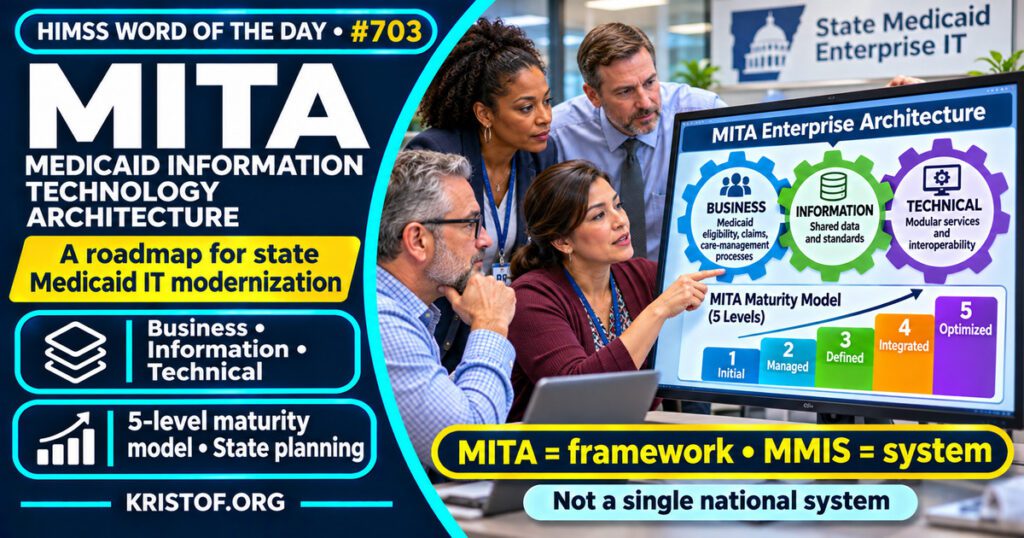
| Maturity Model | Five levels used in a State Self-Assessment to plan movement to higher levels |
⚠️ Exam Alert: MITA here means the Medicaid Information Technology Architecture, which is different from the Medical Imaging and Technology Alliance, an industry trade group that uses the same acronym. MMIS is the claims and management system a state runs, while MITA is the framework used to plan and assess it. Medicaid is administered by states within federal rules, so MITA is not a single national system. Questions may ask which framework guides state Medicaid IT modernization.
🌐 Why It Matters: Real-World Healthcare IT Context
Because MITA is a federal framework and not a clinical intervention, this section draws on CMS and HHS documents, one 2006 peer-reviewed overview, and the 2022 certification letter and guidance. I found no study that tests whether MITA improves Medicaid operations, so the evidence describes the framework and its use in policy.
Why it exists. A 2006 overview by Friedman, in Health Care Financing Review, described MITA as meant to help states align IT opportunities with changing business needs and to address long-standing issues of interoperability, adaptability, and data sharing across organizational boundaries, using models based on nationally accepted technical standards. That article is nearly two decades old and describes the plan at its start. The MITA 3.0 introduction lists aims that include national coordination that still allows for state-specific needs, shared leadership and reuse of solutions, flexible, modular, and interoperable systems aligned with industry standards, and adopting technology only when it serves a clear business need.
Three architectures and funding. MITA 3.0 has three connected architectures: business, information, and technical. The introduction describes the Business Architecture as the place where states map current and future operations and plan their move to higher maturity, the Information Architecture as the link between business needs and the technical messages systems need, and the Technical Architecture as the services and technology standards that support the other two. It also says states use the framework as a template for their own enterprise architectures and use its planning guidance to prepare a State Self-Assessment and a roadmap. The introduction states that, under federal rules effective April 2011 (42 CFR Part 433), states must meet seven standards and conditions to receive enhanced federal matching funds for MMIS and for eligibility and enrollment systems, and that one of them, the MITA condition, requires advancing in MITA maturity for business, architecture, and data.
The maturity model. The MITA Maturity Model defines five levels. At Level 1, the state agency focuses on meeting federal and state requirements, mainly accurate enrollment and timely, accurate claims payment. At Level 2, it focuses on managing costs and improving quality of and access to care. At Level 3, it coordinates with other agencies, adopts national standards, and shares reusable processes. At Level 4, it uses secure access to clinical information to improve health outcomes and supports exchange across state lines. At Level 5, it fine-tunes program management, with national and international interoperability that automates routine operations. States use the model in a State Self-Assessment to describe their business capabilities and plan to move up. Appendix B to the version 3.0 maturity model (a separate document on the same HHS site) says earlier versions did not define Levels 4 and 5, and that the team would refine them as the framework evolved.
Where MITA stands now. CMS’s April 14, 2022 State Medicaid Director Letter introduced Streamlined Modular Certification for Medicaid Enterprise Systems and ended two older certification toolkits. The letter does not mention MITA. The certification guidance mentions MITA in one place, a condition for enhanced funding that requires alignment with MITA maturity for business, architecture, and data and continued advancement in that maturity. The guidance lists that condition among 22 that apply to Medicaid Enterprise Systems modules. I did not find language in these documents about MITA State Self-Assessments being required or retired.
What I could not confirm. The framework documents I read are version 3.0, and I did not verify whether CMS has published a newer version or updated the maturity model since. I read the 2022 letter and guidance through a text extraction tool, so check CMS’s current pages before relying on any requirement. I found no evidence on whether using MITA changed claims accuracy, costs, access, or workload.
Common MITA problems:
- Confusing MITA with the Medical Imaging and Technology Alliance
- Treating MITA as software or a single national system
- Confusing MITA with MMIS, the system itself
- Assuming a state’s maturity level is a quality rating of its Medicaid program
- Assuming the 2022 certification letter retired MITA
What supports MITA:
- A common vocabulary for describing business, data, and technology
- A maturity model that lets states plan stages of improvement
- Links between business needs and technical design
- Ties to federal funding conditions for Medicaid systems
- Reuse of processes and national standards across states
🏥 The Nurse’s Perspective: Clinical, Bedside, & Workflow
No study reviewed measured nurses’ experience with MITA, so this section is workflow context and not evidence.
At the Bedside
Bedside nurses rarely hear about MITA, but they depend on the systems it shapes whenever a patient’s Medicaid coverage, prior authorization, or claim affects care. A delay in verifying coverage or approving a service can change when a patient is discharged or which home services are in place. That is a general workflow observation, not a finding from the sources.
In Clinical Workflow
State Medicaid agencies employ nurses in eligibility, utilization review, case management, and program oversight. Those roles use the business processes MITA describes, such as enrollment, authorization, and care management. A nurse informaticist who joins a state project can help check whether a described process matches how clinical review is done.
In EHR Implementation (Go-Live Perspective)
During an Epic Go-Live, analysts and at-the-elbow support staff see Medicaid-related problems at registration and billing, such as coverage that does not verify or an authorization that does not attach. Those are usually local build or payer issues and not MITA issues. The sources reviewed do not examine go-lives, so this is context only.
🎓 CAHIMS / CPHIMS & HIMSS Perspective
CAHIMS Exam Domain Mapping
MITA connects government programs, system planning, and architecture:
| CAHIMS Domain | How MITA Appears |
|---|---|
| Healthcare & Technology Environments | Medicaid, federal-state programs, and public payers |
| Clinical Informatics | Clinical data sharing across Medicaid systems |
| Healthcare Information & Systems Management | Enterprise architecture, maturity models, and system planning |
| Management & Leadership | Funding conditions, governance, and state-federal coordination |
Key Terms to Know Alongside MITA
- MMIS — the Medicaid Management Information System, the state system that processes claims and manages the program
- Service-Oriented Architecture — a design that builds systems from reusable services
- Interoperability — the ability of systems to exchange and use information
- Health information exchange — the electronic sharing of health information among organizations
- HITECH Act — the 2009 law that funded health IT adoption, including Medicaid incentives
- Cost-Benefit Analysis — a comparison of the costs and benefits of a project
HIMSS Organizational Position
HIMSS offers education and research on health information and technology topics through its Resource Center. Members can find related information on the HIMSS Resource Center page.
🧭 More HIMSS Word of The Day Terms
Related terms in the Healthcare Policy series:
- Covered Entity (HIPAA)
- FFP (Federal Financial Participation)
- CHIP (Children’s Health Insurance Program)
- Prescription Drug Monitoring Program (PDMP)
Browse all Healthcare Policy terms or the A–Z glossary.
🔗 Explore Further: External References
- CMS — Medicaid Information Technology Architecture (Medicaid.gov). https://www.medicaid.gov/medicaid/data-systems/medicaid-information-technology-architecture/index.html
- CMS — MITA Framework 3.0, Part I: Business Architecture, Chapter 3, Maturity Model (February 2012). https://www.hhs.gov/guidance/sites/default/files/hhs-guidance-documents/CMS/part-i-chapter-3-maturity-model-3.0.pdf
- CMS — Introduction to the MITA Framework, Version 3.0. https://www.hhs.gov/guidance/sites/default/files/hhs-guidance-documents/CMS/fm6-introduction-to-the-mita-framework-3.0.pdf
- Friedman (2006), Health Care Financing Review — Medicaid information technology architecture: an overview. https://pubmed.ncbi.nlm.nih.gov/17427840/
- CMS — State Medicaid Director Letter #22-001, Streamlined Modular Certification for Medicaid Enterprise Systems (April 14, 2022). https://www.medicaid.gov/federal-policy-guidance/downloads/smd22001.pdf
- CMS — Streamlined Modular Certification for Medicaid Enterprise Systems Guidance. https://www.medicaid.gov/medicaid/data-and-systems/downloads/smc-certification-guidance.pdf
- HIMSS — Resource Center https://www.himss.org/resource-center
Term source: HIMSS Dictionary of Health Information and Technology Terms, Acronyms, and Organizations, 6th Edition (2025). All definitions in this series are paraphrased for editorial purposes. Readers are encouraged to consult the primary source for exact language.
Eric Andrew Kristof, RN, CAHIMS is a Healthcare IT professional and HIMSS Arkansas Chapter member based in Hot Springs Village, AR, with hands-on Epic Go-Live experience and a diverse healthcare and IT background. He writes at kristof.org at the intersection of clinical care and healthcare technology.
Leave a Reply