By Eric Andrew Kristof, RN, CAHIMS | Healthcare IT Professional | HIMSS Arkansas Chapter Member
About This Series: The HIMSS Word of The Day is a running blog series drawing from the HIMSS Dictionary of Health Information and Technology Terms, Acronyms, and Organizations, 6th Edition (2025) — the authoritative reference for healthcare IT professionals and the primary study resource for CAHIMS and CPHIMS certification. Each post paraphrases the term in plain language, grounds it in real-world healthcare IT context, and adds a bedside nursing perspective you won’t find in a textbook.
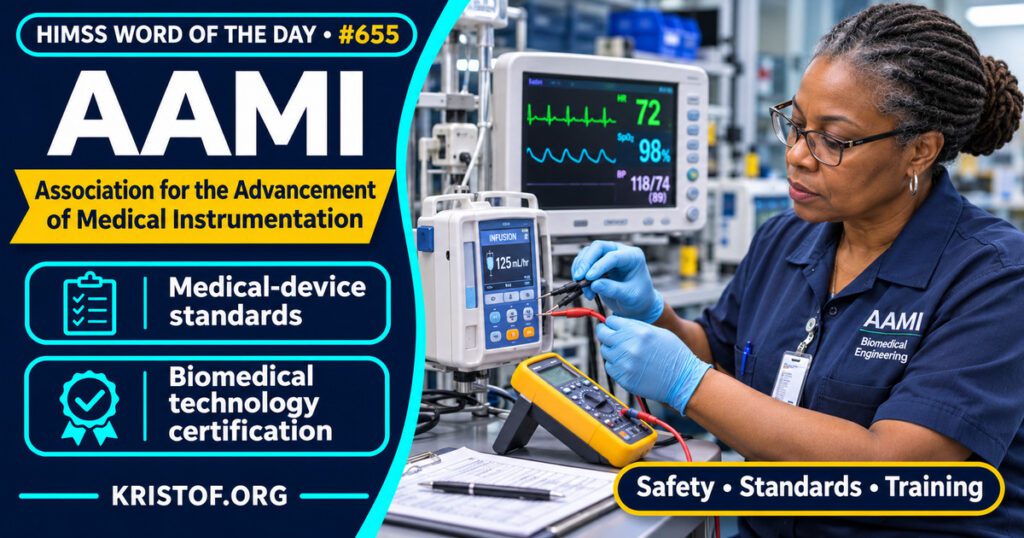
📖 The Term: AAMI (Association for the Advancement of Medical Instrumentation)
Source: HIMSS Dictionary of Health Information and Technology Terms, Acronyms, and Organizations, 6th Edition (2025)
🔍 Plain-Language Definition
The HIMSS Dictionary lists AAMI (Association for the Advancement of Medical Instrumentation) in its organizations appendix. It describes AAMI as an alliance of members, given there as more than 6,000, who share the goal of improving how medical instrumentation is understood and used. That member count is older than AAMI’s own current figure, which is covered below.
AAMI’s home page describes it as a nonprofit community of professionals that works to advance the development, management, and safe, effective use of health technology. The About page states a mission of leading global collaboration toward that goal and reports more than 15,000 members in over 70 countries. The home page says members include clinical engineers, biomedical equipment technicians, sterilization and sterile processing professionals, and early-career engineers, and that companies can also be members. AAMI is headquartered in Arlington, Virginia.
| Item | Detail |
|---|---|
| Type | Nonprofit membership organization and standards developer |
| Founded | 1967 per AAMI’s About page; 1965 per AAMI’s 40th anniversary history book |
| Standards role | Voluntary consensus standards and technical information reports, with over 200 technical committees and working groups, per AAMI |
| Accreditation | AAMI says ANSI accredits it as a standards developer and to administer 18 U.S. technical advisory groups |
| Certification | AAMI Certification Institute offers five credentials: CABT, CBET, CRES, CHTM, and CISS |
| Communities | Healthcare technology management, industry, sterilization, and KiiP, as listed on the About page |
⚠️ Exam Alert: AAMI develops standards and certifies health technology professionals. ANSI accredits standards developers, and ISO and IEC are international bodies. HIMSS issues CAHIMS and CPHIMS. AAMI also should not be confused with AMIA, the informatics association, because the acronyms look alike.
🌐 Why It Matters: Real-World Healthcare IT Context
This section relies on AAMI’s own pages, read directly for this post, and one published consensus statement that AAMI helped produce. None of these is an independent evaluation of AAMI.
History, with a discrepancy. AAMI’s 40th anniversary history book says the organization was founded in 1965 in Boston, that two advertising executives, Robert D. Hall and Robert J. Allen, came up with the idea, and that John Abele joined them. It says they filed articles of organization that June and recruited physicians to give the group credibility. The book adds that AAMI’s leaders often date the real AAMI to 1967, when physician leadership took hold. The About page gives 1967. I read only the first part of the book, up to roughly two-thirds of its length. In that part, the book places the first meeting in Boston in July 1966, and the first published AAMI standard, on electrical safety, in 1971. It also lists the first Certified Biomedical Equipment Technician certificates in 1972. The book’s PDF address returned HTTP 404 to my link checker even though a fetch tool retrieved the text, so I have not listed it in the references. Treat this history as unverified until you can open the document yourself.
Standards. AAMI’s standards page says it has produced voluntary consensus standards, technical information reports, and other documents for almost 60 years. It says volunteers from around the world develop them through more than 200 technical committees and working groups that include manufacturers, testers, servicers, academics, healthcare institutions, clinicians, and government agencies. It also says AAMI runs U.S. committees that feed ISO and IEC work. The page gives no total number of standards and names no specific standard, although the home page mentions ANSI/AAMI ST79 on sterile processing as an example.
Certification and training. AAMI’s certification page lists five credentials from the AAMI Certification Institute: Certified Associate in Biomedical Technology, Certified Biomedical Equipment Technician, Certified Radiology Equipment Specialist, Certified Healthcare Technology Manager, and Certified Industrial Sterilization Specialist. The page gives little per-credential detail, names no accrediting body, and lists two testing windows a year, so confirm dates on the page. The home page also lists courses on topics such as corrective and preventive action requirements, human factors for medical devices, and IEC 60601 compliance.
A published collaboration. Stergiou and colleagues (2018) published a collaboration statement in the Journal of Hypertension on a universal standard for validating blood pressure measuring devices. It says several organizations, including AAMI, the European Society of Hypertension, and ISO, had developed separate validation protocols over 30 years, and that experts from AAMI, the European Society of Hypertension, and ISO agreed to develop one protocol with global acceptance. It states that once the standard is fully developed, it will replace the earlier protocols. This is a consensus statement from 2018, written before the final standard, and I did not verify whether the final standard has replaced all earlier protocols in practice. Because AAMI is one of the participating organizations, it is not an outside assessment of AAMI.
What I could not confirm. AAMI’s own sources disagree on the founding year, and I did not resolve it beyond reporting both. Membership figures also vary: the HIMSS Dictionary says more than 6,000, an older, undated AAMI page in a search result gave 9,000, and the current About page says more than 15,000. I did not find an independent evaluation of AAMI’s influence, and I did not read the rest of the history book, any AAMI standard, or certification details beyond the page I read.
Common AAMI mix-ups:
- Treating AAMI standards as laws, when AAMI describes its standards as voluntary and consensus-based
- Confusing AAMI with AMIA, the informatics association
- Confusing AAMI with ANSI, which accredits AAMI as a standards developer
- Quoting one membership figure as current when sources differ
- Assuming AAMI is only for biomedical technicians, when its pages also name sterilization professionals, engineers, and companies
What AAMI offers:
- Consensus standards and technical information reports for health technology
- U.S. technical advisory groups that contribute to ISO and IEC standards work
- Certification through the AAMI Certification Institute
- Training courses on device quality, regulatory, and human factors topics
- Communities for healthcare technology management, industry, and sterilization professionals
🏥 The Nurse’s Perspective: Clinical, Bedside, & Workflow
Nurses use many devices in the areas AAMI works on, from automated blood pressure monitors to sterilization equipment.
At the Bedside
A nurse taking a blood pressure with an automated device is relying on a device that may have been tested against a validation protocol. The 2018 collaboration statement describes such a protocol for blood pressure devices. This post does not claim that any particular device on a unit meets it, and a nurse who doubts a reading still checks the patient and the technique.
In Clinical Workflow
When a device fails or behaves unexpectedly, nurses report it to biomedical or clinical engineering staff. AAMI’s home page names clinical engineers and biomedical equipment technicians among its members, so these are colleagues who may belong to the organization. Knowing that a professional body and its standards sit behind that work helps nurses see why equipment checks and reporting routines exist.
In EHR Implementation (Go-Live Perspective)
During an Epic Go-Live, device integration brings nurses, analysts, and biomedical staff to the same table: monitors, pumps, and other devices must connect and report correctly. Nurse analysts translate bedside needs for those technical colleagues, and a shared vocabulary about standards and testing makes that conversation easier. This is a workflow observation, not a finding from AAMI’s pages.
🎓 CAHIMS / CPHIMS & HIMSS Perspective
CAHIMS Exam Domain Mapping
AAMI appears in CAHIMS study as a standards and professional organization:
| CAHIMS Domain | How AAMI Appears |
|---|---|
| Healthcare & Technology Environments | Standards developers, medical device safety, and technology management |
| Clinical Informatics | Device data, alarms, and safe use of technology at the bedside |
| Healthcare Information & Systems Management | Device integration and equipment lifecycle roles |
| Management & Leadership | Standards, certification, and professional development for technology staff |
Key Terms to Know Alongside AAMI
- Standards development organization (SDO) — an organization that writes and maintains technical standards
- ANSI (American National Standards Institute) — the body that accredits U.S. standards developers
- ISO (International Organization for Standardization) — the international standards body
- Medical device integration — the flow of device data into clinical information systems
- Human factors — the study of how people interact with devices and systems
- Healthcare technology management — the management of technology and equipment in healthcare organizations
HIMSS Organizational Position
HIMSS offers education and research on health information and technology topics through its Resource Center. Members can find related information on the HIMSS Resource Center page.
🧭 More HIMSS Word of The Day Terms
Related terms in the Interoperability and Standards series:
- Fast Healthcare Interoperability Resources (FHIR)
- HISP (Health Information Service Provider)
- QRDA (Quality Reporting Data Architecture)
- ISO/IEEE 11073 Standards
Browse all Interoperability and Standards terms or the A–Z glossary.
🔗 Explore Further: External References
- AAMI — Home page https://www.aami.org/
- AAMI — About https://www.aami.org/about/
- AAMI — Standards https://www.aami.org/standards/
- AAMI — Certifications https://www.aami.org/certifications/
- Stergiou et al. (2018), Journal of Hypertension — A universal standard for the validation of blood pressure measuring devices: Association for the Advancement of Medical Instrumentation/European Society of Hypertension/International Organization for Standardization (AAMI/ESH/ISO) Collaboration Statement https://pubmed.ncbi.nlm.nih.gov/29384983/
- HIMSS — Resource Center https://www.himss.org/resource-center
Term source: HIMSS Dictionary of Health Information and Technology Terms, Acronyms, and Organizations, 6th Edition (2025). All definitions in this series are paraphrased for editorial purposes. Readers are encouraged to consult the primary source for exact language.
Eric Andrew Kristof, RN, CAHIMS is a Healthcare IT professional and HIMSS Arkansas Chapter member based in Hot Springs Village, AR, with hands-on Epic Go-Live experience and a diverse healthcare and IT background. He writes at kristof.org at the intersection of clinical care and healthcare technology.
Leave a Reply