By Eric Andrew Kristof, RN, CAHIMS | Healthcare IT Professional | HIMSS Arkansas Chapter Member
About This Series: The HIMSS Word of The Day is a running blog series drawing from the HIMSS Dictionary of Health Information and Technology Terms, Acronyms, and Organizations, 6th Edition (2025) — the authoritative reference for healthcare IT professionals and the primary study resource for CAHIMS and CPHIMS certification. Each post paraphrases the term in plain language, grounds it in real-world healthcare IT context, and adds a bedside nursing perspective you won’t find in a textbook.
📖 The Term: HIEx (Health Insurance Exchange)
Source: HIMSS Dictionary of Health Information and Technology Terms, Acronyms, and Organizations, 6th Edition (2025)
🔍 Plain-Language Definition
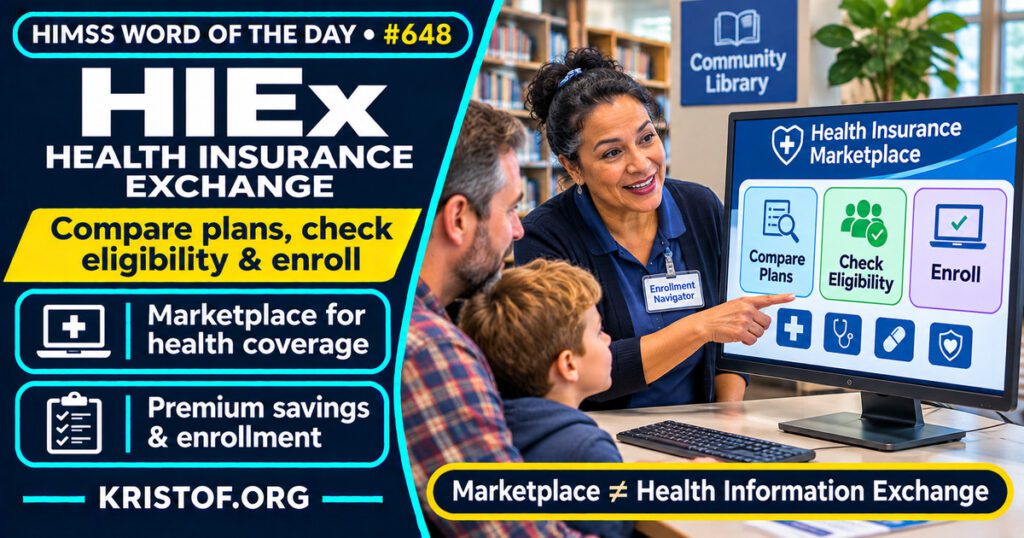
The HIMSS Dictionary describes a health insurance exchange (HIEx) as a set of standardized, state-regulated plans in the United States from which people can buy coverage that may qualify for federal subsidies. It ties exchanges to the Affordable Care Act, gives 2014 as the year they were required to be certified and running, and notes that “marketplace” is another name for them.
HealthCare.gov describes the same idea in consumer terms. Its glossary says the Health Insurance Marketplace is a service that helps people shop for and enroll in coverage, that the federal government runs it through HealthCare.gov for most states, and that some states run their own. It says people can get help through websites, call centers, and in-person assistance, and that “exchange” is another term for the Marketplace. An application asks for income and household information and shows whether the person may qualify for savings on premiums or costs, or for Medicaid or the Children’s Health Insurance Program (CHIP). The dictionary stresses state regulation, while HealthCare.gov stresses the federal role in most states, so the two descriptions differ in emphasis.
For health IT readers, an exchange is a service built on data: applications that collect household and income details, eligibility results, and plan information. This post did not review the technical systems behind any exchange.
| Item | Detail |
|---|---|
| Also called | Health Insurance Marketplace or exchange (HealthCare.gov) |
| Who runs it | The federal government for most states through HealthCare.gov; some states run their own |
| How people use it | Websites, call centers, and in-person help |
| What an application can show | Eligibility for premium savings, Medicaid, or CHIP |
| Who can use it | Individuals, families, and small businesses (HealthCare.gov Exchange glossary) |
⚠️ Exam Alert: HIEx is a health insurance exchange, a place to compare and enroll in coverage. HIE is a health information exchange, the electronic sharing of clinical information between organizations. They are different things. Also keep the exchange (the service) separate from a qualified health plan (a plan sold on it), the Affordable Care Act (the law behind it), and Medicaid (a separate public program the application can screen for).
🌐 Why It Matters: Real-World Healthcare IT Context
Exchanges matter in health IT because they are consumer-facing systems where data, plan information, and decisions meet, and because coverage changes show up later in registration and billing.
What studies show. Politi and colleagues (2016), in MDM Policy and Practice, reported on a decision aid called Show Me My Health Plans. It provides education, a preference assessment, and an out-of-pocket cost calculator with plan recommendations. The team compared it with HealthCare.gov among 328 Missourians enrolling in the marketplace. Users of the decision aid had higher health insurance knowledge (78 versus 62), decision self-efficacy (83 versus 75), and confidence in their choice (3.5 versus 2.9). They were also 10.3 times more likely to select a silver or gold plan. These are short-term measures from one state, and the authors designed the tool they tested, so the results do not show long-term health or cost outcomes.
Housten and colleagues (2016), in BMC Health Services Research, interviewed stakeholders about marketplace enrollment. Stakeholders said consumers felt frustrated by unclear terminology, high plan costs, and complex cost calculations, and anxious about choosing wrong. They recommended plain-language tables, grouped information, and graphics. This is a qualitative study of stakeholders’ perceptions, not a measurement of consumers’ choices.
Ericson and Starc (2016), in the Journal of Health Economics, studied a policy change at the Massachusetts exchange that standardized cost sharing across insurers and changed how information was presented. After the change, consumers chose more generous plans and different brands, but were not more price sensitive. This is an economic analysis of one state’s exchange and tells little about exchanges elsewhere.
Wolf and colleagues (2022), in JAMA Health Forum, analyzed Covered California. Administrative data covered 5.4 million enrollees from 2014 to 2021, and survey data covered 9,571 heads of household in 2018, 2019, and 2021. Median enrollment lasted 14 months, and 41 percent to 46 percent of enrollees disenrolled within one year. Among 6,474 terminating members surveyed, 14 percent reported being uninsured afterward, and the rest moved to job-based coverage or Medicaid. This is a cross-sectional study of one state, so patterns elsewhere may differ.
What I could not find. I did not review current enrollment figures, the technical architecture or security of HealthCare.gov or state exchanges, or changes to federal rules and subsidies since these studies. The HealthCare.gov glossary pages show no dates, and the dictionary’s 2014 timeline describes the law’s early period, so check current rules at CMS or HealthCare.gov before relying on any detail here.
Common HIEx problems:
- Confusing a health insurance exchange with a health information exchange
- Unclear terms and complex cost calculations that frustrate consumers
- Choosing a plan without tools that match needs and preferences
- Frequent coverage turnover, which can disrupt continuity
- Assuming every state runs its exchange the same way
- Treating a 2014-era description as current policy
What supports sound use of exchanges:
- Plain-language tables and graphics, as stakeholders recommended
- Decision aids that include cost calculators, as in the Missouri study
- Help through websites, call centers, and in-person assistance
- Standardized plan features, which changed choices in the Massachusetts study
- Clear eligibility results, including Medicaid and CHIP screening
- Attention to coverage transitions, since many enrollees move to other coverage
🏥 The Nurse’s Perspective: Clinical, Bedside, & Workflow
Nurses meet exchanges mainly through patients, who may ask about coverage, lost coverage, or confusing plan terms.
At the Bedside
Patients may mention that their plan came from the Marketplace or that coverage ended. HealthCare.gov lists websites, call centers, and in-person help as ways to get assistance, so nurses can point patients to those channels or to financial counselors instead of advising on plans. The studies above suggest that unclear terminology and cost worries are common reasons people feel stuck.
In Clinical Workflow
Nurse informaticists often work with registration and patient financial teams. Coverage turnover, such as the churn Wolf and colleagues describe in California, can produce eligibility questions at the front desk. This post did not verify how any specific system handles coverage changes, so the practical step is to know who owns insurance-verification questions locally.
In EHR Implementation (Go-Live Perspective)
During an Epic Go-Live, registration and insurance verification are part of readiness. Analysts at the elbow hear questions about coverage that does not appear or that has changed. This post does not claim that exchange coverage caused any specific go-live issue. It shows why teams benefit from clear ownership of coverage questions before launch.
🎓 CAHIMS / CPHIMS & HIMSS Perspective
CAHIMS Exam Domain Mapping
Health insurance exchanges connect policy, data, and patient access:
| CAHIMS Domain | How HIEx Appears |
|---|---|
| Healthcare & Technology Environments | Payers, federal and state programs, and how people obtain coverage |
| Clinical Informatics | Patient access to coverage and continuity of care |
| Healthcare Information & Systems Management | Eligibility and enrollment data and registration systems |
| Management & Leadership | Policy changes, patient financial counseling, and community resources |
Key Terms to Know Alongside HIEx
- Affordable Care Act (ACA) — the 2010 federal law that created the Marketplaces
- Qualified Health Plan (QHP) — a plan certified to be sold on a Marketplace
- Payer — the organization that pays for care, such as a health plan
- Premium tax credit — a tax credit that lowers the monthly premium for Marketplace coverage
- Health Information Exchange (HIE) — electronic sharing of health information between organizations, not an insurance exchange
- Medicaid — a public program the Marketplace application can screen for
HIMSS Organizational Position
HIMSS offers education and research on health information and technology topics through its Resource Center. Members can find related information on the HIMSS Resource Center page.
🧭 More HIMSS Word of The Day Terms
Related terms in the Healthcare Policy series:
- Covered Entity (HIPAA)
- AUC (Appropriate Use Criteria)
- GUDID (Global Unique Device Identification Database)
- HITAC (Health Information Technology Advisory Committee)
Browse all Healthcare Policy terms or the A–Z glossary.
🔗 Explore Further: External References
- HealthCare.gov — Health Insurance Marketplace Glossary https://www.healthcare.gov/glossary/health-insurance-marketplace-glossary/
- HealthCare.gov — Exchange Glossary https://www.healthcare.gov/glossary/exchange/
- Politi et al. (2016), MDM Policy & Practice — Show Me My Health Plans: Using a Decision Aid to Improve Decisions in the Federal Health Insurance Marketplace https://pubmed.ncbi.nlm.nih.gov/28804780/
- Housten et al. (2016), BMC Health Services Research — Stakeholders’ perceptions of ways to support decisions about health insurance marketplace enrollment: a qualitative study https://pubmed.ncbi.nlm.nih.gov/27821121/
- Ericson and Starc (2016), Journal of Health Economics — How product standardization affects choice: Evidence from the Massachusetts Health Insurance Exchange https://pubmed.ncbi.nlm.nih.gov/27693893/
- Wolf et al. (2022), JAMA Health Forum — Assessment of Churn in Coverage Among California’s Health Insurance Marketplace Enrollees https://pubmed.ncbi.nlm.nih.gov/36459160/
- HIMSS — Resource Center https://www.himss.org/resource-center
Term source: HIMSS Dictionary of Health Information and Technology Terms, Acronyms, and Organizations, 6th Edition (2025). All definitions in this series are paraphrased for editorial purposes. Readers are encouraged to consult the primary source for exact language.
Eric Andrew Kristof, RN, CAHIMS is a Healthcare IT professional and HIMSS Arkansas Chapter member based in Hot Springs Village, AR, with hands-on Epic Go-Live experience and a diverse healthcare and IT background. He writes at kristof.org at the intersection of clinical care and healthcare technology.
Leave a Reply