By Eric Andrew Kristof, RN, CAHIMS | Healthcare IT Professional | HIMSS Arkansas Chapter Member
About This Series: The HIMSS Word of The Day is a running blog series drawing from the HIMSS Dictionary of Health Information and Technology Terms, Acronyms, and Organizations, 6th Edition (2025) — the authoritative reference for healthcare IT professionals and the primary study resource for CAHIMS and CPHIMS certification. Each post paraphrases the term in plain language, grounds it in real-world healthcare IT context, and adds a bedside nursing perspective you won’t find in a textbook.
📖 The Term: CQM (Clinical Quality Measures)
Source: HIMSS Dictionary of Health Information and Technology Terms, Acronyms, and Organizations, 6th Edition (2025)
🔍 Plain-Language Definition
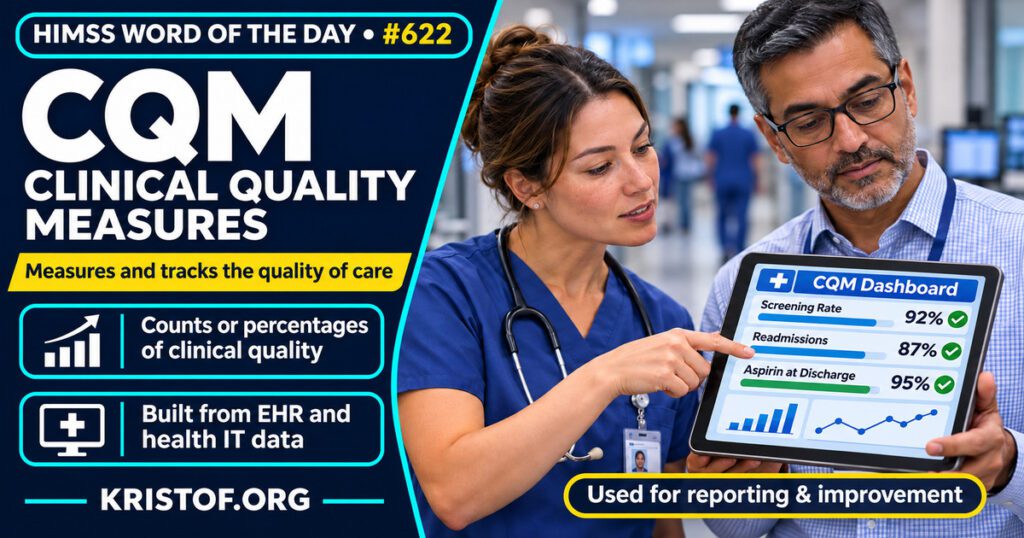
The HIMSS Dictionary describes clinical quality measures (CQMs) as tools for measuring and tracking the quality of care delivered by clinicians and hospitals that take part in federal programs in the United States. A CQM takes one slice of care, such as how a condition is diagnosed or treated, and turns it into something that can be counted, reported, and compared over time.
The electronic version has its own name. The Centers for Medicare & Medicaid Services (CMS) says an electronic clinical quality measure (eCQM) is specified in a standard electronic format and uses data pulled from electronic health records and other health IT systems. The two terms are related, not interchangeable, and exam questions often test the difference.
| Item | Detail |
|---|---|
| What it is | A tool for measuring and tracking the quality of care delivered |
| Who reports | Eligible professionals and clinicians, eligible hospitals, critical access hospitals, and dual-eligible hospitals, depending on the program, per CMS |
| Electronic version | The eCQM, specified in a standard electronic format and using EHR data |
| Data source | Structured fields in the EHR, and in some newer projects, natural language processing of notes |
| Related programs | Medicare and Medicaid Promoting Interoperability Programs and other CMS quality reporting programs |
⚠️ Exam Alert: A CQM is the broad idea of a measure of clinical quality. An eCQM is a CQM specified for electronic data. QRDA is a report format used to submit results, and MIPS is a payment program that uses quality measures, not a measure itself. Read each question for which of these it is asking about.
🌐 Why It Matters: Real-World Healthcare IT Context
Quality measurement is how health systems find out whether care is working. It also drives public reporting and, for many organizations, payment, which is why the technical details of how a measure is built and calculated matter to informatics teams.
What CMS says about electronic reporting. CMS’s eCQM Basics page says eCQMs use data electronically extracted from EHRs and other health IT systems to assess the quality of care delivered. The page names the Medicare and Medicaid Promoting Interoperability Programs and says eligible professionals, eligible hospitals, critical access hospitals, and dual-eligible hospitals report eCQMs, using certified EHR technology. CMS’s eCQI Resource Center publishes updated specifications each year, and program rules decide which measures are required for a given year.
How a measure gets built. The eCQI Resource Center’s eCQM 101 training slides (March 2025) walk through the building blocks of an eCQM, including the Quality Data Model, individual data elements, and Clinical Quality Language, which expresses the measure logic. In practice, that means a measure is more than a name and a target rate. Every numerator, denominator, and exclusion depends on specific data elements that a system must capture and code the same way each time, which is why a small documentation change can shift a reported result.
What studies show. Three studies illustrate burden, practicality, and a newer data source.
- Schreiber and colleagues (2021) describe CMS’s eCQM Strategy Project, launched in December 2017. The article reports stakeholder outreach on implementation and reporting burdens, six themes in the feedback, and CMS’s response, including more than 100 recommendations addressed through implementation strategies and new tools such as the Measure Collaboration Workspace, plus ongoing testing of FHIR-based standards for quality measurement. This is CMS’s own account, so it describes the agency’s actions rather than independent outcomes.
- Richardson and colleagues (2022) interviewed 17 representatives of the seven EvidenceNOW cooperatives about how they generated and reported eCQMs for small and mid-size primary care practices. They found the cooperatives ultimately used hybrid strategies, because neither EHRs alone nor a centralized source alone could operationalize eCQMs for quality improvement, and that this required solutions and resources small practices often lack. This is a qualitative study of one initiative, so its findings are descriptive.
- Evans and colleagues (2026) describe three case reports of CQM projects that used natural language processing on notes and reports to measure diagnostic performance for venous thromboembolism, pneumonia, and pulmonary embolism. The abstract says one algorithm developed in the Department of Veterans Affairs performed comparably in an academic medical system and that two of the measures were endorsed by the CMS consensus-based entity. These are case reports, not a controlled evaluation.
Common CQM problems:
- Confusing a CQM, an eCQM, and the report format used to submit results
- Assuming the data needed by a measure is captured in a structured field
- Documenting the same fact in several places so counts disagree
- Treating annual specification updates as a one-time build
- Measuring what is easy to extract rather than what reflects care quality
- Placing the reporting burden on clinicians through extra clicks
What supports good CQM practice:
- Early review of which EHR fields feed each measure
- Clinician and analyst agreement on where a fact is documented
- Validation of calculated results against a chart sample
- A plan for yearly specification updates
- Feedback to clinicians that is timely and understandable
🏥 The Nurse’s Perspective: Clinical, Bedside, & Workflow
Quality measures reach nurses as documentation expectations, even when the measure never mentions nursing.
At the Bedside
A measure that depends on a time, a score, or a yes-or-no field only works if that fact is recorded in the place the measure reads from. Evans and colleagues note that unstructured notes can hold information that structured fields miss, which is a reminder that free-text charting still matters.
In Clinical Workflow
Nurse informaticists often help decide where a measure’s data element should live so that it fits how care is delivered. Richardson’s finding that small practices struggled to operationalize eCQMs suggests that burden is a real design constraint, not just an inconvenience.
In EHR Implementation (Go-Live Perspective)
During an Epic Go-Live, analysts at the elbow often meet questions such as why a flowsheet row is required or why a field cannot be left blank. Quality reporting is one of several reasons a field can be required, and tracing the reason helps staff accept the workflow. This post does not claim that any specific go-live decision was driven by a particular measure.
🎓 CAHIMS / CPHIMS & HIMSS Perspective
CAHIMS Exam Domain Mapping
Clinical quality measures connect clinical work to reporting:
| CAHIMS Domain | How CQM Appears |
|---|---|
| Healthcare & Technology Environments | Quality reporting programs and certified EHR technology |
| Clinical Informatics | Measure logic, data capture, and clinician workflow |
| Healthcare Information & Systems Management | Data validation, reporting, and specification updates |
| Management & Leadership | Quality governance and burden reduction |
Key Terms to Know Alongside CQM
- eCQM (Electronic Clinical Quality Measures) — measures specified in a standard electronic format that use EHR data
- QRDA (Quality Reporting Document Architecture) — a standard format for reporting quality measure results
- QDM (Quality Data Model) — a model that describes the data elements used in eCQMs
- MIPS (Merit-based Incentive Payment System) — a Medicare payment program that includes quality measures
- HEDIS (Healthcare Effectiveness Data and Information Set) — a set of performance measures used widely by health plans
- QI (Quality Improvement) — the practice of using data to improve care processes and outcomes
HIMSS Organizational Position
HIMSS offers education and research on health information and technology topics through its Resource Center. Members can find related information on the HIMSS Resource Center page.
🧭 More HIMSS Word of The Day Terms
Related terms in the Value-Based Care series:
- Care Coordination
- OASIS (Outcome and Assessment Information Set)
- Activity-Based Costing (ABC)
- IPA (Independent Practice Association)
Browse all Value-Based Care terms or the A–Z glossary.
🔗 Explore Further: External References
- CMS — Electronic Clinical Quality Measures Basics https://www.cms.gov/medicare/regulations-guidance/promoting-interoperability-programs/electronic-clinical-quality-measures-basics
- eCQI Resource Center — Electronic Clinical Quality Improvement Resource Center https://ecqi.healthit.gov/
- Schreiber et al. (2021), Journal of the American Medical Informatics Association : JAMIA — Balancing value and burden: the Centers for Medicare & Medicaid Services electronic Clinical Quality Measure (eCQM) Strategy Project https://pubmed.ncbi.nlm.nih.gov/34383912/
- Richardson et al. (2022), Applied clinical informatics — Generating and Reporting Electronic Clinical Quality Measures from Electronic Health Records: Strategies from EvidenceNOW Cooperatives https://pubmed.ncbi.nlm.nih.gov/35508198/
- Evans et al. (2026), Joint Commission journal on quality and patient safety — Natural Language Processing in Clinical Quality Measures of Diagnostic Performance: Learnings from Three Case Reports https://pubmed.ncbi.nlm.nih.gov/41775594/
- HIMSS — Resource Center https://www.himss.org/resource-center
Term source: HIMSS Dictionary of Health Information and Technology Terms, Acronyms, and Organizations, 6th Edition (2025). All definitions in this series are paraphrased for editorial purposes. Readers are encouraged to consult the primary source for exact language.
Eric Andrew Kristof, RN, CAHIMS is a Healthcare IT professional and HIMSS Arkansas Chapter member based in Hot Springs Village, AR, with hands-on Epic Go-Live experience and a diverse healthcare and IT background. He writes at kristof.org at the intersection of clinical care and healthcare technology.
Leave a Reply