By Eric Andrew Kristof, RN, CAHIMS | Healthcare IT Professional | HIMSS Arkansas Chapter Member
About This Series: The HIMSS Word of The Day is a running blog series drawing from the HIMSS Dictionary of Health Information and Technology Terms, Acronyms, and Organizations, 6th Edition (2025) — the authoritative reference for healthcare IT professionals and the primary study resource for CAHIMS and CPHIMS certification. Each post paraphrases the term in plain language, grounds it in real-world healthcare IT context, and adds a bedside nursing perspective you won’t find in a textbook.
📖 The Term: Instant Messaging (IM)
Source: HIMSS Dictionary of Health Information and Technology Terms, Acronyms, and Organizations, 6th Edition (2025)
🔍 Plain-Language Definition
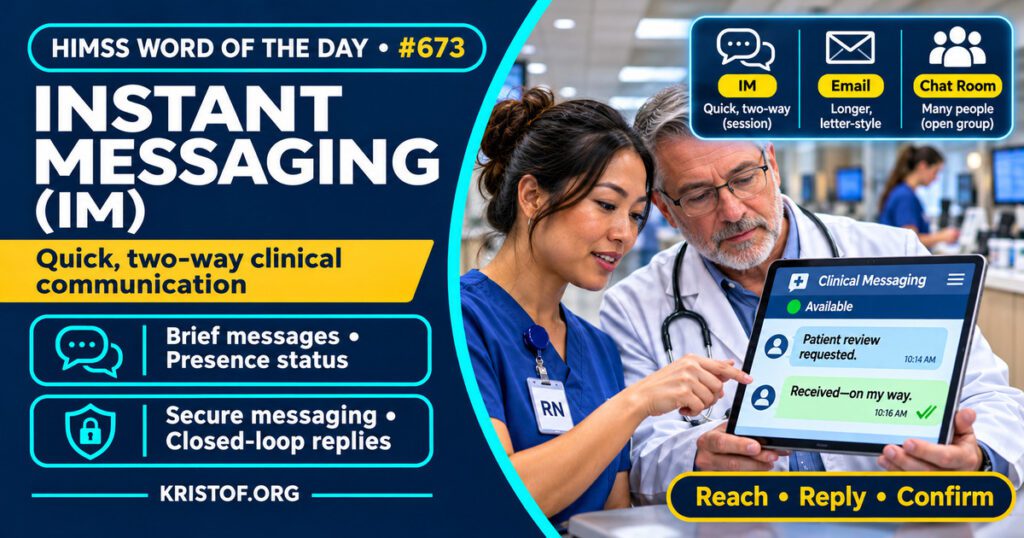
The HIMSS Dictionary describes instant messaging (IM) as the quick exchange of short messages, using either a standalone application or software built into another product. Most IM sessions are private and back-and-forth between two people, unlike a chat room, where many people may carry on overlapping conversations. A core feature of many IM clients is presence, which shows whether a colleague or friend is online and reachable. Over time, many clients added file transfer and image sharing inside the conversation.
The dictionary separates IM from email in two ways. IM is organized around a session that opens and closes, and its messages are usually brief because it imitates conversation. Email is usually longer and closer to letter writing.
| Feature | Instant messaging | Chat room | |
|---|---|---|---|
| Typical participants | Usually two people | Many people | One to many |
| Pace | Quick back-and-forth | Quick, with overlapping threads | Slower, longer replies |
| Structure | Session with a start and an end | Shared room | Individual letters |
| Presence indicator | Common | Varies | Not typical |
| Typical length | Brief | Brief | Longer |
The chat room and email columns follow the dictionary’s contrasts. The “Varies” and “Not typical” entries and the “One to many” entry are my own summary, not the dictionary’s.
⚠️ Exam Alert: Do not confuse instant messaging with email, which is longer and not session-based, or with a chat room, which hosts many overlapping conversations. Whether a particular IM product is acceptable for patient information is a separate question that depends on its security features and the organization’s policy.
🌐 Why It Matters: Real-World Healthcare IT Context
Why clinical teams use it. Clinical work depends on reaching the right person quickly. The studies below look at messaging tools in hospitals. Several of them study secure text messaging systems, which are hospital-oriented messaging products. I treat them here as a closely related category rather than as identical to the dictionary’s definition of IM, and I flag where a study is about a particular product or app.
A small pilot reported time savings. Menon and Rivett (2019) ran a time-motion pilot at an NHS hospital trust, comparing doctors and nurses using Medic Bleep, an information governance-compliant instant messaging app, with the traditional pager. The authors report that adopting the app corresponded to shorter mean task durations in the “To Take Out” (TTO) and patient review categories, and that that nurses saved an average of 21 minutes per shift and doctors 48 minutes. This was a pilot of one product at one trust, so the figures should not be generalized.
A before-and-after comparison on one pathway. Crozier-Shaw et al. (2022) created a group in a GDPR-compliant messaging service for stakeholders in hip fracture care at one hospital and compared April to December 2017 with the same months of 2018, with 121 and 122 patients. Mean time to surgery fell from about 84 hours to about 39 hours (p = 0.026). Time to admission to an orthopaedic ward fell from 47 to 33.3 hours, which was not statistically significant (p = 0.5). The design compares two periods, so other changes between the years cannot be ruled out from the abstract.
How nurses actually use it. Bautista and Lin (2017) interviewed 20 staff nurses at nine hospitals in the Philippines in July 2015. Nurses mostly used Facebook Messenger and Viber on their own smartphones. They used these tools for information exchange, socialization, and catharsis, and conversation was more formal when superiors were in the group. The study is small, qualitative, and from one country, so it describes practice there and does not show how common it is elsewhere.
Benefits and drawbacks side by side. Aziz et al. (2022) held focus groups at a children’s hospital, with 14 residents and 21 nurses. Participants described secure text messaging as helping teamwork through multiple modes of communication, supporting closed-loop communication, and giving ready access to team members. They also reported less face-to-face communication, alarm fatigue, interruptions, miscommunication, and stress from message volume. The authors conclude that guidelines and training could reduce the drawbacks. This is a single-site qualitative study.
Why adoption can stall. Byrd et al. (2023) analyzed free-text survey comments from 1,110 physicians and advanced practice providers at a large health care organization. The overall survey response rate was 20.5%, so the comments may not represent all clinicians. Clinicians often felt existing tools were good enough, worried about more communication, and disliked installing the app on a personal phone. Unclear who was reachable in the app led to missed messages and distrust. Some saw leaving nurses out of the system as a problem, while others at hospitals with wider access complained of too many messages.
What I could not confirm. I did not review regulatory or accreditation guidance on texting in clinical care, so I make no statement about what is permitted. I did not find or verify how many hospitals use IM, and I did not review any evidence on patient outcomes beyond the hip fracture comparison above. I did not look for studies of presence features specifically. The studies reviewed are small, single-organization, or survey-based, and several concern products other than generic IM.
Common instant messaging problems:
- Interruptions and alarm fatigue from message volume
- Unclear who is reachable or on call, leading to missed messages
- Apps installed on personal phones, which some clinicians resent
- Leaving out team members such as nurses
- Use of personal consumer apps on personal phones, as seen in the Philippine interview study
What supports effective instant messaging:
- Clear guidelines and training on when to message and when to call
- A clear, trustworthy benefit that offsets the added burden
- A defined roster so users know who is reachable
- A shared group for coordinating multiple roles around one pathway
- Presence information, which the dictionary names as a core feature (its clinical effect was not studied in the abstracts reviewed)
🏥 The Nurse’s Perspective: Clinical, Bedside, & Workflow
Three of the five studies reviewed include staff nurses as participants.
At the Bedside
Nurses in the Philippine interview study used messaging apps to exchange information with colleagues, and also to socialize and vent. In the NHS pilot, the authors report that nurses saved an average of 21 minutes per shift, and they link the app to less time spent on tasks that require interpersonal communication. That is one pilot, and the abstract does not say how nurses used the time.
In Clinical Workflow
In the children’s hospital focus groups, nurses and residents described both closed-loop communication and interruptions. Messaging can change who a nurse reaches and how often, and participants in that study, who included nurses and residents, reported alarm fatigue and stress from message volume. In the clinician survey, some respondents said leaving nurses out of the messaging system was a problem, although that survey sampled physicians and advanced practice providers, not nurses.
In EHR Implementation (Go-Live Perspective)
During an Epic Go-Live, analysts and at-the-elbow support staff need quick ways to reach each other and unit leaders. Whether that is done through messaging, phone, or a command center depends on the organization. This is general workflow context, and none of the studies reviewed examines go-lives.
🎓 CAHIMS / CPHIMS & HIMSS Perspective
CAHIMS Exam Domain Mapping
Instant messaging appears in questions about communication tools, workflow, and information governance:
| CAHIMS Domain | How Instant Messaging Appears |
|---|---|
| Healthcare & Technology Environments | Communication technologies and how they differ |
| Clinical Informatics | Clinical communication, workflow, and interruptions |
| Healthcare Information & Systems Management | Selecting, securing, and governing messaging tools |
| Management & Leadership | Adoption, training, and policies for messaging use |
Key Terms to Know Alongside Instant Messaging
- Presence — an indicator of whether a contact is online and available
- Asynchronous communication — communication in which participants do not need to be present at the same moment
- Secure text messaging system — a messaging product aimed at health care settings, a term used in the studies above
- Closed-loop communication — a practice in which the receiver confirms a message back to the sender
- Alarm fatigue — reduced responsiveness caused by too many alerts or interruptions
- Email — a longer-form, letter-style message that is not organized around a live session, as the dictionary contrasts it with IM
HIMSS Organizational Position
HIMSS offers education and research on health information and technology topics through its Resource Center. Members can find related information on the HIMSS Resource Center page.
🧭 More HIMSS Word of The Day Terms
Related terms in the Clinical Informatics series:
- Quality Improvement (QI)
- SBAR (Situation, Background, Assessment, Recommendation)
- APACHE (Acute Physiology and Chronic Health Evaluation)
- Clinical Informaticist
Browse all Clinical Informatics terms or the A–Z glossary.
🔗 Explore Further: External References
- Menon and Rivett (2019), Digital Health — Time-motion analysis examining of the impact of Medic Bleep, an instant messaging platform, versus the traditional pager: a prospective pilot study. https://pubmed.ncbi.nlm.nih.gov/30815275/
- Crozier-Shaw et al. (2022), Irish Journal of Medical Science — Instant messaging apps and data protection: combining to improve hip fracture care? https://pubmed.ncbi.nlm.nih.gov/33818739/
- Bautista and Lin (2017), International Journal of Nursing Practice — Nurses’ use of mobile instant messaging applications: A uses and gratifications perspective. https://pubmed.ncbi.nlm.nih.gov/28752519/
- Aziz et al. (2022), Journal of Hospital Medicine — Resident and nurse perspectives on the use of secure text messaging systems. https://pubmed.ncbi.nlm.nih.gov/36036216/
- Byrd TF 4th et al. (2023), Journal of General Internal Medicine — Barriers to Adoption of a Secure Text Messaging System: a Qualitative Study of Practicing Clinicians. https://pubmed.ncbi.nlm.nih.gov/36376637/
- HIMSS — Resource Center https://www.himss.org/resource-center
Term source: HIMSS Dictionary of Health Information and Technology Terms, Acronyms, and Organizations, 6th Edition (2025). All definitions in this series are paraphrased for editorial purposes. Readers are encouraged to consult the primary source for exact language.
Eric Andrew Kristof, RN, CAHIMS is a Healthcare IT professional and HIMSS Arkansas Chapter member based in Hot Springs Village, AR, with hands-on Epic Go-Live experience and a diverse healthcare and IT background. He writes at kristof.org at the intersection of clinical care and healthcare technology.
Leave a Reply