By Eric Andrew Kristof, RN, CAHIMS | Healthcare IT Professional | HIMSS Arkansas Chapter Member
About This Series: The HIMSS Word of The Day is a running blog series drawing from the HIMSS Dictionary of Health Information and Technology Terms, Acronyms, and Organizations, 6th Edition (2025) — the authoritative reference for healthcare IT professionals and the primary study resource for CAHIMS and CPHIMS certification. Each post paraphrases the term in plain language, grounds it in real-world healthcare IT context, and adds a bedside nursing perspective you won’t find in a textbook.
📖 The Term: ANCC (American Nurses Credentialing Center)
Source: HIMSS Dictionary of Health Information and Technology Terms, Acronyms, and Organizations, 6th Edition (2025)
🔍 Plain-Language Definition
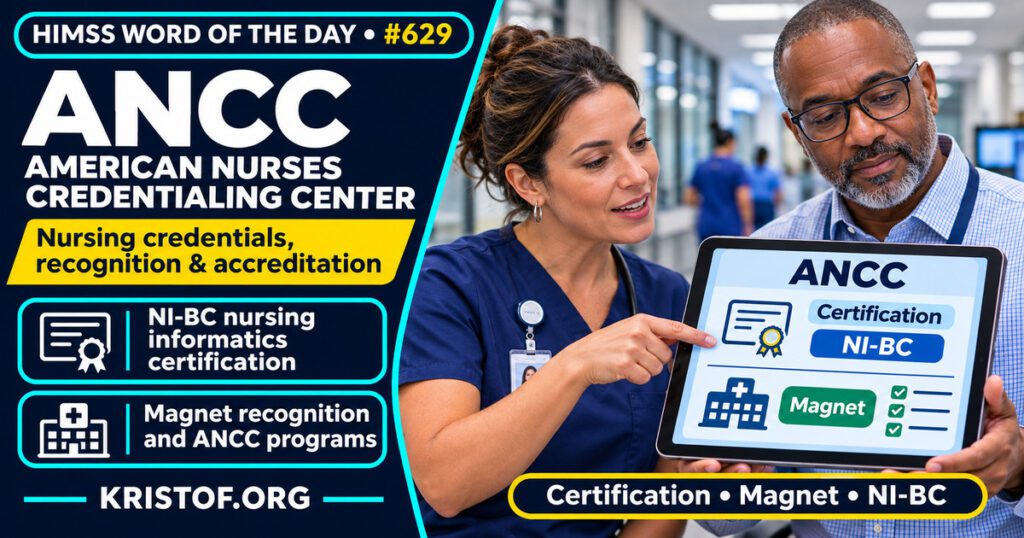
The HIMSS Dictionary lists ANCC (American Nurses Credentialing Center) in its organizations appendix. It describes ANCC as a nursing certification organization that tests and credentials nurses who have finished an accredited nursing program and satisfy the certification criteria, and it notes that a certification exists for nursing informatics.
ANCC’s own pages give a wider picture. They describe ANCC as a subsidiary of the American Nurses Association (ANA) that credentials both individual nurses and healthcare organizations. ANCC calls itself the recognized authority in nursing credentialing, which is the organization’s own statement of its standing. The nursingworld.org site groups ANCC with ANA and the American Nurses Foundation as related entities.
According to the history section of ANCC’s Magnet pages, ANCC was incorporated in June 1990 as a nonprofit subsidiary through which ANA offers credentialing programs and services. Those pages date the first Magnet designation to 1994, when the University of Washington Medical Center in Seattle became the first ANCC Magnet-designated organization.
For informatics readers, the practical point is that ANCC runs the board certification for informatics nurses, and that this is a nursing credential, separate from the credentials HIMSS offers.
| Item | Detail |
|---|---|
| Type | Credentialing subsidiary of the American Nurses Association (ANCC’s description) |
| Incorporated | June 1990, per ANCC’s Magnet history page |
| Focus | Certification of nurses, recognition of organizations, accreditation of education programs |
| Main programs | Specialty certifications, Magnet Recognition Program, Pathway to Excellence, ANCC Accreditation |
| Informatics credential | Informatics Nursing certification, awarding NI-BC |
| Relation to HIMSS | None found on the pages read; CAHIMS and CPHIMS come from HIMSS |
⚠️ Exam Alert: ANCC is the credentialing center of the American Nurses Association and offers nursing certifications such as NI-BC. HIMSS is a separate organization that offers CAHIMS and CPHIMS. Do not confuse ANCC with ANA (the professional association that owns it), AMIA (a biomedical and health informatics association), AHIMA (a health information management association), or ANSI (a standards organization).
🌐 Why It Matters: Real-World Healthcare IT Context
Because ANCC is an organization and not a research topic, this section draws on ANCC’s own pages, which were read directly for this post, and then on two independent reviews. ANCC’s pages show what the organization says it does, not an outside evaluation of it.
Certification. ANCC says certification lets nurses demonstrate specialty expertise and validate their knowledge to employers and patients. A certifications page on the ANCC site, which appears to be several years old, says ANCC has certified nurses since 1990 and counts more than a quarter million certified nurses. Treat that count as dated and as ANCC’s own figure.
Informatics Nursing certification. ANCC’s Informatics Nursing page lists these requirements for the NI-BC credential: a current, active RN license or its legal equivalent, a bachelor’s or higher degree in nursing, the equivalent of two years of full-time RN practice, and 30 hours of informatics continuing education within the last three years. Applicants must also show informatics experience through one of three routes: 2,000 hours of informatics nursing practice in the last three years, 1,000 hours plus 12 semester hours of graduate informatics coursework, or a graduate informatics nursing program with at least 200 supervised practicum hours. The exam is computer-based, with 150 questions in three hours, of which 125 are scored and 25 are unscored pretest items. ANCC describes it as a competency-based exam of entry-level knowledge and skills for informatics nurses, and says the credential is valid for five years. ABSNC and NCCA accredit the certification, according to the page. The page also says the test content outline and reference list will change effective April 19, 2027, with testing suspended for about eight business days, so candidates should read the current page before scheduling.
Organizational recognition. ANCC’s Magnet Recognition Program page says the program designates organizations where nursing leaders align nursing strategic goals with improved patient outcomes. The history section says the program was renamed the Magnet Recognition Program in 2002 and that a 2008 conceptual model organized the 14 Forces of Magnetism into five components. ANCC also runs Pathway to Excellence, which it describes as recognition for organizations that create a positive nursing practice environment.
Accreditation and quality claims. ANCC Accreditation recognizes continuing nursing education and several other education and residency programs. ANCC also says it is the only nurse credentialing organization to hold ISO 9001:2015 certification, which is its own statement and is not independently confirmed here.
What independent sources show. Two published papers add outside context.
- Rodríguez-García and colleagues (2020) published a systematic review of how Magnet status relates to outcomes. The abstract says 21 of 163 identified studies met the criteria, and that Magnet hospitals showed lower rates of nursing shortages, burnout, job dissatisfaction, turnover, patient mortality, falls, hospital-acquired infections, and pressure ulcers. The included studies were observational, so the review shows associations and cannot show that Magnet recognition caused the differences.
- Cummins and colleagues (2016) reviewed nursing informatics certification worldwide. The abstract says a formal certification program appeared to be available only in the United States at that time, and that it was established in 1992 alongside ANA’s definition of nursing informatics as a specialty. The paper states that, as of 2016, certification required no formal informatics education. ANCC’s current page lists a degree and continuing education requirements, so requirements may have changed since then and the current ANCC page should be the guide.
What I could not find. ANCC’s Magnet page does not state how many organizations hold recognition or how long recognition lasts, and the informatics page does not list exam content domains or a passing score. I did not look for these in third-party sources, so check ANCC’s current pages for them.
Common ANCC mix-ups:
- Treating ANCC and ANA as the same organization
- Confusing NI-BC with CAHIMS or CPHIMS
- Assuming Magnet recognition certifies individual nurses
- Reading an old eligibility list instead of the current ANCC page
- Treating ANCC’s own program claims as independent evidence
What ANCC offers:
- Specialty certifications for individual nurses, including informatics
- Magnet and Pathway to Excellence recognition for organizations
- Accreditation of continuing nursing education and related programs
- Renewal pathways for certified nurses
🏥 The Nurse’s Perspective: Clinical, Bedside, & Workflow
Nurses meet ANCC in three ways: through certification, through the organization where they work, and through the continuing education they take.
At the Bedside
A nurse who holds an ANCC specialty certification can show a recognized credential for that specialty. For nurses interested in technology, Informatics Nursing certification is a way to show informatics knowledge that goes beyond everyday use of the chart.
In Clinical Workflow
Nurse informaticists with this credential often work between clinical units and technical teams, translating how care is delivered into how the system is built. ANCC’s eligibility rules count informatics practice hours, which means the credential is tied to actual work and not only to a degree. At organizations that pursue Magnet recognition, ANCC describes the aim as aligning nursing goals with patient outcomes, which can bring documentation, measurement, and data work to the foreground.
In EHR Implementation (Go-Live Perspective)
During an Epic Go-Live, analysts at the elbow work alongside super users and nurse leaders who may hold various certifications. A nurse informaticist can help translate unit questions into build requests. This post does not claim that any specific go-live involved ANCC-certified staff or that ANCC credentials are required for such roles.
🎓 CAHIMS / CPHIMS & HIMSS Perspective
CAHIMS Exam Domain Mapping
ANCC connects professional practice, credentials, and the nursing role in informatics:
| CAHIMS Domain | How ANCC Appears |
|---|---|
| Healthcare & Technology Environments | Professional organizations, credentialing bodies, and recognition programs |
| Clinical Informatics | The nursing informatics specialty and its certification |
| Healthcare Information & Systems Management | Staff roles, credentials, and workforce planning |
| Management & Leadership | Magnet-style quality and leadership frameworks, and professional development |
Key Terms to Know Alongside ANCC
- Nursing informatics — the specialty that integrates nursing science with information management and technology
- Clinical informatics — the application of informatics and information technology to deliver healthcare services
- Accreditation — formal recognition that an organization or program meets defined standards
- Chief Nursing Informatics Officer — an executive role that leads nursing informatics strategy
- AMIA — the American Medical Informatics Association, a separate informatics organization
- Magnet Recognition Program — ANCC’s program recognizing organizations for nursing excellence
HIMSS Organizational Position
HIMSS offers education and research on health information and technology topics through its Resource Center. Members can find related information on the HIMSS Resource Center page.
🧭 More HIMSS Word of The Day Terms
Related terms in the Clinical Informatics series:
Browse all Clinical Informatics terms or the A–Z glossary.
🔗 Explore Further: External References
- ANCC — American Nurses Credentialing Center https://www.nursingworld.org/ancc/
- ANCC — About ANCC https://www.nursingworld.org/ancc/about-ancc/
- ANCC — Informatics Nursing Certification (NI-BC) https://www.nursingworld.org/our-certifications/informatics-nurse/
- ANCC — About Magnet (history of the Magnet program) https://www.nursingworld.org/organizational-programs/magnet/about-magnet/
- Rodríguez-García et al. (2020), The American Journal of Nursing — Original Research: How Magnet Hospital Status Affects Nurses, Patients, and Organizations: A Systematic Review https://pubmed.ncbi.nlm.nih.gov/32541337/
- Cummins et al. (2016), Yearbook of Medical Informatics — Nursing Informatics Certification Worldwide: History, Pathway, Roles, and Motivation https://pubmed.ncbi.nlm.nih.gov/27830261/
- HIMSS — Resource Center https://www.himss.org/resource-center
Term source: HIMSS Dictionary of Health Information and Technology Terms, Acronyms, and Organizations, 6th Edition (2025). All definitions in this series are paraphrased for editorial purposes. Readers are encouraged to consult the primary source for exact language.
Eric Andrew Kristof, RN, CAHIMS is a Healthcare IT professional and HIMSS Arkansas Chapter member based in Hot Springs Village, AR, with hands-on Epic Go-Live experience and a diverse healthcare and IT background. He writes at kristof.org at the intersection of clinical care and healthcare technology.
Leave a Reply