By Eric Andrew Kristof, RN, CAHIMS | Healthcare IT Professional | HIMSS Arkansas Chapter Member
About This Series: The HIMSS Word of The Day is a running blog series drawing from the HIMSS Dictionary of Health Information and Technology Terms, Acronyms, and Organizations, 6th Edition (2025) — the authoritative reference for healthcare IT professionals and the primary study resource for CAHIMS and CPHIMS certification. Each post paraphrases the term in plain language, grounds it in real-world healthcare IT context, and adds a bedside nursing perspective you won’t find in a textbook.
📖 The Term: Clinical Documentation System
Source: HIMSS Dictionary of Health Information and Technology Terms, Acronyms, and Organizations, 6th Edition (2025)
🔍 Plain-Language Definition
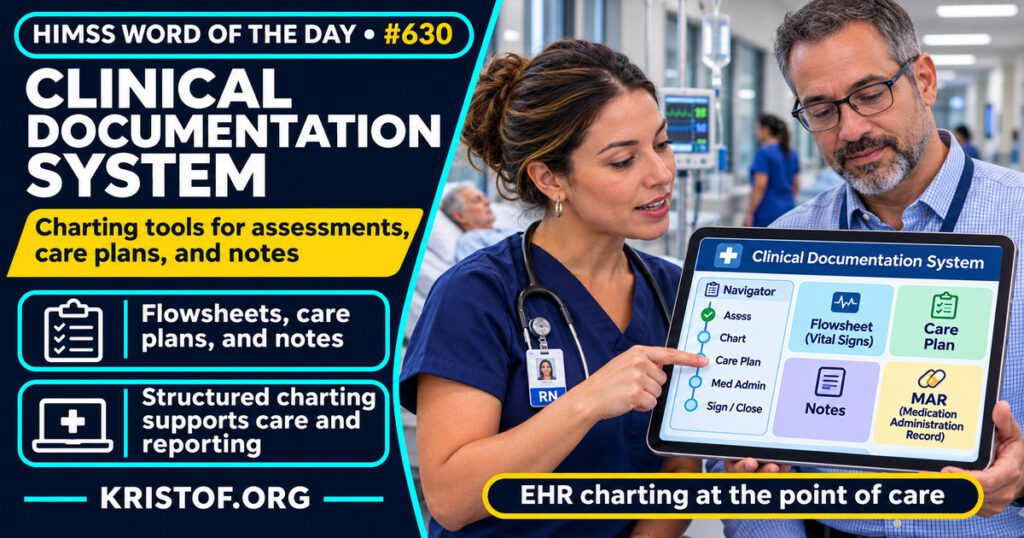
The HIMSS Dictionary describes a clinical documentation system as an application that lets clinicians record treatments, therapies, and assessment results for a patient. It is also the place where a patient’s flowsheets and care plan documentation are kept across the course of treatment.
In practice, a clinical documentation system is rarely a stand-alone product. In most hospitals it is a set of components inside the electronic health record. One 2024 study of acute and critical care nursing named five key components: flowsheets, the medication administration record, the care plan, notes, and navigators (guided screens that walk a nurse through a set of tasks). The same pieces appear under different names in different vendors’ products.
| Component | What it holds | Example of nursing use |
|---|---|---|
| Flowsheets | Repeated measurements and assessments over time | Vital signs, intake and output, pain scores |
| Care plan | Problems, goals, and planned interventions | A fall prevention plan updated each shift |
| Notes | Narrative documentation | A shift summary or event note |
| Medication administration record | A record of medications given | Documentation of a scheduled dose |
| Navigators | Guided workflows that group tasks | An admission screen that collects history and screens |
⚠️ Exam Alert: A clinical documentation system is the charting application inside the record, not the whole electronic health record. It differs from clinical documentation integrity (the work of keeping documentation complete and accurate), from a clinical data repository (a store that gathers data from many sources), and from a point-of-care system (the broader class of tools used at the bedside).
🌐 Why It Matters: Real-World Healthcare IT Context
Documentation is one of the largest parts of a nurse’s day, and the design of the system that holds it affects how long it takes, how accurate it is, and what can later be reported or analyzed. A clinical documentation system turns charting into structured data, which is what makes search, decision support, quality reporting, and handoff possible. The same structure can also add clicks and duplicate entry.
What studies show. The research is useful but uneven, and much of it comes from single sites and quality improvement projects.
- McCarthy and colleagues (2019) reviewed studies of electronic nursing documentation interventions in acute hospitals. Only six studies met the criteria, and all were uncontrolled before-and-after studies that reported positive effects on at least one outcome, mostly outcomes about documentation practice and content. The authors conclude that there is some evidence of time savings and fewer documentation errors, falls, and infections, which is a modest finding given the study designs.
- Jamieson and colleagues (2017) ran a randomized crossover study of a semistructured electronic admission documentation system on one 80-bed medical teaching unit. Using the QNOTE instrument, 21 pairs of electronic and paper notes scored a mean of 90 versus 69 for overall quality, and the electronic history of present illness sections were longer. This was a small, single-site study of admission notes, so it shows that a well-designed system can raise note quality and does not show the same effect elsewhere.
- Cho and colleagues (2024) combined EHR log analysis with interviews and surveys of nurses on five high-burden units at one university hospital. Nurses valued documentation but found it burdensome. Flowsheets, care plans, and navigators were rated below acceptable usability, and the most troublesome issues were data redundancy, poor workflow navigation, and cumbersome data entry. The study also notes that non-EHR factors such as staffing ratios, patient acuity, and time management contribute to burden. With four nurses per unit, the qualitative sample was small.
- Lee and colleagues (2025) reviewed 47 studies of additional required nursing documentation. In the abstract, 27 studies (57.4%) measured only process measures such as documentation compliance, and 20 (42.6%) included patient outcomes. Of those 20, 9 reported a statistically significant relationship with better outcomes. The quality of evidence was generally low, with most studies being quality improvement projects and only one randomized trial. The authors describe the connection between added required documentation and better outcomes as assumed but not substantiated by high-quality evidence.
- Moy and colleagues (2021) reviewed how documentation burden is measured. Of 3,482 articles retrieved, 35 met the criteria. The authors found no standard, validated measure and no consensus on the best approach, which means comparisons of burden across studies should be made with care.
What I could not find. I did not find a large, controlled evaluation showing that one design of nursing documentation system produces better patient outcomes than another. The studies above point to the value of structure and to the cost of redundant, poorly designed entry, but they do not settle which features matter most.
Common clinical documentation system problems:
- Duplicate entry of the same data in several places
- Flowsheet rows and navigators that do not match unit workflow
- Required fields added for compliance without a clear clinical purpose
- Care plans that are completed but not used to guide care
- Free text where structured data is needed for reporting
- Limited nurse input into design and change requests
What supports good clinical documentation system practice:
- Nurse involvement in design, testing, and change review
- A clear purpose for each required field, reviewed on a schedule
- Workflows that match the way each unit works
- Structured data for elements that are reported or used for decision support
- Measurement of documentation time using logs, with staff feedback
- Training that covers shortcuts as well as required steps
🏥 The Nurse’s Perspective: Clinical, Bedside, & Workflow
Nurses are the heaviest users of the clinical documentation system, so its design shows up in every shift.
At the Bedside
Flowsheets, care plans, and notes are where an assessment becomes part of the record. A well-built flowsheet captures a value once and reuses it. A poorly built one asks for the same data in several places, which takes time from the patient. The 2024 mixed-methods study found that nurses valued documentation for patient care and still found parts of it burdensome.
In Clinical Workflow
The shift handoff, the care plan, and the plan for the next assessment all draw on documentation. Nurse informaticists and unit leaders review which fields are truly needed, which are used for reporting, and which can be removed or auto-filled. The 2025 scoping review suggests that adding required documentation without evidence of benefit can increase burden, which is why those reviews matter.
In EHR Implementation (Go-Live Perspective)
During an Epic Go-Live, analysts at the elbow field many of the same questions: where to find a flowsheet row, why a navigator opens in a certain order, and why a value appears in two places. These questions are a source of build feedback. This post does not claim that any specific go-live had a particular documentation problem. It notes that early nurse feedback is one of the most useful inputs to refine the system after launch.
🎓 CAHIMS / CPHIMS & HIMSS Perspective
CAHIMS Exam Domain Mapping
The clinical documentation system touches clinical, technical, and management topics:
| CAHIMS Domain | How Clinical Documentation Systems Appear |
|---|---|
| Healthcare & Technology Environments | Where documentation sits in the EHR and the point-of-care environment |
| Clinical Informatics | Flowsheets, care plans, structured data, and nursing documentation |
| Healthcare Information & Systems Management | Build, testing, upgrades, and measurement of documentation time |
| Management & Leadership | Governance of required fields, change control, and clinician engagement |
Key Terms to Know Alongside Clinical Documentation System
- Documentation integrity — the practice of keeping clinical documentation complete, accurate, and consistent
- Clinical data repository — a data store that gathers clinical information from several source systems
- Point-of-care system — an application or device used where care is delivered
- Nursing informatics — the specialty that integrates nursing science with information management and technology
- Flowsheet — a structured grid for recording repeated measurements and assessments over time
HIMSS Organizational Position
HIMSS offers education and research on health information and technology topics through its Resource Center. Members can find related information on the HIMSS Resource Center page.
🧭 More HIMSS Word of The Day Terms
Related terms in the Clinical Informatics series:
Browse all Clinical Informatics terms or the A–Z glossary.
🔗 Explore Further: External References
- McCarthy et al. (2019), Journal of Nursing Management — Electronic nursing documentation interventions to promote or improve patient safety and quality care: A systematic review https://pubmed.ncbi.nlm.nih.gov/30387215/
- Jamieson et al. (2017), Journal of the American Medical Informatics Association — An electronic documentation system improves the quality of admission notes: a randomized trial https://pubmed.ncbi.nlm.nih.gov/27274016/
- Cho et al. (2024), Journal of the American Medical Informatics Association — Electronic health record system use and documentation burden of acute and critical care nurse clinicians: a mixed-methods study https://pubmed.ncbi.nlm.nih.gov/39259920/
- Lee et al. (2025), Applied Clinical Informatics — Relationship between Additional Required Nursing Documentation and Patient Outcomes: A Scoping Review https://pubmed.ncbi.nlm.nih.gov/40107304/
- Moy et al. (2021), Journal of the American Medical Informatics Association — Measurement of clinical documentation burden among physicians and nurses using electronic health records: a scoping review https://pubmed.ncbi.nlm.nih.gov/33434273/
- HIMSS — Resource Center https://www.himss.org/resource-center
Term source: HIMSS Dictionary of Health Information and Technology Terms, Acronyms, and Organizations, 6th Edition (2025). All definitions in this series are paraphrased for editorial purposes. Readers are encouraged to consult the primary source for exact language.
Eric Andrew Kristof, RN, CAHIMS is a Healthcare IT professional and HIMSS Arkansas Chapter member based in Hot Springs Village, AR, with hands-on Epic Go-Live experience and a diverse healthcare and IT background. He writes at kristof.org at the intersection of clinical care and healthcare technology.
Leave a Reply