By Eric Andrew Kristof, RN, CAHIMS | Healthcare IT Professional | HIMSS Arkansas Chapter Member
About This Series: The HIMSS Word of The Day is a running blog series drawing from the HIMSS Dictionary of Health Information and Technology Terms, Acronyms, and Organizations, 6th Edition (2025) — the authoritative reference for healthcare IT professionals and the primary study resource for CAHIMS and CPHIMS certification. Each post paraphrases the term in plain language, grounds it in real-world healthcare IT context, and adds a bedside nursing perspective you won’t find in a textbook.
📖 The Term: Local Codes
Source: HIMSS Dictionary of Health Information and Technology Terms, Acronyms, and Organizations, 6th Edition (2025)
🔍 Plain-Language Definition
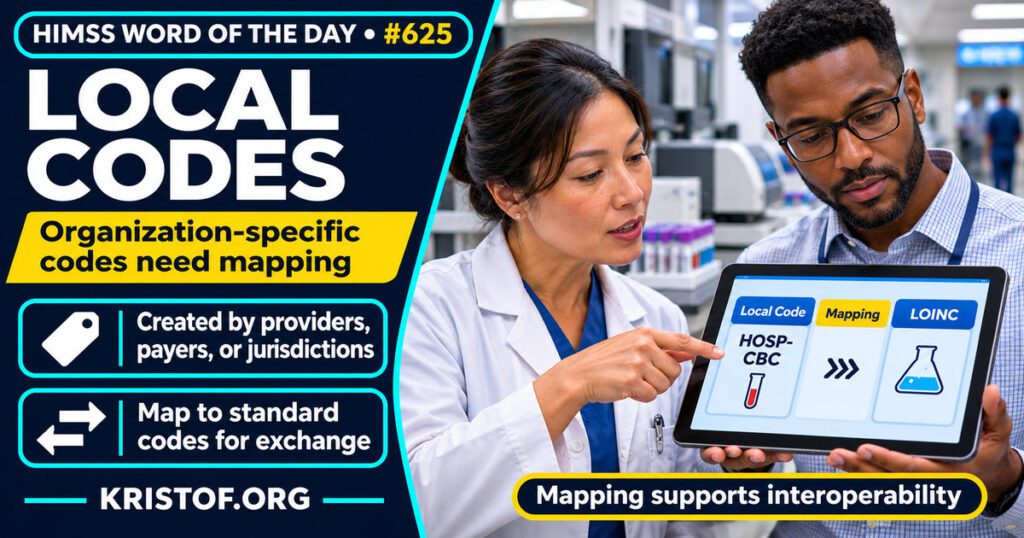
The HIMSS Dictionary uses local codes as an umbrella term for code values created by a particular payer, provider, or political jurisdiction rather than by a national or international body. A local code is a label an organization created for its own purposes, such as an internal laboratory test code, a facility-specific procedure code, or a payer’s own billing code.
Local codes are not inherently wrong. They let an organization describe things its standard systems do not cover and name things the way its staff use them. The problem is that a local code means nothing to anyone outside the organization unless someone has linked it to a shared standard.
| Item | Detail |
|---|---|
| What it is | A code value defined for a specific payer, provider, or jurisdiction |
| Typical examples | Internal laboratory test codes, order codes, and facility-specific procedure or charge codes |
| Contrast | Nationally maintained code sets such as CPT and HCPCS Level II |
| Main risk | Data cannot be compared or exchanged until it is mapped to a standard |
| Common fix | A governed mapping from each local code to a standard code, such as LOINC for laboratory tests |
⚠️ Exam Alert: A local code is defined by one organization, a standard code comes from a recognized body, and a mapping (or crosswalk) links the two. A mapped local code is still a local code. The mapping is what makes its data usable elsewhere.
🌐 Why It Matters: Real-World Healthcare IT Context
Every organization builds some of its own vocabulary, and most large health systems carry thousands of local codes. They are invisible while data stays inside one system and become obvious the moment data moves, whether to a registry, a research network, a payer, or a new EHR.
How local codes arise. Local codes usually start as a reasonable shortcut. A laboratory adds a new assay before a standard code exists, a hospital needs a charge item that no national code describes, or a payer creates its own category for a benefit design. Each decision is sensible on its own. Over years, an organization accumulates thousands of codes, some duplicated, some retired but never removed, and some whose original meaning only one long-tenured employee remembers. The cost shows up later, when someone asks a question that spans systems or years and the codes do not line up.
What national code sets look like. CMS’s HCPCS page says CMS maintains the HCPCS Level II national codes, which are alphanumeric, a letter followed by four digits, and mainly cover items and services not in CPT, such as ambulance services and durable medical equipment. The page also says HCPCS Level I is CPT, maintained by the American Medical Association. Those national sets are what local codes are usually mapped toward for billing, while terminologies such as LOINC serve laboratory content.
What studies show. Three papers illustrate the cost of unmapped codes and the effort needed to fix them.
- Stegink and colleagues (2024) evaluated whether routine EHR data could be used to calculate four quality indicators for intensive care unit antibiotic use. The abstract reports that three of four indicators were feasible, and that the main barriers included local codes for lab tests and surveillance cultures, plus a lack of data on empirical prescribing. The authors say future work should include data from multiple ICUs, so this is a small feasibility study.
- Yamashita and colleagues (2026) describe a governance framework for medical code standardization across 18 institutions in Japan’s MID-NET network, run through a governance center at Kyushu University Hospital. After about 1.5 years, the reported rates of correct standardized code assignment were 36% for drugs, 29% for laboratory tests, and 67% for diseases. The authors describe these as the real-world baseline and note that gains were modest, especially for laboratory tests, where the JLAC-10 codes were complex. The setting is Japanese national databases, so the specific codes differ from US practice, but the governance problem is familiar.
- Pierre-Jean and colleagues (2024) describe a pipeline that builds an automated dashboard for monitoring laboratory results in a clinical data warehouse. For each LOINC code, the dashboard summarizes how many local codes map to it and flags events, such as new equipment, that shift the distribution of results. The paper describes a method and not a measured clinical outcome.
Common local code problems:
- Treating a local code as if outsiders could interpret it
- Mapping once and never reviewing the mapping as codes change
- Mapping several different local tests to one standard code without checking units and methods
- Letting departments create new local codes without governance
- Assuming the standard code applies to specimen, method, and unit as well
- Losing the mapping table during a system migration
What supports good local code practice:
- A named owner and a governance process for new codes
- A mapping table with version history
- Clinician or laboratory review of difficult mappings
- Routine checks that mapped codes still produce plausible data
- Planning for mapping before a research, registry, or migration project begins
🏥 The Nurse’s Perspective: Clinical, Bedside, & Workflow
Nurses use local codes constantly, usually without seeing them. Flowsheet rows, order names, and assessment items all carry codes that an organization defined.
At the Bedside
A row named one way on the unit may have a different label in a registry extract or a report. When values look different across screens or reports, a local naming choice may be the reason.
In Clinical Workflow
Nurse informaticists help decide whether a new flowsheet row or order is truly new or can be mapped to something that already exists. Careful naming at the start reduces the mapping work for everyone downstream, and the Yamashita governance study shows that cleanup after the fact is slow.
In EHR Implementation (Go-Live Perspective)
During an Epic Go-Live, analysts at the elbow often hear questions such as why an item is named differently from the old system. Local naming and local codes are often part of the answer. This post does not claim that any specific go-live had a coding problem.
🎓 CAHIMS / CPHIMS & HIMSS Perspective
CAHIMS Exam Domain Mapping
Local codes appear in questions about standards and data quality:
| CAHIMS Domain | How Local Codes Appear |
|---|---|
| Healthcare & Technology Environments | Standard code sets and terminologies |
| Clinical Informatics | Mapping clinical content to standard terminologies |
| Healthcare Information & Systems Management | Data quality, migration, and governance |
| Management & Leadership | Ownership and change control for code sets |
Key Terms to Know Alongside Local Codes
- LOINC (Logical Observation Identifiers Names and Codes) — a standard for identifying laboratory and clinical observations
- ICD (International Classification of Diseases) — a classification used for diagnoses and statistics
- Designated code set — a code set required for use in a HIPAA standard transaction
- Terminology mapping — linking terms in one coding system to terms in another
- Data quality — the fitness of data for its intended use
- Data warehouse — a repository that integrates data from many sources for reporting and analysis
HIMSS Organizational Position
HIMSS offers education and research on health information and technology topics through its Resource Center. Members can find related information on the HIMSS Resource Center page.
🧭 More HIMSS Word of The Day Terms
Related terms in the Interoperability and Standards series:
- Fast Healthcare Interoperability Resources (FHIR)
- Normalization
- Healthcare Terminology
- Interface Terminology
Browse all Interoperability and Standards terms or the A–Z glossary.
🔗 Explore Further: External References
- CMS — Healthcare Common Procedure Coding System (HCPCS) https://www.cms.gov/medicare/coding-billing/healthcare-common-procedure-system
- Stegink et al. (2024), Studies in health technology and informatics — Feasibility of Calculating Indicators for Intensive Care Unit Antibiotic Use Based on Routine Electronic Health Record Data https://pubmed.ncbi.nlm.nih.gov/39176673/
- Yamashita et al. (2026), BMC medical informatics and decision making — A governance framework for medical code standardization to enhance multi-institutional data quality https://pubmed.ncbi.nlm.nih.gov/41736045/
- Pierre-Jean et al. (2024), Studies in health technology and informatics — Monitoring Variability of Laboratory Results in a Clinical Data Warehouse Using Automatic Dashboard https://pubmed.ncbi.nlm.nih.gov/39176509/
- HIMSS — Resource Center https://www.himss.org/resource-center
Term source: HIMSS Dictionary of Health Information and Technology Terms, Acronyms, and Organizations, 6th Edition (2025). All definitions in this series are paraphrased for editorial purposes. Readers are encouraged to consult the primary source for exact language.
Eric Andrew Kristof, RN, CAHIMS is a Healthcare IT professional and HIMSS Arkansas Chapter member based in Hot Springs Village, AR, with hands-on Epic Go-Live experience and a diverse healthcare and IT background. He writes at kristof.org at the intersection of clinical care and healthcare technology.
Leave a Reply