By Eric Andrew Kristof, RN, CAHIMS | Healthcare IT Professional | HIMSS Arkansas Chapter Member
About This Series: The HIMSS Word of The Day is a running blog series drawing from the HIMSS Dictionary of Health Information and Technology Terms, Acronyms, and Organizations, 6th Edition (2025) — the authoritative reference for healthcare IT professionals and the primary study resource for CAHIMS and CPHIMS certification. Each post paraphrases the term in plain language, grounds it in real-world healthcare IT context, and adds a bedside nursing perspective you won’t find in a textbook.
📖 The Term: Quality of Care
Source: HIMSS Dictionary of Health Information and Technology Terms, Acronyms, and Organizations, 6th Edition (2025)
🔍 Plain-Language Definition
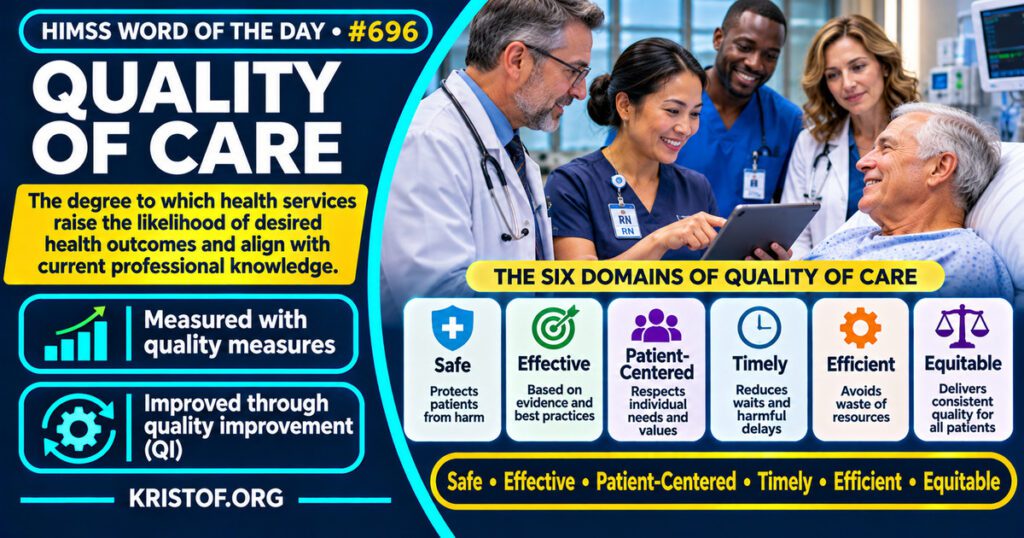
The HIMSS Dictionary describes quality of care as the degree to which health services, for individuals and for populations, raise the likelihood of desired health outcomes and agree with current professional knowledge. It adds that the National Academy of Medicine, known until recently as the IOM, names six domains: safety, effectiveness, patient-centeredness, timeliness, efficiency, and equity.
AHRQ describes the same six aims as an influential framework for quality assessment and attributes them to the IOM. The wording below is a paraphrase of that page.
| Domain | What it asks |
|---|---|
| Safe | Is the patient protected from harm caused by care meant to help? |
| Effective | Is care based on scientific knowledge, given to those who could benefit, and withheld from those unlikely to? |
| Patient-centered | Is care respectful of and responsive to individual preferences, needs, and values? |
| Timely | Are waits and harmful delays reduced? |
| Efficient | Is waste of equipment, supplies, ideas, and energy avoided? |
| Equitable | Does quality stay the same regardless of personal characteristics such as location or socioeconomic status? |
⚠️ Exam Alert: Quality of care is the concept, and quality measures are the tools used to put numbers on it. Quality improvement is the work of changing care to raise it. Donabedian’s structure, process, and outcome categories are a way to assess quality, not the six domains. Also note that the dictionary lists the domains as nouns (safety, timeliness), while the IOM aims are usually written as adjectives (safe, timely), so questions may use either form.
🌐 Why It Matters: Real-World Healthcare IT Context
Where it shows up. Quality of care is the outcome that quality reporting, payment programs, and many technology projects say they are trying to improve. Because the concept is broad, a project that claims to improve it needs to say which domain it targets and how that will be measured. The sources below were read as abstracts, apart from the AHRQ page, which I saw only through search results because the site blocks automated retrieval.
Defining it comes before measuring it. Donabedian (1988) wrote that before assessment can begin, quality must be defined, and the definition depends on whether only practitioner performance is assessed or also the contributions of patients and the health system, how broadly health is defined, whether the maximally or optimally effective care is sought, and whether individual or social preferences define the optimum. He also called for detailed information about the causal links among the structure of care settings, the processes of care, and its outcomes, and noted that much remained to be known. It is a 1988 conceptual article, not an empirical study.
The claims run ahead of the evidence. Black et al. (2011) reviewed the systematic review literature on eHealth and the quality and safety of care. They identified 53 systematic reviews that assessed impact on quality or safety, plus 55 supporting reviews, and found that this literature was generally of substandard quality in methods, reporting, and usefulness. They grouped the technologies into data storage and transmission, clinical decision support, and care from a distance. They found relatively little empirical evidence behind many claims made for these technologies, a large gap between postulated and demonstrated benefits, and little robust research on risks and cost-effectiveness. The review covers reviews published from 1997 to 2010, so it predates many current systems.
Some measured improvements, but not mortality. Campanella et al. (2016) pooled 47 studies of EHR implementation and process or outcome indicators. EHR use was associated with a 22.4% reduction in documentation time, higher guideline adherence (risk ratio 1.33), fewer medication errors (risk ratio 0.46), and fewer adverse drug events (risk ratio 0.66). No association with mortality was evident, and the authors report high heterogeneity among the studies. The confidence interval for guideline adherence (1.01 to 1.76) is wide, which means the estimate is imprecise. These are associations from mixed study designs, not proof that an EHR caused the change.
Staffing is a quality input, studied observationally. Aiken et al. (2014) used discharge data for 422,730 patients aged 50 or older who had common surgeries in 300 hospitals in nine European countries, together with surveys of 26,516 nurses. Each additional patient in a nurse’s workload was associated with a 7% higher likelihood of death within 30 days of admission (odds ratio 1.068), and each 10% increase in nurses with bachelor’s degrees was associated with a 7% lower likelihood (odds ratio 0.929). The authors suggest that staffing cuts might harm outcomes and that more emphasis on bachelor’s education could reduce preventable deaths. It is an observational study, so the associations do not establish cause, and hospital differences beyond those adjusted for may matter.
What I could not confirm. I could not retrieve the IOM report itself in a form that lists the six aims, and the National Academies publication page shows only a general summary, so the domain wording rests on AHRQ’s attribution; it is worth checking against the report. I did not review studies on every domain, and none of the sources measures equity or patient-centeredness directly. I also did not verify whether the Campanella findings hold for current EHR systems, since the underlying studies are older.
Common quality of care problems:
- Claiming improvement without naming the domain or the measure
- Measuring what is easy to count, such as documentation time, instead of outcomes patients value
- Evidence that is weak, mixed in design, or highly variable across studies
- Technology benefits assumed in policy before they are demonstrated
- Staffing and education effects that are observed but hard to separate from hospital differences
What supports quality of care work:
- A widely used six-domain framework that gives teams shared language
- A structure, process, and outcome lens for deciding what to measure
- Measured reductions in medication errors and adverse drug events in pooled EHR studies
- Large observational datasets that link staffing and education to patient outcomes
- Calls in the reviews for evaluating technology across its whole life cycle
🏥 The Nurse’s Perspective: Clinical, Bedside, & Workflow
Only one of the sources reviewed, Aiken et al. (2014), measured nurses directly, so the rest of this section is workflow context and not evidence.
At the Bedside
The six domains show up in ordinary work. Safe care is the double check at the bedside, timely care is the call light answered, and patient-centered care is the plan built around what the patient says matters. The staffing findings in the nine-country study describe workload per nurse, which is the bedside condition under which every other domain has to be delivered.
In Clinical Workflow
Several quality measures depend on documentation that nurses enter during care. When a field is hard to find or means different things on different units, the data that reach a quality report are harder to trust. The pooled EHR analysis reported shorter documentation time on average, but it did not separate nurses from other clinicians, so it does not show that effect for nursing.
In EHR Implementation (Go-Live Perspective)
During an Epic Go-Live, analysts and at-the-elbow support staff hear quality questions in practical form: which field feeds a report, why a safety alert fires, and who owns a measure. The Black overview warns that benefits are often assumed instead of shown, which is why tracking a defined measure after go-live matters more than the expectation of improvement. This is context only, and none of the studies reviewed examines go-lives.
🎓 CAHIMS / CPHIMS & HIMSS Perspective
CAHIMS Exam Domain Mapping
Quality of care appears in questions about measurement, safety, and the purpose of health IT:
| CAHIMS Domain | How Quality of Care Appears |
|---|---|
| Healthcare & Technology Environments | The six domains and external quality programs |
| Clinical Informatics | Documentation, decision support, and the measures built from them |
| Healthcare Information & Systems Management | Data for quality reporting and evaluation of systems |
| Management & Leadership | Quality improvement, staffing, and accountability |
Key Terms to Know Alongside Quality of Care
- Quality measures — standardized ways to put a number on a part of care quality
- Quality improvement — organized work to change processes so care gets better
- Medication error — a preventable event in the ordering, dispensing, or giving of a medication
- HEDIS — a widely used set of health plan performance measures
- Joint Commission — an accrediting body whose standards address care quality and safety
- Electronic clinical quality measure — a quality measure built to be calculated from EHR data
HIMSS Organizational Position
HIMSS offers education and research on health information and technology topics through its Resource Center. Members can find related information on the HIMSS Resource Center page.
🧭 More HIMSS Word of The Day Terms
Related terms in the Value-Based Care series:
- Care Coordination
- Leapfrog Group
- CQM (Clinical Quality Measures)
- IPA (Independent Practice Association)
Browse all Value-Based Care terms or the A–Z glossary.
🔗 Explore Further: External References
- AHRQ — Six Domains of Healthcare Quality https://www.ahrq.gov/talkingquality/measures/six-domains.html
- National Academies Press — Crossing the Quality Chasm: A New Health System for the 21st Century (2001) https://www.nationalacademies.org/projects/HMD-HCS-18-P-114/publication/10027
- Donabedian (1988), JAMA — The quality of care. How can it be assessed? https://pubmed.ncbi.nlm.nih.gov/3045356/
- Black et al. (2011), PLoS Medicine — The impact of eHealth on the quality and safety of health care: a systematic overview. https://pubmed.ncbi.nlm.nih.gov/21267058/
- Campanella et al. (2016), European Journal of Public Health — The impact of electronic health records on healthcare quality: a systematic review and meta-analysis. https://pubmed.ncbi.nlm.nih.gov/26136462/
- Aiken et al. (2014), The Lancet — Nurse staffing and education and hospital mortality in nine European countries: a retrospective observational study. https://pubmed.ncbi.nlm.nih.gov/24581683/
- HIMSS — Resource Center https://www.himss.org/resource-center
Term source: HIMSS Dictionary of Health Information and Technology Terms, Acronyms, and Organizations, 6th Edition (2025). All definitions in this series are paraphrased for editorial purposes. Readers are encouraged to consult the primary source for exact language.
Eric Andrew Kristof, RN, CAHIMS is a Healthcare IT professional and HIMSS Arkansas Chapter member based in Hot Springs Village, AR, with hands-on Epic Go-Live experience and a diverse healthcare and IT background. He writes at kristof.org at the intersection of clinical care and healthcare technology.
Leave a Reply