By Eric Andrew Kristof, RN, CAHIMS | Healthcare IT Professional | HIMSS Arkansas Chapter Member
About This Series: The HIMSS Word of the Day is a running blog series drawing from the HIMSS Dictionary of Health Information and Technology Terms, Acronyms, and Organizations, 6th Edition (2025) — the authoritative reference for healthcare IT professionals and the primary study resource for CAHIMS and CPHIMS certification. Each post paraphrases the term in plain language, grounds it in real-world healthcare IT context, and adds a bedside nursing perspective you won’t find in a textbook.
📖 The Term: eMAR (Electronic Medication Administration Record)
Source: HIMSS Dictionary of Health Information and Technology Terms, Acronyms, and Organizations, 6th Edition (2025)
🔍 Plain-Language Definition
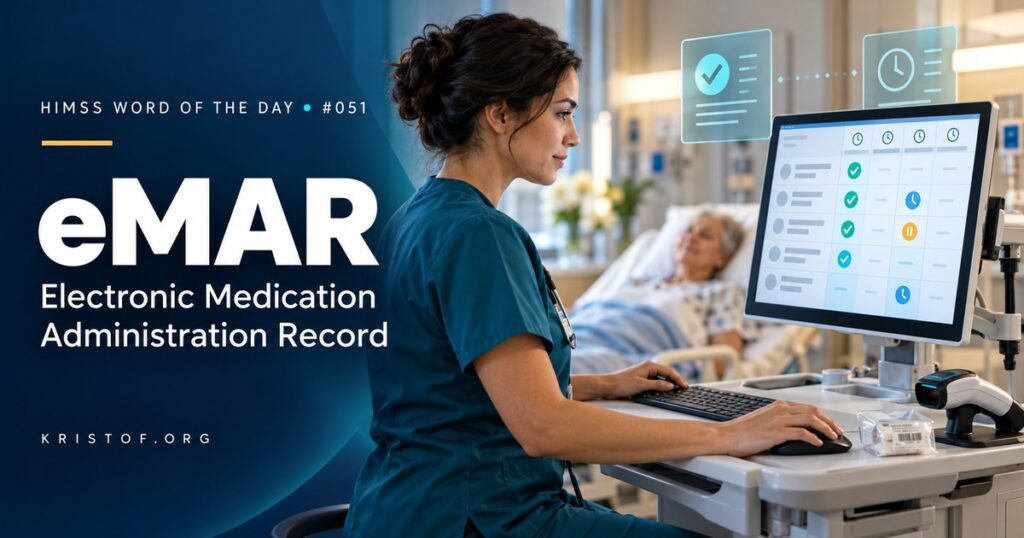
The electronic medication administration record (eMAR) is the digital version of the medication administration record that nurses once kept on paper. It lists every medication ordered for a patient, shows when each dose is due, and records what was actually given, held, or refused, by whom, and when.
The HIMSS Dictionary describes the eMAR as an electronic system for recording when medications are administered to hospitalized patients. It notes that the eMAR helps nurses follow the five rights of medication administration, which are the right patient, medication, dose, time, and route. The Dictionary also points out that an eMAR can work with barcode scanning but does not require it, and that eMAR functions usually sit inside the nursing documentation part of the EHR.
The eMAR is one link in a chain often called closed-loop medication management:
| Step | System | What Happens |
|---|---|---|
| Ordering | CPOE | A provider enters a structured medication order with decision support |
| Verification | Pharmacy system | A pharmacist reviews the order for appropriateness and verifies it |
| Dispensing | Pharmacy and automated dispensing cabinets | The medication is prepared and made available on the unit |
| Administration | eMAR with BCMA | The nurse scans the patient and medication, gives the dose, and documents it |
| Monitoring | eMAR, flowsheets, and results | The nurse documents effect, reassessment, and any adverse reaction |
⚠️ Exam Alert: CPOE is where medications are ordered. The eMAR is where administration is scheduled and documented. BCMA is the scanning check at the bedside that confirms patient and medication. An eMAR without scanning still documents administration but does not verify it electronically. Together, CPOE, pharmacy verification, eMAR, and BCMA form the closed loop.
🌐 Why It Matters: Real-World Healthcare IT Context
Paper medication records required orders to be transcribed by hand, which introduced errors before a dose ever reached the patient. Handwriting was misread, orders were copied incorrectly, and discontinued medications sometimes stayed on the paper record. The eMAR removes manual transcription when it is fed directly by verified electronic orders.
The strongest evidence comes from studies of the eMAR combined with barcode scanning. In a 2010 study in the New England Journal of Medicine, Eric Poon and colleagues observed more than 14,000 medication administrations. On units using a bar-code eMAR, non-timing administration errors fell from 11.5% to 6.8%, a 41.4% relative reduction, and potential adverse drug events from those errors fell by about half. Timing errors also declined, and transcription errors dropped substantially, though the system did not eliminate errors entirely.
The eMAR is also a rich source of data. It records administration times, missed doses, overrides, and reasons for holding medications. Organizations use that data to monitor scanning compliance, late doses, PRN use and reassessment, and patterns that may point to workflow or supply problems.
Design matters a great deal. An eMAR that clutters the screen, hides changes, or makes PRN reassessment hard to document can create new opportunities for error.
Common eMAR problems:
- Cluttered displays that make due and overdue doses hard to spot
- Changes to orders that are not clearly highlighted for the nurse
- Confusing displays of titrated drips, tapers, and variable doses
- PRN reassessments that are easy to miss
- Long lists of override reasons that encourage clicking the first option
- Delays between pharmacy verification and eMAR availability
Characteristics of a well-designed eMAR:
- Clear visual cues for due, overdue, new, changed, and discontinued medications
- Relevant data shown at the point of administration, such as blood pressure or glucose
- Built-in prompts for PRN effectiveness reassessment
- Simple, specific documentation for held, refused, and partial doses
- Integration with barcode scanning and, where available, smart infusion pumps
- Reports that support handoff and medication pass planning
🏥 The Nurse’s Perspective: Clinical, Bedside, & Workflow
For inpatient nurses, the eMAR is often the screen they use most, and its design shapes nearly every medication pass.
At the Bedside
A typical medication pass begins with the eMAR: reviewing what is due, noticing what is new or changed, checking relevant labs and vital signs, and planning around procedures or meals. At the bedside, the nurse scans the patient’s wristband and each medication, confirms the dose and route, and documents administration in real time.
Clinical judgment stays central. The eMAR may show a dose as due, but the nurse decides whether the patient’s condition supports giving it. A blood pressure that is too low, a glucose that has dropped, or a patient who is unable to swallow may call for holding a dose and notifying the provider, with a clear reason documented.
In Clinical Workflow
The eMAR supports communication between shifts and disciplines. Oncoming nurses review recent administrations and held doses during handoff. Pharmacists see when doses are given and can respond to missed or late doses. Providers can check whether a PRN medication was effective before changing the plan.
Accurate timing matters. Documenting administration hours later, or in batches, distorts the record and can lead to duplicate doses or missed reassessments. Real-time documentation at the bedside keeps the eMAR trustworthy.
In EHR Implementation (Go-Live Perspective)
During an Epic Go-Live, the eMAR is one of the highest-attention areas. Nurses are learning new layouts, new scanning steps, and new ways to document held, refused, and titrated medications all at once. At-the-elbow support analysts often spend much of the first days at the medication room and the bedside, helping with scanner pairing, finding due medications, and documenting complex doses.
Medication conversion is a major Go-Live task. Active orders from the legacy system must be re-entered or converted and verified so the first medication pass is accurate. Close collaboration between nursing, pharmacy, and support teams during the first twenty-four hours helps catch timing errors and duplicate orders before they reach patients.
🎓 CAHIMS / CPHIMS & HIMSS Perspective
CAHIMS Exam Domain Mapping
The eMAR is a core clinical system topic:
| CAHIMS Domain | How the eMAR Appears |
|---|---|
| Healthcare & Technology Environments | Medication safety research; closed-loop medication management; regulatory focus on medication errors |
| Clinical Informatics | Five rights; nursing documentation; PRN reassessment; display and alert design |
| Healthcare Information & Systems Management | Integration with CPOE, pharmacy, BCMA, and smart pumps; downtime reports; medication conversion |
| Management & Leadership | Scanning compliance metrics, late dose monitoring, Go-Live readiness, optimization |
Key Terms to Know Alongside eMAR
- Medication Administration Record (MAR) — the record of medications ordered and administered for a patient
- BCMA (Bar Code Medication Administration) — scanning the patient and medication at the bedside to verify administration
- CPOE (Computerized Provider Order Entry) — electronic entry of medication and other orders by providers
- Closed-Loop Medication Management — integrated ordering, verification, dispensing, administration, and monitoring
- PRN — an as-needed medication given based on patient need within ordered parameters
- Five Rights — the right patient, medication, dose, time, and route of administration
HIMSS Organizational Position
HIMSS treats medication administration technology as a central nursing informatics topic. Its Nursing Informatics Community focuses on systems like the eMAR that support safe, efficient nursing practice, and HIMSS maturity models, including EMRAM, consider closed-loop medication administration. Members can find related education and research through the HIMSS Resource Center.
🔗 Explore Further: External References
- Poon et al. (2010), New England Journal of Medicine — Effect of Bar-Code Technology on the Safety of Medication Administration https://pubmed.ncbi.nlm.nih.gov/20445181/
- AHRQ PSNet — Medication Administration Errors https://psnet.ahrq.gov/primer/medication-administration-errors
- AHRQ PSNet — Medication Errors and Adverse Drug Events https://psnet.ahrq.gov/primer/medication-errors-and-adverse-drug-events
- ISMP — High-Alert Medications in Acute Care Settings https://home.ecri.org/blogs/guidance-insights-tools/high-alert-medications-in-acute-care-settings
- HIMSS — Electronic Medical Record Adoption Model (EMRAM) https://www.himss.org/maturity-models/emram
- HIMSS — Nursing Informatics Community https://www.himss.org/networking/communities/nursing-informatics/
Term source: HIMSS Dictionary of Health Information and Technology Terms, Acronyms, and Organizations, 6th Edition (2025). All definitions in this series are paraphrased for editorial purposes. Readers are encouraged to consult the primary source for exact language.
Eric Andrew Kristof, RN, CAHIMS is a Healthcare IT professional and HIMSS Arkansas Chapter member based in Hot Springs Village, AR, with hands-on Epic Go-Live experience and a diverse healthcare and IT background. He writes at kristof.org at the intersection of clinical care and healthcare technology.
Leave a Reply