By Eric Andrew Kristof, RN, CAHIMS | Healthcare IT Professional | HIMSS Arkansas Chapter Member
About This Series: The HIMSS Word of The Day is a running blog series drawing from the HIMSS Dictionary of Health Information and Technology Terms, Acronyms, and Organizations, 6th Edition (2025) — the authoritative reference for healthcare IT professionals and the primary study resource for CAHIMS and CPHIMS certification. Each post paraphrases the term in plain language, grounds it in real-world healthcare IT context, and adds a bedside nursing perspective you won’t find in a textbook.
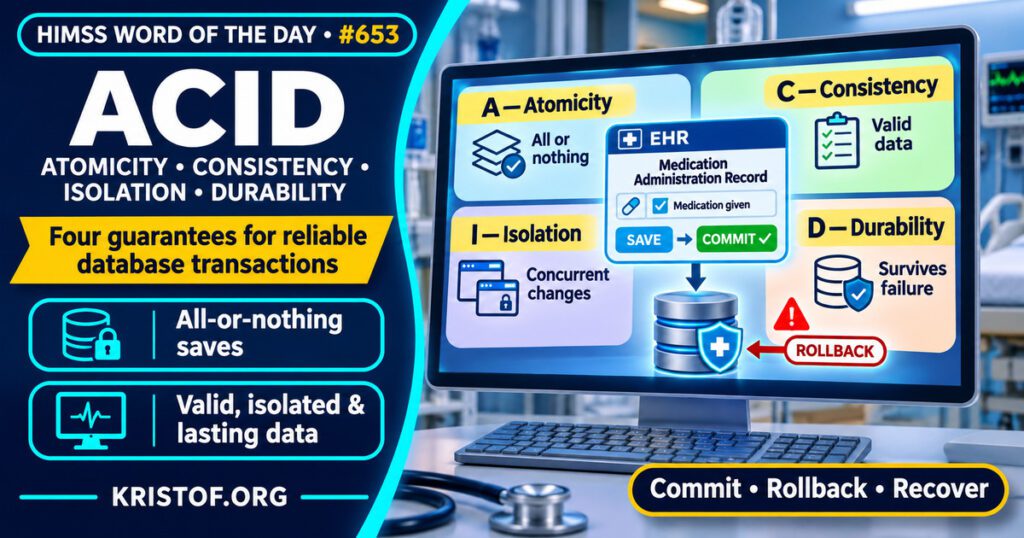
📖 The Term: ACID (Atomicity, Consistency, Isolation, and Durability)
Source: HIMSS Dictionary of Health Information and Technology Terms, Acronyms, and Organizations, 6th Edition (2025)
🔍 Plain-Language Definition
The HIMSS Dictionary defines ACID as a mnemonic for four attributes that a transaction manager (also called a transaction monitor) ensures for every transaction. It points to the 1992 edition of ISO/IEC 10026-1 as the place the concept is laid out, and it adds that each attribute can be measured against a benchmark. I did not read that standard, so the plain-language descriptions below come from database documentation.
| Letter | Property | Plain-language meaning |
|---|---|---|
| A | Atomicity | A transaction takes effect completely or not at all |
| C | Consistency | A transaction moves the data from one valid state to another, following the database’s rules |
| I | Isolation | Concurrent transactions do not see each other’s unfinished changes |
| D | Durability | Once a transaction is confirmed, its changes survive a crash |
The PostgreSQL documentation describes the first idea this way: a transaction bundles several steps into one operation, and if something fails partway, none of the steps so far take effect. Its example is a bank transfer, where a debit must never occur without the matching credit. The same page describes durability without using the word, saying updates are logged to permanent storage before the transaction is reported complete. The dictionary supplies the ACID labels, and the documentation pages describe the behaviors behind them.
⚠️ Exam Alert: The C in ACID means a transaction leaves the database valid under its own rules. It is not the same as the “consistency” discussed for copies of data spread across servers. Likewise, isolation here concerns concurrent transactions, not network or security isolation.
🌐 Why It Matters: Real-World Healthcare IT Context
ACID is a design contract between a database and the software that uses it. Clinical systems store orders, results, and documentation in databases, so the contract matters whenever two people or processes touch the same record, or a server fails mid-save. The sources below are technical documentation and one 2026 study, and the study is not a clinical trial.
Isolation has levels. The PostgreSQL documentation describes four SQL standard isolation levels and the concurrency anomalies each must prevent. PostgreSQL’s default is Read Committed, where each statement sees only data committed before it began. Repeatable Read gives a transaction a stable snapshot, and Serializable adds checks that abort transactions whose concurrent execution could not match any one-at-a-time order. The page notes that applications using the stricter levels must be prepared to retry transactions that fail. Isolation is therefore a setting with trade-offs, not an on-or-off feature, and these details describe PostgreSQL specifically. Other databases differ.
Durability depends on hardware. The SQLite documentation on atomic commit explains how SQLite keeps a transaction all-or-nothing even if power fails during a write: in rollback-journal mode it saves the original page contents to a journal first, and if a journal remains after a crash, the changes are rolled back. The same page lists its assumptions about storage. It says flush operations are assumed to work as advertised, that these are reported to be broken on some systems, and that SQLite cannot detect or repair that. The lesson for health IT is that a database’s guarantee is only as strong as the storage and operating system beneath it.
Some designs trade ACID for speed. Veerapaneni and colleagues (2026) built a RAM-resident database called SubDataBase-0.91s for intelligent video surveillance in critical care. They benchmarked it against SQL Server, OracleDB, MySQL, PostgreSQL, MongoDB, and Redis with simulated write and read cycles. The abstract reports a write and read speed increase of 8.6 times compared with MySQL, the slowest control, and says the speed gain came from stripping away the overhead of universal ACID compliance. The design synchronizes to the file system periodically and asynchronously. As I read that, recent writes could be lost if a failure came between synchronizations, though the abstract does not say so. This is a prototype tested by its own authors on simulated workloads, and the abstract does not report clinical use. I also cannot say whether the speed comparison would hold elsewhere.
What I could not confirm. I did not read ISO/IEC 10026-1, so I cannot confirm what the dictionary says about it. I did not find peer-reviewed research in PubMed that measures ACID compliance in electronic health record products, because a search on the term mostly returned chemistry papers. The PostgreSQL pages are for the current documentation release and section numbers can change.
Common ACID problems:
- Assuming a database gives the strictest isolation when its default, as in PostgreSQL, is weaker
- Treating a confirmed save as durable when storage or caching settings do not match what the database assumes
- Splitting one clinical action across several transactions, so a failure leaves half of it recorded
- Confusing ACID consistency with agreement between replicated copies
- Building a speed-focused component that drops guarantees the clinical workflow still relies on
What supports reliable transactions:
- Clear transaction boundaries, so related changes commit together
- Rollback and retry handling for failed or conflicting transactions
- Storage and backup settings that match the durability the system promises
- Testing for crashes and power loss, as the SQLite documentation describes for its own code
- Documenting which isolation level each critical function relies on
🏥 The Nurse’s Perspective: Clinical, Bedside, & Workflow
Nurses never see a transaction manager, but they see its results when a save works or fails.
At the Bedside
A nurse who documents a medication administration and receives an error message needs to know whether the entry saved. Atomicity is the property that lets software answer that cleanly: the entry either committed or did not. When an application hides the outcome, nurses may document twice or not at all. This is an illustrative scenario, not a finding from the sources above.
In Clinical Workflow
Two clinicians may open the same chart or order set at nearly the same moment. How a system handles two changes in flight is partly an isolation question, and the user-facing result can be a message that another user changed the record. Analysts who know the concept can explain to staff why a save was refused and what to check before trying again.
In EHR Implementation (Go-Live Perspective)
During an Epic Go-Live, at-the-elbow support sees the symptoms of these behaviors as tickets: duplicate entries, a lost note, or a screen that will not save. Analysts triage by asking whether the entry was committed, whether a competing change occurred, and whether the cause was the database or an interface. Learning the vocabulary helps nurse super users describe a problem precisely for the build and infrastructure teams.
🎓 CAHIMS / CPHIMS & HIMSS Perspective
CAHIMS Exam Domain Mapping
ACID appears as a foundational database concept:
| CAHIMS Domain | How ACID Appears |
|---|---|
| Healthcare & Technology Environments | Database management systems and how clinical applications store data |
| Clinical Informatics | Data integrity for orders, results, and documentation |
| Healthcare Information & Systems Management | Backup, recovery, downtime planning, and transaction handling |
| Management & Leadership | Vendor questions about reliability and data protection |
Key Terms to Know Alongside ACID
- Transaction — a unit of database work that is committed or undone as a whole
- Database management system (DBMS) — software that stores, retrieves, and controls access to data
- Data integrity — the accuracy and consistency of data over its life
- Rollback — undoing a transaction’s changes so the data returns to its prior state
- Audit trail — a record of who did what in a system and when
HIMSS Organizational Position
HIMSS offers education and research on health information and technology topics through its Resource Center. Members can find related information on the HIMSS Resource Center page.
🧭 More HIMSS Word of The Day Terms
Related terms in the IT Infrastructure series:
Browse all IT Infrastructure terms or the A–Z glossary.
🔗 Explore Further: External References
- PostgreSQL Documentation — 3.4. Transactions https://www.postgresql.org/docs/current/tutorial-transactions.html
- PostgreSQL Documentation — 13.2. Transaction Isolation https://www.postgresql.org/docs/current/transaction-iso.html
- SQLite — Atomic Commit In SQLite https://www.sqlite.org/atomiccommit.html
- Veerapaneni et al. (2026), Frontiers in Digital Health — Development of a high-performance in-memory database architecture for intelligent video surveillance in critical patient care https://pubmed.ncbi.nlm.nih.gov/42158173/
- HIMSS — Resource Center https://www.himss.org/resource-center
Term source: HIMSS Dictionary of Health Information and Technology Terms, Acronyms, and Organizations, 6th Edition (2025). All definitions in this series are paraphrased for editorial purposes. Readers are encouraged to consult the primary source for exact language.
Eric Andrew Kristof, RN, CAHIMS is a Healthcare IT professional and HIMSS Arkansas Chapter member based in Hot Springs Village, AR, with hands-on Epic Go-Live experience and a diverse healthcare and IT background. He writes at kristof.org at the intersection of clinical care and healthcare technology.
Leave a Reply