By Eric Andrew Kristof, RN, CAHIMS | Healthcare IT Professional | HIMSS Arkansas Chapter Member
About This Series: The HIMSS Word of The Day is a running blog series drawing from the HIMSS Dictionary of Health Information and Technology Terms, Acronyms, and Organizations, 6th Edition (2025) — the authoritative reference for healthcare IT professionals and the primary study resource for CAHIMS and CPHIMS certification. Each post paraphrases the term in plain language, grounds it in real-world healthcare IT context, and adds a bedside nursing perspective you won’t find in a textbook.
📖 The Term: Asynchronous Communication
Source: HIMSS Dictionary of Health Information and Technology Terms, Acronyms, and Organizations, 6th Edition (2025)
🔍 Plain-Language Definition
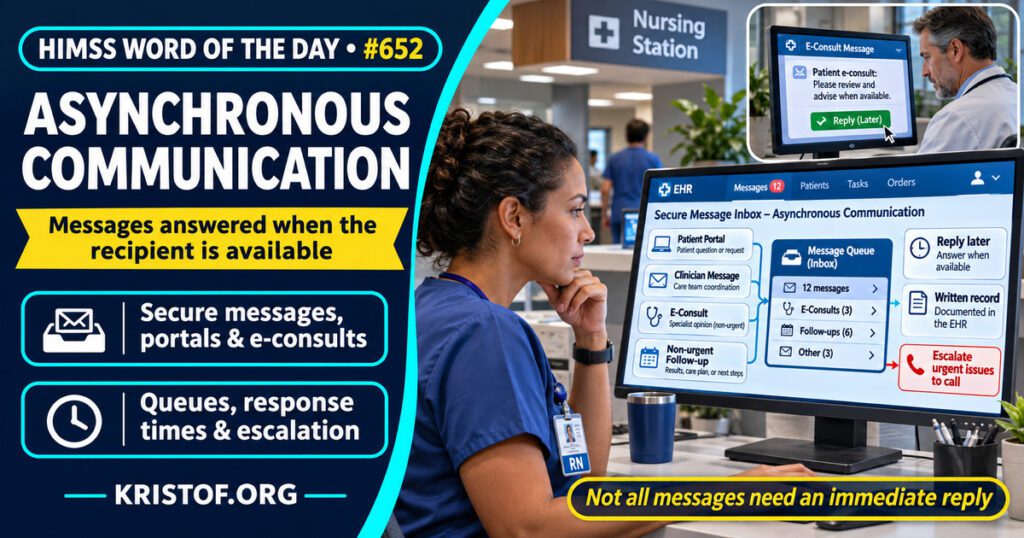
The HIMSS Dictionary describes asynchronous communication as an exchange in which the sender does not expect an immediate answer. The recipient replies when available, and email is the dictionary’s example.
In healthcare IT, the same idea covers any message that waits for its reader: secure messages between clinicians, patient portal messages, electronic consultations between a primary care provider and a specialist, and queued inbox items in an electronic health record (EHR). The opposite is synchronous communication, where both parties take part at the same moment, as in a phone call, a video visit, or a bedside conversation.
| Feature | Asynchronous | Synchronous |
|---|---|---|
| Timing | Reply when the recipient is available | Both parties present at once |
| Examples | Email, portal message, e-consult, secure chat | Phone call, video visit, in-person talk |
| Record | Usually leaves a written trail | May leave none unless documented |
| Main strength | Does not interrupt the recipient’s task | Immediate clarification |
| Main risk | Delay, backlog, lost tone | Interruption, scheduling conflicts |
⚠️ Exam Alert: Do not equate “asynchronous” with “unreliable” or “slow.” The term describes the timing relationship between sender and recipient, not delivery quality. Also keep asynchronous communication distinct from store-and-forward telehealth, which is one clinical use of the idea rather than a synonym for it.
🌐 Why It Matters: Real-World Healthcare IT Context
Most clinical work mixes both modes. A nurse may page a physician, then document the exchange in a secure message so it can be found later. The studies below show what researchers have measured in different settings. All five are observational, retrospective, survey, or qualitative designs, so none proves cause and effect.
Workflow time. Jhala and Menon (2021) followed cohorts of healthcare professionals for two weeks using a time-motion method and compared the Medic Bleep instant-messaging platform with synchronous methods such as the non-cardiac pager. The abstract reports a 20.1 minute reduction in average task completion with the asynchronous platform, which it describes as a 58.8 percent time saving, and an average staff rating of 8.7 on a Likert scale. This was an observational study of one platform. The abstract does not state the sample size, and I did not check for vendor involvement.
Cost and access. Newman and colleagues (2019) studied Geisinger’s Ask-a-Doc tool, launched in January 2014, which let primary care providers message specialists in 14 medical and 5 surgical specialties. Using claims data and a difference-in-differences analysis, they associated the tool with an approximately 14 percent reduction in total cost of care in the first month and a 20 percent reduction in the second month, driven by fewer emergency department and office visits. This was a retrospective analysis in one integrated health system, and the abstract describes the finding as a potential reduction in avoidable care, not proof.
What messages contain. Steitz and colleagues (2021) analyzed nearly two years of EHR messages among breast cancer care team members at Vanderbilt University Medical Center: 81,857 messages containing 613,877 sentences. Across roles, 63.4 percent of messages contained logistical information and 21.8 percent contained clinical information. Administrative and clinical staff sent 81 percent of all messages with logistical content. This is a single-center analysis of one disease area. The authors suggest that knowing message content can help informatics teams reduce clerical burden and unnecessary interruptions.
Patient perspective. Eschler and colleagues (2015) interviewed 34 people who manage a chronic illness for themselves or for a child or partner. They note that patient portals allow messaging at any hour, but that the mode strips out tone and body language. The study is qualitative and now more than ten years old, so it offers design ideas rather than measured outcomes.
Specialist workload. Mader and colleagues (2026) surveyed specialists who took part in Newfoundland and Labrador’s province-wide e-consult service. Thirty-six of 66 responded, a 55 percent response rate. Ninety percent reported no protected clinical time for e-consults, 92 percent said they answered some outside regular working hours, and 44 percent were financially reimbursed. This is a self-reported survey from one province, and the authors conclude that time and compensation may limit long-term sustainability.
What I could not find. I did not find a national standard for acceptable response times to asynchronous clinical messages in the studies I reviewed, and none of the five was a randomized trial. The abstracts I read report no measured patient-outcome results; Jhala and Menon’s abstract says only that the platform may positively affect patient care.
Common asynchronous communication problems:
- Message backlogs when volume outpaces the people assigned to answer
- Unclear expectations about how fast a reply is due
- Loss of tone and context in short written messages
- Work performed outside regular hours without protected time
- Logistical messages crowding out clinical ones in a shared inbox
What supports good asynchronous communication:
- Routing rules that send each message type to the right role
- Written expectations for response times that staff and patients both know
- Messages that stand alone, with the question, context, and needed action stated
- Review of message content to find what can be automated or redirected
- Escalation to a synchronous channel when a situation is urgent
🏥 The Nurse’s Perspective: Clinical, Bedside, & Workflow
Nurses use asynchronous channels in many settings, and choosing between a message and a call is a frequent judgment call.
At the Bedside
A nurse who needs a non-urgent order clarification may send a secure message and keep working instead of waiting on hold. The same nurse recognizes when a change in condition needs a call or a rapid response, not a message. The studies above did not measure bedside outcomes, so these are workflow observations and not findings.
In Clinical Workflow
Nurses who staff clinic phone lines and portal inboxes triage messages that arrive at any hour. Steitz and colleagues found that most messages in one cancer program were logistical, which suggests that logistical tasks can take up much of a shared inbox. Nurse leaders and analysts can use that kind of message-content review to decide which tasks belong with clerical staff, which belong with nurses, and which can be automated.
In EHR Implementation (Go-Live Perspective)
During an Epic Go-Live, at-the-elbow support often fields questions about where messages land and who sees them. Routing, shared inbox pools, and coverage during absences are build decisions that shape how asynchronous messaging behaves on the unit. Analysts and nurse super users can test those paths with realistic scenarios before go-live, because a message sent to an unstaffed pool may sit unread without anyone noticing.
🎓 CAHIMS / CPHIMS & HIMSS Perspective
CAHIMS Exam Domain Mapping
Asynchronous communication appears wherever information moves between people on different schedules:
| CAHIMS Domain | How Asynchronous Communication Appears |
|---|---|
| Healthcare & Technology Environments | Email, secure messaging, portals, and e-consult services as communication channels |
| Clinical Informatics | Care team coordination, inbox design, and message routing |
| Healthcare Information & Systems Management | Message queues, delivery reliability, audit trails, and uptime |
| Management & Leadership | Response-time expectations, staffing for inboxes, and workload policy |
Key Terms to Know Alongside Asynchronous Communication
- Secure messaging — electronic messaging between users with protections for confidentiality
- Patient portal — a secure website that lets patients view parts of their record and message their care team
- Telehealth — the use of communication technology to deliver care at a distance
- Instant messaging — near-real-time text exchange; one study above classed an instant-messaging platform as asynchronous
- E-consult — a message-based consultation between a primary care provider and a specialist
HIMSS Organizational Position
HIMSS offers education and research on health information and technology topics through its Resource Center. Members can find related information on the HIMSS Resource Center page.
🧭 More HIMSS Word of The Day Terms
Related terms in the Connected Health series:
Browse all Connected Health terms or the A–Z glossary.
🔗 Explore Further: External References
- Jhala and Menon (2021), BMJ Innovations — Examining the impact of an asynchronous communication platform versus existing communication methods: an observational study https://pubmed.ncbi.nlm.nih.gov/33479571/
- Newman et al. (2019), American Journal of Managed Care — Impact of primary and specialty care integration via asynchronous communication https://pubmed.ncbi.nlm.nih.gov/30667608/
- Steitz et al. (2021), JAMIA Open — Classification and analysis of asynchronous communication content between care team members involved in breast cancer treatment https://pubmed.ncbi.nlm.nih.gov/34396056/
- Eschler et al. (2015), AMIA Annual Symposium Proceedings — Designing Asynchronous Communication Tools for Optimization of Patient-Clinician Coordination https://pubmed.ncbi.nlm.nih.gov/26958188/
- Mader et al. (2026), Digital Health — Experiences of specialist physicians with e-consultations https://pubmed.ncbi.nlm.nih.gov/41982623/
- HIMSS — Resource Center https://www.himss.org/resource-center
Term source: HIMSS Dictionary of Health Information and Technology Terms, Acronyms, and Organizations, 6th Edition (2025). All definitions in this series are paraphrased for editorial purposes. Readers are encouraged to consult the primary source for exact language.
Eric Andrew Kristof, RN, CAHIMS is a Healthcare IT professional and HIMSS Arkansas Chapter member based in Hot Springs Village, AR, with hands-on Epic Go-Live experience and a diverse healthcare and IT background. He writes at kristof.org at the intersection of clinical care and healthcare technology.
Leave a Reply