By Eric Andrew Kristof, RN, CAHIMS | Healthcare IT Professional | HIMSS Arkansas Chapter Member
About This Series: The HIMSS Word of The Day is a running blog series drawing from the HIMSS Dictionary of Health Information and Technology Terms, Acronyms, and Organizations, 6th Edition (2025) — the authoritative reference for healthcare IT professionals and the primary study resource for CAHIMS and CPHIMS certification. Each post paraphrases the term in plain language, grounds it in real-world healthcare IT context, and adds a bedside nursing perspective you won’t find in a textbook.
📖 The Term: Open Systems
Source: HIMSS Dictionary of Health Information and Technology Terms, Acronyms, and Organizations, 6th Edition (2025)
🔍 Plain-Language Definition
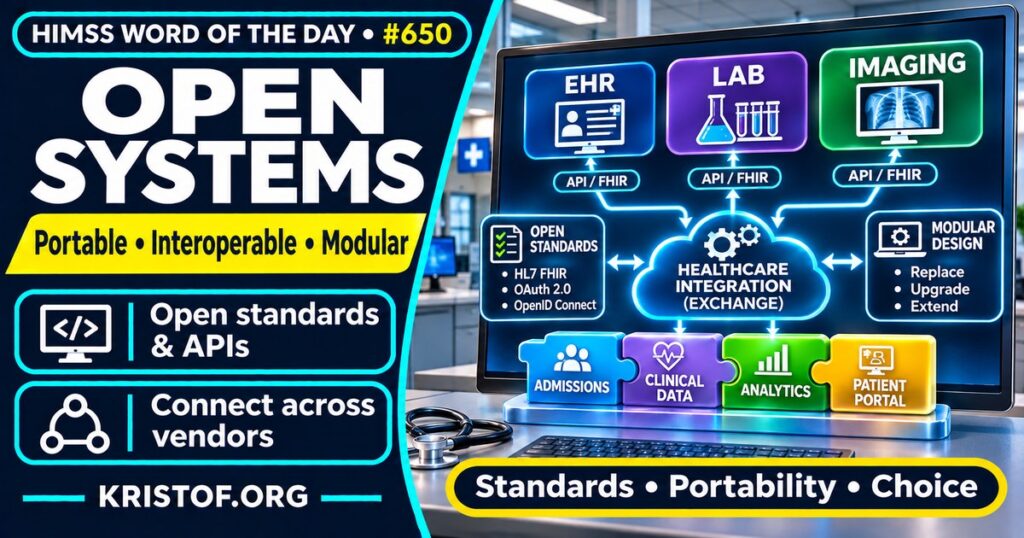
The HIMSS Dictionary describes an open system as a computer system that pairs portability with interoperability and relies on open software standards. In practice, the entry says, the term points to a system that works across different vendors and standards and is modular, so hardware and software are not locked to one vendor or platform.
Three ideas sit inside that description: portability (software can move between environments), interoperability (systems can exchange and use data), and modularity (parts can be swapped without rebuilding everything). The practical tests for health IT are whether a system uses published standards and whether other systems can connect to it without special arrangements.
In the United States, that second test has a legal hook. ONC’s blog post on application programming interfaces (June 2020) says the 21st Century Cures Act Final Rule requires health IT certified through the ONC program to include standardized APIs for patient and population services. It names standards such as HL7 FHIR, OAuth 2.0, and OpenID Connect 1.0 as supporting interoperability, and says the aim is to reduce the “special effort” needed to access and use electronic health information.
| Idea | What it means in health IT |
|---|---|
| Open standard | A published specification that many vendors can implement |
| Open system | A system built on open standards so it can connect to others and be modular |
| Open source | Software whose code is publicly available, which is a separate question |
| Proprietary interface | A vendor-specific connection that other systems may not be able to use |
⚠️ Exam Alert: Open system is about standards-based interoperability, portability, and modularity. Open source is about access to code. Open standards are a specification. Kapitan and colleagues (2025) argue that open standards are necessary but not sufficient for interoperability. The networking term Open Systems Interconnection shares the words but is a different concept that this post does not cover.
🌐 Why It Matters: Real-World Healthcare IT Context
Open systems matter in health IT because the choice between standards-based and proprietary connections affects how easily data moves, how much manual work staff do, and how hard it is to change vendors.
What studies show. ONC Data Brief No. 81 (February 2026) reports on hospital API use from the 2024 American Hospital Association Annual Survey IT Supplement. About 9 in 10 hospitals enabled patient access to health information through an API, and about 7 in 10 used standards-based APIs for patient access. For at least one clinical purpose, 91 percent of hospitals integrated data from third-party technology into the EHR and 83 percent provided EHR data to third-party technology, and 52 percent integrated clinical data through standards-based APIs. For administrative purposes, 86 percent integrated and 87 percent provided data, mostly through non-standards-based methods, with roughly one-third using standards-based APIs. The brief says most clinical and administrative sharing relied on proprietary EHR APIs or HL7 interfaces. Use of standards-based APIs was higher at medium-to-large hospitals, system-affiliated hospitals, and hospitals using one of the three largest EHR vendors, which ONC names as Cerner, Epic, and MEDITECH. For example, 77 percent of system-affiliated hospitals used standards-based APIs for patient access, compared with 57 percent of independent hospitals. The brief says non-standards-based methods involve manual effort and limit automation, but it does not analyze the causes in depth. These are survey-based, self-reported figures for hospitals, not measurements of system behavior.
Kapitan and colleagues (2025), in the Journal of Medical Internet Research, wrote a viewpoint arguing that open standards are necessary but not sufficient for interoperability and that the ecosystem of open-source software should be considered when choosing a standard. In federated learning they observe convergence toward OMOP and FHIR used side by side, and in health information exchanges in low- and middle-income countries they see convergence toward FHIR. It is an opinion piece based on the authors’ ongoing work.
Mehl and colleagues (2023), in Oxford Open Digital Health, say the global digital health ecosystem is project-centric, which results in data fragmentation and technology lock-in. They propose a “full-STAC” remedy of open standards, technologies, architectures, and content. This article advocates an approach and focuses on global digital health, not on US hospital systems.
Fechner and colleagues (2020), in Studies in Health Technology and Informatics, evaluated three repositories implementing the openEHR standard for compliance, completeness, and vendor lock-in. Basic functionality worked consistently, but no vendor supported the entire API, and some vendors offered custom APIs that were easier to use but led to vendor lock-in. The authors note that openEHR was a young standard and that these issues might be resolved. The study is small and from 2020, so conditions may have changed.
Randine and Arsand (2025), in the same journal, describe the patient user experience with a diabetes information system and discuss the lack of publicly available APIs for retrieving medical data and what that means for competitors, vendors, and user experience. It covers one system and its experienced users, and the abstract does not give the number of users.
What I could not find. I did not find evidence that open-system architectures lower cost or improve safety, independent measures of vendor lock-in in US hospitals, or how any specific EHR vendor implements its APIs. I also did not review the technical documents for FHIR or other standards.
Common open systems problems:
- Assuming “open” means interoperable in practice, when no vendor may support an entire standard
- Proprietary interfaces that create vendor lock-in
- Data sharing that depends on manual effort or non-standards-based methods
- Mixing up open standards, open-source software, and open systems
- Uneven use of standards-based APIs across hospital types
- Administrative data sharing lagging clinical data sharing
What supports sound open system practice:
- Standards-based APIs such as FHIR, as ONC describes
- Considering the open-source ecosystem when choosing a standard
- Testing vendors for standard compliance and completeness
- Publicly documented APIs
- Modular design so parts can change without a full rebuild
- Asking vendors to document which parts of a standard they support, an inference from the openEHR evaluation
🏥 The Nurse’s Perspective: Clinical, Bedside, & Workflow
Nurses feel the difference between open and closed systems when data from another system appears in the chart, or does not.
At the Bedside
Patient-generated data and device data are examples of information that may come from outside the main EHR. ONC’s brief reports that about two-thirds of hospitals enabled patient-generated health data submission to the EHR. Nurses are often the first to notice when such data is missing, late, or in the wrong place, and reporting it with the device or app name helps the right team trace it.
In Clinical Workflow
Nurse informaticists can join evaluations of apps, devices, and interfaces. A useful set of questions is which standard an interface uses, which version, how much of it the vendor supports, and whether the interface is documented. The openEHR evaluation above is a reminder that supporting only part of a standard is possible.
In EHR Implementation (Go-Live Perspective)
During an Epic Go-Live, interface testing covers devices, labs, and other systems. Analysts at the elbow hear interface problems as clinical questions, such as why a value did not arrive. This post does not claim that any specific go-live had an open-systems problem. It shows why the standards behind each interface belong on the test list.
🎓 CAHIMS / CPHIMS & HIMSS Perspective
CAHIMS Exam Domain Mapping
Open systems connect standards, architecture, and procurement:
| CAHIMS Domain | How Open Systems Appear |
|---|---|
| Healthcare & Technology Environments | Standards, APIs, and vendor-neutral architecture |
| Clinical Informatics | Data from apps, devices, and other systems reaching the chart |
| Healthcare Information & Systems Management | Interface design, testing, and avoiding vendor lock-in |
| Management & Leadership | Procurement language, vendor governance, and standards policy |
Key Terms to Know Alongside Open Systems
- Interoperability — the ability of systems to exchange and use data
- Open Source — software whose source code is publicly available
- Application Programming Interface (API) — a defined way for one program to work with another
- FHIR — HL7 Fast Healthcare Interoperability Resources, a standard named in ONC’s API requirements
- Vendor lock-in — dependence on one vendor’s products or interfaces that makes switching hard
- Modularity — a design in which parts can be replaced or added independently
HIMSS Organizational Position
HIMSS offers education and research on health information and technology topics through its Resource Center. Members can find related information on the HIMSS Resource Center page.
🧭 More HIMSS Word of The Day Terms
Related terms in the Interoperability and Standards series:
Browse all Interoperability and Standards terms or the A–Z glossary.
🔗 Explore Further: External References
- ONC — Hospital Use of APIs to Enable Data Sharing between EHRs and Third-Party Technology (Data Brief No. 81) https://healthit.gov/data/data-briefs/hospital-use-of-apis-to-enable-data-sharing-between-ehrs-and-third-party-technology/
- ONC — Application Programming Interfaces in Health IT (blog, June 11, 2020) https://healthit.gov/blog/21st-century-cures-act/application-programming-interfaces-in-health-it/
- Kapitan et al. (2025), Journal of Medical Internet Research — Data Interoperability in Context: The Importance of Open-Source Implementations When Choosing Open Standards https://pubmed.ncbi.nlm.nih.gov/40232773/
- Mehl et al. (2023), Oxford Open Digital Health — A full-STAC remedy for global digital health transformation: open standards, technologies, architectures and content https://pubmed.ncbi.nlm.nih.gov/40231272/
- Fechner et al. (2020), Studies in Health Technology and Informatics — Evaluation of openEHR Repositories Regarding Standard Compliance https://pubmed.ncbi.nlm.nih.gov/32570452/
- Randine and Arsand (2025), Studies in Health Technology and Informatics — User Experience and Vendor Lock-in with Current Diabetes Information System https://pubmed.ncbi.nlm.nih.gov/40380544/
- HIMSS — Resource Center https://www.himss.org/resource-center
Term source: HIMSS Dictionary of Health Information and Technology Terms, Acronyms, and Organizations, 6th Edition (2025). All definitions in this series are paraphrased for editorial purposes. Readers are encouraged to consult the primary source for exact language.
Eric Andrew Kristof, RN, CAHIMS is a Healthcare IT professional and HIMSS Arkansas Chapter member based in Hot Springs Village, AR, with hands-on Epic Go-Live experience and a diverse healthcare and IT background. He writes at kristof.org at the intersection of clinical care and healthcare technology.
Leave a Reply