By Eric Andrew Kristof, RN, CAHIMS | Healthcare IT Professional | HIMSS Arkansas Chapter Member
About This Series: The HIMSS Word of the Day is a running blog series drawing from the HIMSS Dictionary of Health Information and Technology Terms, Acronyms, and Organizations, 6th Edition (2025) — the authoritative reference for healthcare IT professionals and the primary study resource for CAHIMS and CPHIMS certification. Each post paraphrases the term in plain language, grounds it in real-world healthcare IT context, and adds a bedside nursing perspective you won’t find in a textbook.
📖 The Term: Biometrics
Source: HIMSS Dictionary of Health Information and Technology Terms, Acronyms, and Organizations, 6th Edition (2025)
🔍 Plain-Language Definition
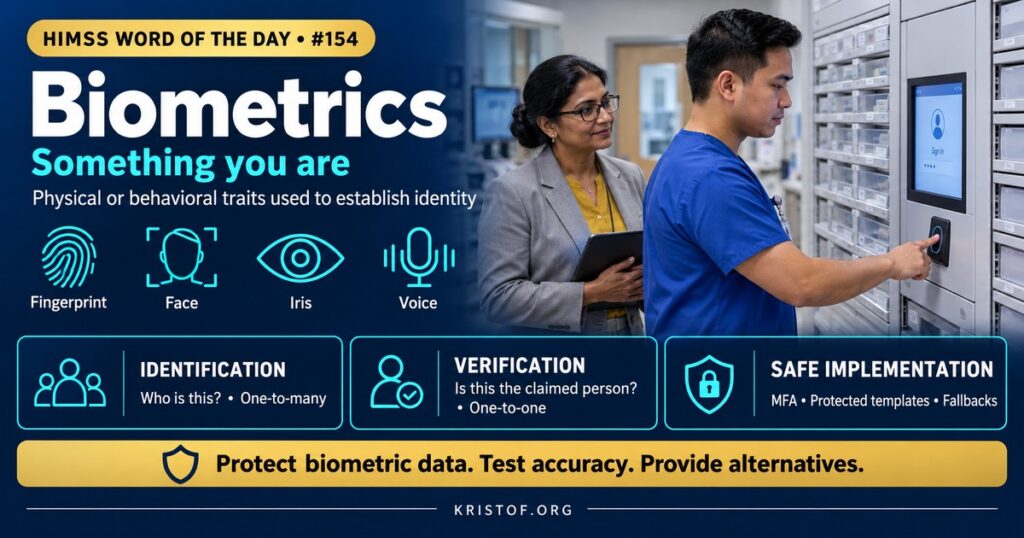
Biometrics are measurable physical or behavioral characteristics, such as fingerprints, facial geometry, iris patterns, palm veins, or voice, used to identify individuals or verify their claimed identity.
The HIMSS Dictionary gives several related descriptions: a physical or behavioral characteristic of a person; the use of unique personal traits, such as fingerprints, eye blood-vessel patterns, or voice prints, to confirm identity; and a science-based authentication method used in information assurance. It explains that biometric systems link an event to a single person, whereas a PIN or similar credential can be used by anyone who knows it.
| Biometric Type | How It Works | Healthcare Example |
|---|---|---|
| Fingerprint | Matches ridge patterns on the finger | Logging in to automated dispensing cabinets |
| Facial Recognition | Matches facial geometry from a camera | Unlocking mobile devices; some identity verification apps |
| Palm Vein | Uses infrared to map vein patterns in the palm | Patient identification at registration |
| Iris | Matches patterns in the colored part of the eye | High-security access or patient identification |
| Voice | Analyzes speech characteristics | Some telephone identity verification systems |
| Behavioral | Analyzes typing, gait, or usage patterns | Continuous authentication on devices |
⚠️ Exam Alert: Biometrics are something you are, one of three authentication factor types alongside something you know (password) and something you have (badge or token). Identification answers “who is this?” (one-to-many matching); verification answers “is this the person claimed?” (one-to-one matching). Biometrics cannot be changed if compromised, unlike passwords.
🌐 Why It Matters: Real-World Healthcare IT Context
Healthcare depends on knowing exactly who is who. Clinicians must be authenticated before accessing records, ordering medications, or removing controlled substances, and patients must be correctly identified so that results, orders, and records attach to the right person. Biometrics can strengthen both.
For clinicians, biometrics offer convenience and accountability. A fingerprint at an automated dispensing cabinet or a facial scan on a mobile device is faster than typing a password, and it is harder to share. That reduces the temptation to use shared logins in busy settings and creates a stronger link between actions and individuals.
Biometrics usually work best as part of multifactor authentication. NIST’s digital identity guidelines treat biometrics as a factor to be used together with a physical authenticator rather than as a standalone credential, in part because biometric matching is probabilistic and biometric traits are not secret. Electronic prescribing of controlled substances, for example, requires two-factor authentication, and a biometric can serve as one of those factors.
For patients, biometric identification can reduce duplicate records and misidentification. Some health systems use palm vein or facial recognition at registration to retrieve the correct record, which can help prevent overlays and duplicate medical record numbers and can support fraud prevention. Patient identification errors are a known safety risk, and biometrics are one tool alongside strong registration practices and master patient index management.
Accuracy matters. Biometric systems can produce false matches and false non-matches, and performance can vary with sensor quality, lighting, age, skin condition, injuries, gloves, or masks. NIST evaluates face recognition algorithms and has documented differences in accuracy across demographic groups for some algorithms, so organizations should test systems with their own populations.
Spoofing is a concern. Fake fingerprints, photos, or recordings can sometimes fool poorly designed systems, which is why liveness detection, which checks that a real person is present, is an important feature.
Privacy deserves special care. Biometric data is sensitive and permanent: a compromised password can be changed, but a fingerprint cannot. Some states have specific biometric privacy laws that require notice, consent, and limits on retention, and biometric identifiers are among the identifiers HIPAA lists for de-identification. Organizations should store biometric templates securely, often as encrypted mathematical representations rather than images, and limit their use to stated purposes.
Accessibility and alternatives matter as well. Some people cannot enroll certain biometrics because of disabilities, injuries, or cultural concerns, so systems need fallback methods that remain secure.
Common biometric challenges in healthcare:
- Gloves, masks, and hand hygiene products affecting readers
- False rejections slowing urgent workflows
- Spoofing of systems without liveness detection
- Privacy concerns and state biometric laws
- Enrollment difficulties for some patients and staff
- Secure storage of biometric templates
Practices for effective biometric use:
- Biometrics as one factor in multifactor authentication
- Liveness detection and quality sensors
- Encrypted template storage and clear retention limits
- Patient notice and consent where required
- Secure fallback methods for those who cannot enroll
- Testing accuracy across the organization’s population
🏥 The Nurse’s Perspective: Clinical, Bedside, & Workflow
Nurses use biometrics regularly, often at medication cabinets, workstations, and mobile devices.
At the Bedside
Fingerprint or other biometric logins at automated dispensing cabinets create a clear record of who removed each medication, supporting controlled substance accountability. Nurses should never allow others to use their biometric login or “pull under” their credentials.
When readers fail because of wet hands, lotion, or gloves, using approved fallback methods rather than asking a colleague to log in preserves accountability. Reporting persistent reader problems helps biomedical or IT teams fix or replace devices.
In Clinical Workflow
Biometric patient identification at registration or point of care can help ensure the right record is opened. Nurses still follow two-identifier verification at the bedside, because biometrics supplement, rather than replace, established patient identification practices.
Biometric authentication on mobile devices and workstations can speed access between patients, reducing the urge to leave sessions logged in. Combined with tap-and-go badges, these tools support both security and efficiency.
Patients may ask why their palm or face is being scanned. Nurses and registration staff can explain the purpose, how the information is protected, and whether alternatives exist.
In EHR Implementation (Go-Live Perspective)
During an Epic Go-Live, organizations may enroll staff in biometric authentication for medication cabinets, controlled substance prescribing, or single sign-on. Enrollment sessions must be scheduled before Go-Live so staff are not locked out on the first day.
At-the-elbow support analysts help with enrollment issues and fallback methods, and report devices that consistently fail. Clear instructions reduce frustration and discourage unsafe credential sharing.
🎓 CAHIMS / CPHIMS & HIMSS Perspective
CAHIMS Exam Domain Mapping
Biometrics appear in security and patient identification questions:
| CAHIMS Domain | How Biometrics Appear |
|---|---|
| Healthcare & Technology Environments | Digital identity standards; state biometric privacy laws; EPCS requirements |
| Clinical Informatics | Medication cabinet access, patient identification, workflow speed |
| Healthcare Information & Systems Management | Authentication factors, template storage, liveness detection, integration |
| Management & Leadership | Privacy policy, consent, vendor selection, accessibility |
Key Terms to Know Alongside Biometrics
- Multifactor Authentication (MFA) — verifying identity with two or more types of factors
- Identification vs Verification — one-to-many matching versus one-to-one confirmation
- False Match and False Non-Match — biometric errors accepting the wrong person or rejecting the right one
- Liveness Detection — techniques confirming a real, present person rather than a fake
- Biometric Template — the stored mathematical representation of a biometric trait
- Patient Identification — accurately matching a patient to the correct record and care
HIMSS Organizational Position
HIMSS addresses identity management and patient identification through its cybersecurity and interoperability work, supporting accurate patient matching and strong authentication. Members can find related education and research through the HIMSS Resource Center.
🔗 Explore Further: External References
- NIST — SP 800-63-4, Digital Identity Guidelines https://csrc.nist.gov/pubs/sp/800/63/4/final
- NIST — SP 800-76-2, Biometric Specifications for Personal Identity Verification https://csrc.nist.gov/pubs/sp/800/76/2/final
- NIST — Face Recognition Technology Evaluation https://www.nist.gov/programs-projects/face-recognition-vendor-test-frvt
- HHS — Guidance Regarding Methods for De-identification of PHI https://www.hhs.gov/hipaa/for-professionals/special-topics/de-identification/index.html
- eCFR — 45 CFR 164.312, HIPAA Technical Safeguards https://www.ecfr.gov/current/title-45/subtitle-A/subchapter-C/part-164/subpart-C/section-164.312
- HIMSS — Healthcare Cybersecurity Community https://www.himss.org/networking/communities/healthcare-cybersecurity/
Term source: HIMSS Dictionary of Health Information and Technology Terms, Acronyms, and Organizations, 6th Edition (2025). All definitions in this series are paraphrased for editorial purposes. Readers are encouraged to consult the primary source for exact language.
Eric Andrew Kristof, RN, CAHIMS is a Healthcare IT professional and HIMSS Arkansas Chapter member based in Hot Springs Village, AR, with hands-on Epic Go-Live experience and a diverse healthcare and IT background. He writes at kristof.org at the intersection of clinical care and healthcare technology.
Leave a Reply