By Eric Andrew Kristof, RN, CAHIMS | Healthcare IT Professional | HIMSS Arkansas Chapter Member
About This Series: The HIMSS Word of The Day is a running blog series drawing from the HIMSS Dictionary of Health Information and Technology Terms, Acronyms, and Organizations, 6th Edition (2025) — the authoritative reference for healthcare IT professionals and the primary study resource for CAHIMS and CPHIMS certification. Each post paraphrases the term in plain language, grounds it in real-world healthcare IT context, and adds a bedside nursing perspective you won’t find in a textbook.
📖 The Term: EAV (Entity-Attribute-Value) Model
Source: HIMSS Dictionary of Health Information and Technology Terms, Acronyms, and Organizations, 6th Edition (2025)
🔍 Plain-Language Definition
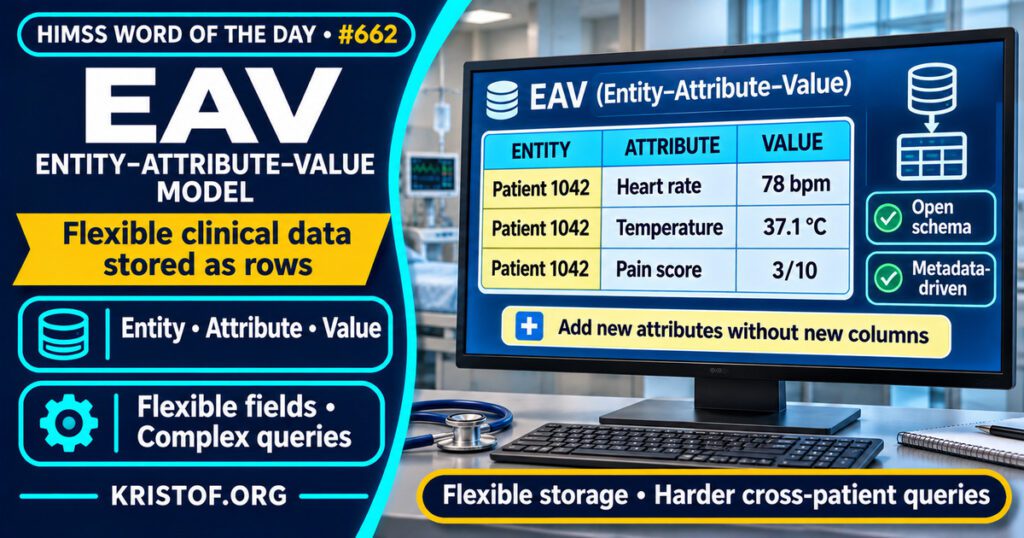
The HIMSS Dictionary describes the EAV (entity-attribute-value) model as a database design, also called an open schema or a vertical model, for situations in which the full list of attributes is not known ahead of time and may grow large. An entity is the thing being described, much like an object. An attribute is a property of that thing. A value is what the property holds for that particular entity. The dictionary also notes that developers sometimes reach for this design early in a project, when requirements are not settled or when a stakeholder wants one generic structure that could fit any future need.
In a conventional relational table, each attribute is a column. In an EAV table, each attribute value is its own row, so the table has few columns and many rows, which is why it is called vertical.
| Component | Meaning | Illustrative example (not from a source) |
|---|---|---|
| Entity | The thing being described | A patient or encounter identifier |
| Attribute | A property of the entity | “Heart rate” or “pressure ulcer stage” |
| Value | What the attribute holds for that entity | A number, a code, or a text entry |
| Metadata | The description of what each attribute means | A dictionary of attribute names, types, and limits |
⚠️ Exam Alert: Do not confuse the EAV model with an entity-relationship (ER) model. An ER model is a way to draw the entities in a domain and how they relate. EAV is a physical storage pattern in which attributes are stored as rows. Also note that “vertical” and “open schema” describe the same design as EAV in the HIMSS Dictionary.
🌐 Why It Matters: Real-World Healthcare IT Context
Clinical data changes constantly. New assessments, new devices, and new research questions all add data elements. Anhøj (2003) reviewed the literature on generic clinical database design, finding eight peer-reviewed articles and one web tutorial, and reported that all of them described the entity-attribute-value design as a way to simplify the physical layout of clinical data tables. The paper explains the logic: in a conventional relational system, adding or changing a data type means changing the physical database design, while EAV lets new attributes be added as stored values. It names the main advantages as flexibility and effective entity-centered data retrieval. It names the main disadvantages as complicated front-end programming needed to show data in a layout users recognize, and less efficient attribute-centered queries.
The query cost. Wade and colleagues (2011) note that many clinical research data integration platforms rely on EAV because of its flexibility, even though it presents problems in query formulation and execution time. They designed an alternative, the Dimensional Bus model, which borrows from both EAV and enterprise data warehousing. In it, each type of observational collection has its own table, and those tables link to a bus that holds provenance and classification dimensions. They report implementing a clinical research data repository on that design. Deshpande and colleagues (2003) describe a related problem for time-based questions: because of the EAV storage used by clinical study systems and patient record systems, parameter data must first be converted into a conventional one-column-per-parameter form before temporal operators can be applied.
Standards and exchange. Duftschmid and colleagues (2010) worked with a research-oriented electronic health record system built on EAV at the Medical University of Vienna. They proposed a method to extract data in a form that conforms to the ISO/EN 13606 record architecture standard, using archetypes, and tested it with three archetypes. They state that the approach requires the system’s internal data model and the archetype to overlap enough for a semantic mapping, and that the system must provide an XML export. Bouaud and colleagues (2018) describe an ontology template built on the EAV model, developed for a breast cancer decision support module in the DESIREE project, that combines generic data model components with existing terminology resources.
Nursing data entry. Kim and Park (2012) built structured data entry templates on EAV models for pressure ulcer wound management. They identified 13 entities, defined attribute cardinalities and data types, mapped terms to SNOMED CT concepts, and produced six templates and a relational database with ten tables. Five nurse experts tested scenarios heuristically and entered all data except one element, and retrieved the expected recommendations when data were entered correctly. This was a development and heuristic evaluation with scenarios, not a trial in live care.
What I could not confirm. I did not find a public source that describes the internal data model of any specific commercial EHR, so I cannot say which products store clinical observations in EAV form. The studies above are mostly from 2003 to 2012, with one from 2018, and database technology has changed since. The abstracts do not give query timing figures, so I cannot quantify how much slower attribute-centered queries are. I read abstracts only, not full texts.
Common EAV problems:
- Using EAV by default because requirements are unclear, without weighing query needs
- Slow or complicated queries that ask about one attribute across many entities
- Front-end code that must rebuild a familiar table layout from rows
- Weak metadata, so attribute names and types are unclear
- Time-based queries that need data converted to a column-per-parameter form first
What supports EAV:
- Adding new data elements without changing the physical schema
- Efficient retrieval of everything recorded about one entity
- Generic forms generated at run time from metadata
- Mapping attributes to standard terminologies such as SNOMED CT
- Hybrid designs that combine EAV flexibility with conventional tables
🏥 The Nurse’s Perspective: Clinical, Bedside, & Workflow
Nurses meet EAV-style design as structured fields, templates, and flowsheet rows, even when the storage design is invisible to them.
At the Bedside
A nurse records an assessment value, and the system stores it against the patient and the item being assessed. Kim and Park (2012) built EAV models for a pressure ulcer wound assessment data set, created templates from them, and had five nurse experts try the templates in scenarios. When data are entered incorrectly or left out, downstream recommendations depend on what was entered, so complete entry matters.
In Clinical Workflow
When a unit wants a new assessment field, the question for the analyst is whether it fits an existing structure or needs a new one. Flexible designs make it easier to add elements, but the reviews above also warn that retrieving one attribute across many patients can be harder. A nurse leader asking for a report on a single measurement across a unit may therefore depend on how the data model was built.
In EHR Implementation (Go-Live Perspective)
During an Epic Go-Live, analysts and at-the-elbow support staff hear requests for new data fields, reports, and quality measures. Knowing that some data models favor flexible entry over simple reporting helps analysts explain why a report request can take time. This is a workflow observation, and no source reviewed here says that any specific EHR uses EAV.
🎓 CAHIMS / CPHIMS & HIMSS Perspective
CAHIMS Exam Domain Mapping
The EAV model appears wherever clinical data are stored, queried, and exchanged:
| CAHIMS Domain | How the EAV Model Appears |
|---|---|
| Healthcare & Technology Environments | Database design, clinical data repositories, and research platforms |
| Clinical Informatics | Structured data entry, terminology mapping, and decision support |
| Healthcare Information & Systems Management | Data modeling choices, reporting, and system performance |
| Management & Leadership | Governance of data elements, requirements, and design trade-offs |
Key Terms to Know Alongside the EAV Model
- Relational database — a database that organizes data into tables of rows and columns
- Data warehouse — a store that integrates data from several sources for analysis and reporting
- Metadata — data that describe other data, such as attribute names, types, and meanings
- Schema — the formal structure of a database, including its tables and fields
- Archetype — a formal definition of the structure and meaning of a clinical content item
- SNOMED CT — a clinical terminology used to represent clinical meaning in records
HIMSS Organizational Position
HIMSS offers education and research on health information and technology topics through its Resource Center. Members can find related information on the HIMSS Resource Center page.
🧭 More HIMSS Word of The Day Terms
Related terms in the Data and Analytics series:
Browse all Data and Analytics terms or the A–Z glossary.
🔗 Explore Further: External References
- Anhøj (2003), Journal of Medical Internet Research — Generic design of Web-based clinical databases https://pubmed.ncbi.nlm.nih.gov/14713655/
- Wade et al. (2011), Journal of the American Medical Informatics Association — A Dimensional Bus model for integrating clinical and research data https://pubmed.ncbi.nlm.nih.gov/21856687/
- Duftschmid et al. (2010), International Journal of Medical Informatics — Extraction of standardized archetyped data from Electronic Health Record systems based on the Entity-Attribute-Value Model https://pubmed.ncbi.nlm.nih.gov/20537942/
- Kim and Park (2012), International Journal of Medical Informatics — Development and evaluation of data entry templates based on the entity-attribute-value model for clinical decision support of pressure ulcer wound management https://pubmed.ncbi.nlm.nih.gov/22079242/
- Deshpande et al. (2003), International Journal of Medical Informatics — Temporal query of attribute-value patient data: utilizing the constraints of clinical studies https://pubmed.ncbi.nlm.nih.gov/12706183/
- Bouaud et al. (2018), Studies in Health Technology and Informatics — Combining the Generic Entity-Attribute-Value Model and Terminological Models into a Common Ontology to Enable Data Integration and Decision Support https://pubmed.ncbi.nlm.nih.gov/29678019/
- HIMSS — Resource Center https://www.himss.org/resource-center
Term source: HIMSS Dictionary of Health Information and Technology Terms, Acronyms, and Organizations, 6th Edition (2025). All definitions in this series are paraphrased for editorial purposes. Readers are encouraged to consult the primary source for exact language.
Eric Andrew Kristof, RN, CAHIMS is a Healthcare IT professional and HIMSS Arkansas Chapter member based in Hot Springs Village, AR, with hands-on Epic Go-Live experience and a diverse healthcare and IT background. He writes at kristof.org at the intersection of clinical care and healthcare technology.
Leave a Reply