By Eric Andrew Kristof, RN, CAHIMS | Healthcare IT Professional | HIMSS Arkansas Chapter Member
About This Series: The HIMSS Word of The Day is a running blog series drawing from the HIMSS Dictionary of Health Information and Technology Terms, Acronyms, and Organizations, 6th Edition (2025) — the authoritative reference for healthcare IT professionals and the primary study resource for CAHIMS and CPHIMS certification. Each post paraphrases the term in plain language, grounds it in real-world healthcare IT context, and adds a bedside nursing perspective you won’t find in a textbook.
📖 The Term: LTCF (Long-Term Care Facility)
Source: HIMSS Dictionary of Health Information and Technology Terms, Acronyms, and Organizations, 6th Edition (2025)
🔍 Plain-Language Definition
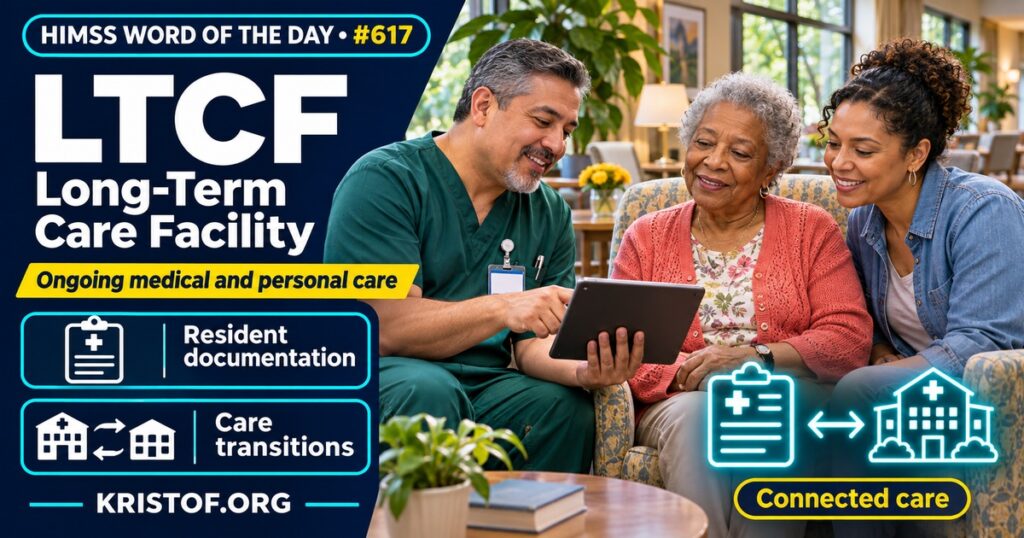
The HIMSS Dictionary uses LTCF as a group name for skilled nursing facilities, assisted living facilities, and nursing homes. Residents receive medical and personal care because they cannot manage on their own in the community.
The federal regulations are narrower. In 42 CFR Part 483, Subpart B, titled requirements for long-term care facilities, the definitions section (as posted by Cornell’s Legal Information Institute, with amendments listed through December 2025) says a facility is either a skilled nursing facility that meets certain requirements of section 1819 of the Social Security Act or a nursing facility that meets certain requirements of section 1919. A facility can be a distinct part of a larger institution, and the section excludes institutions for individuals with intellectual disabilities or related conditions. The page does not define “long term care facility” as a stand-alone term. CMS says on its nursing homes page that skilled nursing facilities and nursing facilities must meet Subpart B to receive Medicare or Medicaid payment, and that facilities participating in both programs are called dually participating. The CMS page does not mention assisted living, and this post did not research how assisted living is regulated.
| Item | Detail |
|---|---|
| Dictionary scope | Skilled nursing facilities, assisted living facilities, and nursing homes |
| Federal scope (42 CFR Part 483, Subpart B) | Skilled nursing facilities (Medicare) and nursing facilities (Medicaid) |
| Certification | A state surveyor completes a Life Safety Code survey, a standard health survey, and an emergency preparedness survey, per CMS |
| Data requirement | The Minimum Data Set for every resident of a certified nursing facility |
| Related terms | Long-term care, skilled nursing facility, MDS, and EHR |
⚠️ Exam Alert: LTC is the care, and an LTCF is a place that delivers it. A skilled nursing facility is the Medicare-certified type, and a nursing facility is the Medicaid type. Do not assume every setting the dictionary groups under LTCF falls under the same federal certification rules.
🌐 Why It Matters: Real-World Healthcare IT Context
For health IT teams, a long-term care facility is both a care setting and a data trading partner. Hospitals send residents to facilities and receive them back, and the facility’s own records and reporting duties shape what information moves.
CMS certification and the Minimum Data Set. The CMS nursing homes page says a state surveyor must complete a Life Safety Code survey, a standard health survey, and an emergency preparedness survey before certifying a skilled nursing facility or nursing facility. For a non-state-operated skilled nursing facility, the state certifies compliance subject to CMS approval, while for a non-state-operated nursing facility the state’s certification is final. A separate CMS page, last modified September 10, 2024, says certified Medicare or Medicaid nursing facilities must complete, record, encode, and transmit the Minimum Data Set for every resident regardless of age, diagnosis, length of stay, or payment category. It lists two exceptions: licensed-only facilities that participate in neither program, unless the state requires otherwise, and residents of non-certified units that are physically distinct from the rest of the institution. It says failing to complete and transmit the MDS counts as noncompliance with 42 CFR 483.20 and can lead to enforcement action. The figures below come from study abstracts, so confirm them in the original papers.
What recent studies show. The studies below describe associations and syntheses. None proves that a technology caused an outcome.
- Pradhan and colleagues (2025) surveyed federally certified Arkansas nursing homes in 2018. Of 223 homes surveyed, 63 responded and 48 of those reported EHR implementation. Using 744 facility-years from 2008 to 2020 and a before-and-after regression, they found that homes that had implemented an EHR had an 18% lower rate of deficiencies (incidence rate ratio 0.82, 95% confidence interval 0.70 to 0.99). EHR implementation was self-reported, response was limited, and the data come from one state.
- Turbow and colleagues (2025) studied 385,895 Medicare heart failure admissions in 2018, of which 21.9% ended in discharge to a skilled nursing facility. Hospital health information exchange participation was not significantly associated with discharge to a skilled nursing facility overall, but among beneficiaries admitted from one it was associated with 17% lower odds (adjusted odds ratio 0.83, 95% confidence interval 0.73 to 0.95). The authors suggest that expanding information exchange to skilled nursing facilities and other long-term care facilities may matter, which is their interpretation of observational data.
- Monticelli and colleagues (2025) systematically reviewed 30 studies of data quality in resident documentation in residential long-term care. They report that electronic health records, education, incident reporting systems, and reminders were associated with small to moderate improvements, with an average 13% improvement in data completeness (95% confidence interval 7% to 20%). The evidence was rated very low certainty, mostly covered completeness, and the authors conclude it remains unclear which interventions work.
Common LTCF problems:
- Treating LTCF as one regulatory category when programs define facility types differently
- Assuming assisted living follows the same federal certification rules as nursing facilities, a point the CMS pages read for this post do not address
- Incomplete resident documentation, the focus of the Monticelli review
- Limited information exchange with hospitals when residents transfer
- Missed or incomplete Minimum Data Set completion and transmission
What supports sound LTCF data work:
- Knowing the facility’s type and certification status
- Complete and timely Minimum Data Set submission
- Documentation tools and EHR features that support completeness
- Information exchange that includes facilities, not only hospitals
- Champions, audit and feedback, and ongoing consultation, the implementation strategies the Monticelli review lists
🏥 The Nurse’s Perspective: Clinical, Bedside, & Workflow
Nurses in long-term care facilities care for residents over months and years, and much of their documentation feeds the facility’s required data.
At the Bedside
Residents often move between a facility and a hospital, and nurses on both sides handle those handoffs. What arrives with the resident, and in what form, shapes the first hours of care. The Turbow study suggests that information exchange reaching facilities could matter, though it does not test a specific handoff process.
In Clinical Workflow
Facility nurses document care that supports the Minimum Data Set, which CMS requires certified nursing facilities to complete and transmit for every resident. Nurse informaticists help by making documentation easy to complete and by tracking gaps. The Monticelli review lists champions, audit and feedback, and ongoing consultation as strategies that supported implementation.
In EHR Implementation (Go-Live Perspective)
Analysts supporting an Epic Go-Live at a hospital may encounter facility staff at discharge points, where the questions are about what information arrives and when. Working out which facility types a hospital sends residents to, and how their records and exchange options differ, is a practical early step. This post does not claim that any specific go-live had a facility handoff problem.
🎓 CAHIMS / CPHIMS & HIMSS Perspective
CAHIMS Exam Domain Mapping
LTCF supports care-setting and data-requirement knowledge:
| CAHIMS Domain | How LTCF Appears |
|---|---|
| Healthcare & Technology Environments | Post-acute settings and their connections to hospitals |
| Clinical Informatics | Resident documentation and transitions of care |
| Healthcare Information & Systems Management | Certification, the MDS, and data reporting |
| Management & Leadership | Quality oversight and information exchange planning |
Key Terms to Know Alongside LTCF
- Long-term care — ongoing services for people who cannot manage independently
- Skilled nursing facility — the Medicare-certified nursing home type in 42 CFR Part 483, Subpart B
- Minimum Data Set — the resident assessment data certified nursing facilities complete and transmit for every resident
- Health information exchange — electronic sharing of health information across organizations
- Transition of care — a resident’s move between settings, such as hospital to facility
- Electronic health record — the digital record of a resident’s care
HIMSS Organizational Position
HIMSS offers education and research on health information and technology topics through its Resource Center. Members can find related information on the HIMSS Resource Center page.
🧭 More HIMSS Word of The Day Terms
Related terms in the Healthcare Policy series:
Browse all Healthcare Policy terms or the A–Z glossary.
🔗 Explore Further: External References
- Cornell Legal Information Institute — 42 CFR 483.5, Definitions (Part 483, Subpart B, long-term care facilities) https://www.law.cornell.edu/cfr/text/42/483.5
- CMS — Nursing Homes (Certification and Compliance) https://www.cms.gov/medicare/health-safety-standards/certification-compliance/nursing-homes
- CMS — MDS Applicability https://www.cms.gov/data-research/computer-data-systems/minimum-data-sets-2.0-tool-public-reports/mds-applicability
- Pradhan et al. (2025), Health information management journal — Enhancing nursing home quality through electronic health record implementation https://pubmed.ncbi.nlm.nih.gov/39183673/
- Turbow et al. (2025), BMC health services research — Hospital health information exchange participation and heart failure discharges to skilled nursing facilities: a cohort study https://pubmed.ncbi.nlm.nih.gov/40814121/
- Monticelli et al. (2025), Journal of the American Medical Directors Association — Data Quality of Resident Documentation in Long-Term Care: A Systematic Review and Meta-analysis https://pubmed.ncbi.nlm.nih.gov/40024615/
- HIMSS — Resource Center https://www.himss.org/resource-center
Term source: HIMSS Dictionary of Health Information and Technology Terms, Acronyms, and Organizations, 6th Edition (2025). All definitions in this series are paraphrased for editorial purposes. Readers are encouraged to consult the primary source for exact language.
Eric Andrew Kristof, RN, CAHIMS is a Healthcare IT professional and HIMSS Arkansas Chapter member based in Hot Springs Village, AR, with hands-on Epic Go-Live experience and a diverse healthcare and IT background. He writes at kristof.org at the intersection of clinical care and healthcare technology.
Leave a Reply