By Eric Andrew Kristof, RN, CAHIMS | Healthcare IT Professional | HIMSS Arkansas Chapter Member
About This Series: The HIMSS Word of the Day is a running blog series drawing from the HIMSS Dictionary of Health Information and Technology Terms, Acronyms, and Organizations, 6th Edition (2025) — the authoritative reference for healthcare IT professionals and the primary study resource for CAHIMS and CPHIMS certification. Each post paraphrases the term in plain language, grounds it in real-world healthcare IT context, and adds a bedside nursing perspective you won’t find in a textbook.
📖 The Term: Voice Recognition
Source: HIMSS Dictionary of Health Information and Technology Terms, Acronyms, and Organizations, 6th Edition (2025)
🔍 Plain-Language Definition
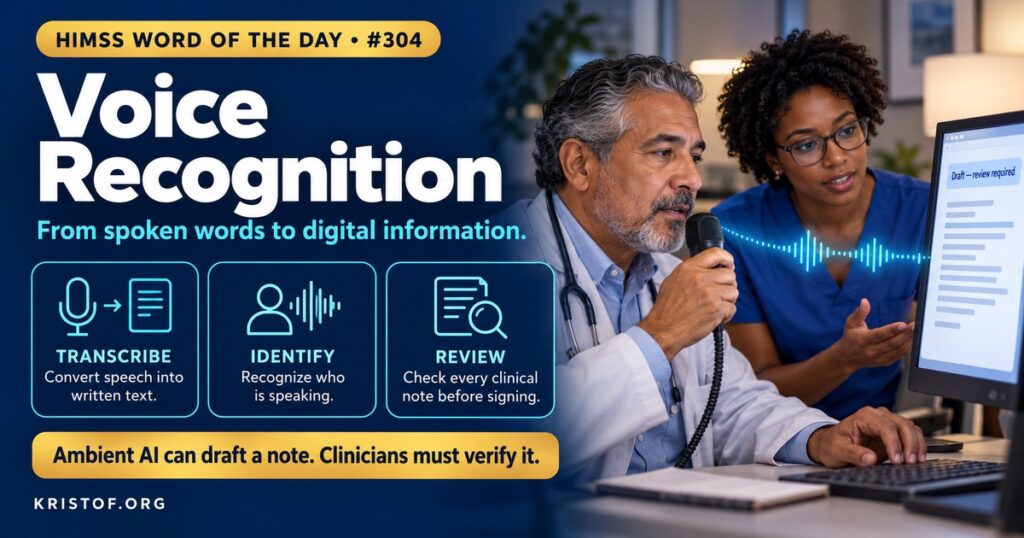
Voice recognition is the computer analysis of the human voice. The HIMSS Dictionary describes two main purposes: interpreting words and phrases, and identifying an individual speaker. In health care, the first purpose is better known as speech recognition or speech-to-text, in which software converts a clinician’s spoken words into written text. The second, speaker identification or voice biometrics, uses the sound of a voice to verify who is speaking.
The technology has changed greatly. Early systems required users to train the software on their own voice and to dictate into a note one phrase at a time, with commands for punctuation and navigation. Modern automatic speech recognition (ASR) systems use machine learning and can transcribe natural speech. The newest products are ambient voice technologies or ambient AI scribes, which listen to the conversation between clinician and patient, transcribe it, and use generative AI to draft a note for the clinician to review and sign.
| Technology | What It Does | Main Risk |
|---|---|---|
| Dictation and speech-to-text | Converts a clinician’s speech to text | Misrecognized words and uncorrected errors |
| Voice commands | Controls software by voice | Accidental or misheard commands |
| Ambient AI scribe | Drafts a note from a conversation | Omissions, invented content, propagated errors |
| Speaker identification | Verifies or identifies a speaker | False accept or reject, privacy concerns |
⚠️ Exam Alert: Voice recognition can mean speech-to-text or identifying a speaker; natural language processing interprets the meaning of text; an ambient AI scribe combines speech recognition with generative AI. The signing clinician remains responsible for the content of the note.
🌐 Why It Matters: Real-World Healthcare IT Context
Documentation is a major source of clinician workload, so voice tools are attractive. Evidence is accumulating on both benefits and risks.
A 2026 controlled evaluation in the Journal of Medical Systems tested eight systems on narrated surgical case reports: three commercial transcription systems (including Dragon Medical One), four ASR speech-to-text APIs, and an experimental pipeline that corrected ASR output with a large language model. The reference set was 100 transcripts of 32,897 words, producing 800 outputs. The main outcome was the proportion of outputs with at least one clinically significant error graded for potential harm. Across systems, that proportion ranged from 30 to 68 percent, with the experimental two-stage pipeline lowest at 30 percent. In the raw speech-recognition output that fed the experimental pipeline, 89 clinically significant errors were found; language-model correction resolved 51, left 38, and introduced 4 new ones. The study used one speaker and surgical narratives, so it cannot be applied to every setting, but it shows that even strong systems produced potentially harmful errors in a large share of transcripts, and that automatic correction can both fix and create errors.
Language barriers add risk. A 2026 study in JMIR Medical Informatics used simulated English and Spanish clinical encounters to see how ambient AI scribes handled interpreter-mediated visits. The scribes carried interpreter errors into the clinical notes, with patterns that varied by speaker role and error type. The authors called for more evaluation of scribe performance in multilingual and interpreter-mediated care, which matters because patients with limited English proficiency are already at higher risk of communication harm.
Time savings are modest but measurable. A 2026 retrospective cohort study in JMIR AI examined an emergency department rollout of an ambient scribe, with 10,344 encounters managed by 100 attending physicians. Use at the physician’s discretion was associated with a 72.6-second reduction in on-shift documentation time per encounter (95 percent confidence interval 63.8 to 81.4), and a small increase of 9.1 seconds in after-shift time. A 2026 multisite study in Annals of Emergency Medicine compared AI-scribed and unassisted notes among 275 attending physicians across 20 emergency departments, using EHR audit logs. About 31 percent of encounters were AI-scribed. Active time in the note was lower, with a median of 10.0 versus 12.5 minutes (2.4 minutes less after adjustment), notes were started later and were about 14 percent longer, completion was not delayed, and 72-hour return rates were not increased. Both studies are observational, so unmeasured differences between scribed and unscribed encounters may remain, but they use objective audit data, not only self-report.
Traditional speech recognition remains a source of errors that persist when the software does not learn them. A 2026 report in the American Journal of Roentgenology described a radiologist without programming expertise who used AI-assisted coding to build a personalized rule-based proofreading system for recurrent speech recognition errors in radiology reports. It was a single-user development report, but it illustrates that users often develop their own safeguards.
Safe use depends on process. Organizations that adopt voice tools define who may use them and for what visits, tell patients that a recording or transcription tool is in use and obtain consent where required, and decide how recordings and transcripts are stored and protected. Clinicians review every note before signing, since a fluent draft can hide errors. Teams monitor for patterns such as omitted history, wrong laterality, or incorrect medication doses, and gather feedback from users and patients. Contracts cover whether the vendor may keep or use audio and text.
Common voice recognition problems:
- Misrecognized drug names, numbers, or laterality
- Clinicians signing drafts without careful review
- Errors carried through interpreters or noisy rooms
- Unclear patient notice and consent for recording
- Vendor reuse of audio and transcripts
- Time savings that are claimed but not measured
What supports safe voice tools:
- Clinician review and sign-off on every note
- Pilot evaluation with error audits in local settings
- Patient notice and consent practices
- Contracts that limit vendor use of data
- Monitoring for omissions and invented content
- Attention to multilingual and interpreter-mediated visits
🏥 The Nurse’s Perspective: Clinical, Bedside, & Workflow
Nurses use voice tools in documentation, in dictating telephone encounters, and as patients and colleagues of clinicians who use ambient scribes.
At the Bedside
Where voice tools are available, nurses use them to document assessments and notes more quickly, and check that the text matches what was said. Numbers, units, and drug names deserve particular attention. Nurses also explain to patients when a recording tool is in use and answer questions about privacy.
In Clinical Workflow
Nurse managers decide whether voice documentation fits the unit’s noise and privacy conditions. Clinic nurses see ambient scribes in physician visits and watch whether the resulting notes reflect what was discussed, flagging omissions. In interpreter-mediated visits, nurses help ensure that clinicians confirm key points directly with the patient.
Nurse informaticists take part in pilots, design error-audit methods, and help set rules on consent, review, and storage. They also collect feedback from staff about time savings, accuracy, and burdens such as editing.
In EHR Implementation (Go-Live Perspective)
An Epic Go-Live that introduces voice or ambient tools changes documentation habits. At-the-elbow support analysts see where a transcription habit leaves information in the wrong field or where staff do not edit drafts, and they pass these examples to training and governance teams.
🎓 CAHIMS / CPHIMS & HIMSS Perspective
CAHIMS Exam Domain Mapping
Voice recognition appears in AI, documentation, and privacy questions:
| CAHIMS Domain | How Voice Recognition Appears |
|---|---|
| Healthcare & Technology Environments | Privacy, consent for recording, regulation of AI tools |
| Clinical Informatics | Documentation workflow, accuracy, safety, human factors |
| Healthcare Information & Systems Management | ASR integration, audio storage, vendor contracts, security |
| Management & Leadership | Pilot design, evaluation, change management, burnout |
Key Terms to Know Alongside Voice Recognition
- Automatic Speech Recognition (ASR) — software that converts spoken language to text
- Natural Language Processing (NLP) — computer analysis of the meaning of language
- Ambient AI Scribe — tool that listens to a visit and drafts a clinical note
- Large Language Model (LLM) — AI model trained on large text collections to generate and transform language
- Voice Biometrics — use of voice characteristics to verify identity
- Hallucination — AI output that is fluent but not supported by the source
HIMSS Organizational Position
HIMSS supports the responsible use of artificial intelligence and documentation technology through its research, education, and community work. Members can find related resources through the HIMSS Resource Center.
🔗 Explore Further: External References
- O’Kane et al. (2026), Journal of Medical Systems — A Controlled Single-Speaker Evaluation of Ambient Voice Technologies’ Speech-to-Text Function Using Narrated Surgical Case-Reports https://pubmed.ncbi.nlm.nih.gov/42853293/
- Rabotin et al. (2026), JMIR Medical Informatics — Propagation of Interpreter Errors by Ambient AI Scribes: Study Using Simulated Clinical Encounters https://pubmed.ncbi.nlm.nih.gov/42520279/
- Preiksaitis et al. (2026), JMIR AI — Ambient AI Scribes and Emergency Department Documentation Burden: Retrospective Cohort Study https://pubmed.ncbi.nlm.nih.gov/42391625/
- Martini et al. (2026), Annals of Emergency Medicine — Ambient Artificial Intelligence Scribe Use and Objective Documentation Effort Among Emergency Physicians https://pubmed.ncbi.nlm.nih.gov/42949694/
- Araki et al. (2026), AJR American Journal of Roentgenology — Personalized Rule-Based Proofreading for Speech Recognition Errors in Radiology Reports: Development Using Artificial Intelligence Coding Assistance https://pubmed.ncbi.nlm.nih.gov/41811142/
Term source: HIMSS Dictionary of Health Information and Technology Terms, Acronyms, and Organizations, 6th Edition (2025). All definitions in this series are paraphrased for editorial purposes. Readers are encouraged to consult the primary source for exact language.
Eric Andrew Kristof, RN, CAHIMS is a Healthcare IT professional and HIMSS Arkansas Chapter member based in Hot Springs Village, AR, with hands-on Epic Go-Live experience and a diverse healthcare and IT background. He writes at kristof.org at the intersection of clinical care and healthcare technology.
Leave a Reply