By Eric Andrew Kristof, RN, CAHIMS | Healthcare IT Professional | HIMSS Arkansas Chapter Member
About This Series: The HIMSS Word of The Day is a running blog series drawing from the HIMSS Dictionary of Health Information and Technology Terms, Acronyms, and Organizations, 6th Edition (2025) — the authoritative reference for healthcare IT professionals and the primary study resource for CAHIMS and CPHIMS certification. Each post paraphrases the term in plain language, grounds it in real-world healthcare IT context, and adds a bedside nursing perspective you won’t find in a textbook.
📖 The Term: ISBT 128
Source: HIMSS Dictionary of Health Information and Technology Terms, Acronyms, and Organizations, 6th Edition (2025)
🔍 Plain-Language Definition
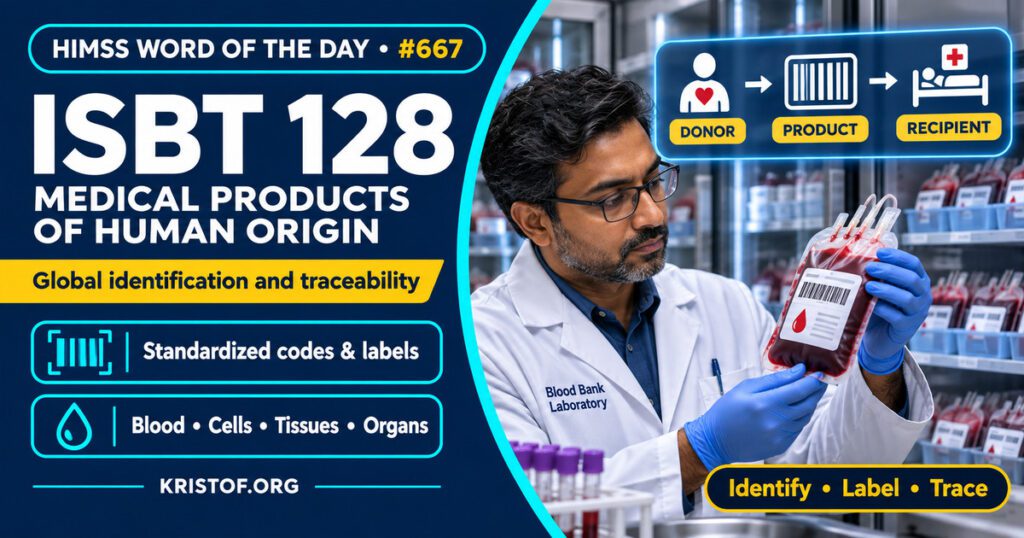
The HIMSS Dictionary describes ISBT 128 as a worldwide standard for how medical products of human origin are named, identified, coded, and labeled. That group includes blood, cell, tissue, milk, and organ products. The dictionary says the standard is used in more than 77 countries on six continents, that the professional community widely endorses it, and that it is meant to give international consistency to the transfer, traceability, and transfusion or transplantation of these products.
ICCBBA, the International Council for Commonality in Blood Banking Automation, maintains the standard. ICCBBA’s home page calls itself a global nonprofit focused on patient safety that leads the development and management of ISBT 128, and says the standard is used on six continents. The page does not give a count of countries, so I could not verify the dictionary’s 77 figure.
| Element | What it covers | Source |
|---|---|---|
| Terminology | Standard names for products | Dictionary and ICCBBA |
| Coding | Codes for products and facilities | Dictionary and ICCBBA |
| Labeling | Machine-readable labels on products | Dictionary and ICCBBA |
| Scope | Blood, cell, tissue, milk, and organ products, plus other therapeutic biological products | ICCBBA home page |
⚠️ Exam Alert: ISBT 128 is a labeling and coding standard for medical products of human origin, while GS1 standards identify trade items and locations more broadly. GS1 and ICCBBA, which maintains ISBT 128, are two of the three UDI issuing agencies that FDA has accredited, together with HIBCC. Also note that sources expand “ISBT” differently, as International Society of Blood Transfusion in one report and Information Standard for Blood and Transplant in another, so learn both.
🌐 Why It Matters: Real-World Healthcare IT Context
Governance. Ashford and Delgado (2017) describe ISBT 128 as an international standard for terminology, coding, labeling, and identification of medical products of human origin. They say ICCBBA maintains it through a network of expert volunteers, including representatives of professional scientific societies, governments, and users, organized into Technical Advisory Groups within a quality-controlled development process. They state it is fully compatible with Single European Code requirements for tissues and cells and is used by many European tissue establishments, and that its flexibility has allowed expansion into cellular therapy, regenerative medicine, and tissue banking. I did not check the authors’ affiliations, so this is best read as a description of the standard’s governance from people close to it.
Twenty-five years of use. Distler and Ashford (2019) reviewed the standard’s development and current status. They say the first specification was published 25 years earlier, that it has since become the global standard for labeling and information transfer for these products, and that standardized, granular product description codes have supported hemovigilance and other work that depends on aggregated data. The abstract does not give adoption numbers.
Regulatory link. An FDA document, UDI Formats by FDA-Accredited Issuing Agency (version 1.4, September 1, 2025), states that FDA has accredited three UDI issuing agencies: GS1, HIBCC, and ICCBBA, and that each agency’s UDI format was reviewed and approved by FDA. That places ISBT 128 inside the FDA device identification framework as ICCBBA’s format.
Using the codes in analytics. Obidi and colleagues (2024) linked ISBT 128 codes to electronic health record data from three health systems in FDA’s Biologics Effectiveness and Safety initiative. They identified 577,822 red blood cell units transfused among 112,705 patients, in 345,373 transfusion episodes, from 2012 to 2018, and described utilization and processing patterns. They conclude that ISBT 128 coding in an EHR environment is a feasible source for hemovigilance. This is a descriptive study of three systems.
Implementation in practice. Aggarwal and colleagues (2023) describe how one blood center in India moved to ISBT 128 labeling for whole blood donations. Steps included registering the facility with ICCBBA, receiving a facility identification number, developing a four-quadrant label for blood components, and integrating Indian licensing requirements into a combined label. The authors say they found no earlier published implementation report from India. This is a single-center experience report, not an outcome study.
What I could not confirm. I could not verify the dictionary’s figure of more than 77 countries. I did not find a study measuring whether ISBT 128 adoption reduces transfusion errors, and the sources describe benefits mainly as traceability, interoperability, and data quality. I read abstracts and ICCBBA’s home page, not full texts or the technical specification.
Common ISBT 128 problems:
- Confusing it with a general-purpose barcode standard for all supplies
- Mixing local label requirements with the standard without a plan
- Facilities not registered or not assigned identifiers
- Product codes that are inconsistent across systems
- Assuming the standard alone proves safety outcomes
What supports ISBT 128:
- Standardized terminology, codes, and labels for products of human origin
- Traceability from donor to recipient
- Granular product description codes that support hemovigilance
- A volunteer technical advisory structure
- Linking codes to EHR data for surveillance
🏥 The Nurse’s Perspective: Clinical, Bedside, & Workflow
Nurses who give blood products work with the labels that ISBT 128 standardizes.
At the Bedside
Before a transfusion, nurses check the product label against the patient and the order under the organization’s procedure. A standardized, machine-readable label is meant to support traceability, according to the reviews above, but the sources do not describe bedside steps, so the procedure itself comes from the organization’s policy.
In Clinical Workflow
When a product label will not scan or does not match, the nurse follows policy and reports the problem to the blood bank. Consistent labels also let blood banks and quality teams study utilization, as the three-system study did using ISBT 128 codes linked to EHR data.
In EHR Implementation (Go-Live Perspective)
During an Epic Go-Live, blood bank and transfusion workflows depend on interfaces between the laboratory system and the EHR. Analysts and at-the-elbow support staff test that product identifiers carry through to the record. This is a workflow observation, and no source reviewed here describes a specific EHR’s handling of ISBT 128.
🎓 CAHIMS / CPHIMS & HIMSS Perspective
CAHIMS Exam Domain Mapping
ISBT 128 connects standards, laboratory systems, and traceability:
| CAHIMS Domain | How ISBT 128 Appears |
|---|---|
| Healthcare & Technology Environments | Barcode labeling and device and product identification |
| Clinical Informatics | Transfusion workflow and linking product data to patient records |
| Healthcare Information & Systems Management | Interfaces, product codes, and surveillance data |
| Management & Leadership | Standards adoption, registration, and regulatory alignment |
Key Terms to Know Alongside ISBT 128
- Medical products of human origin (MPHO) — products such as blood, cells, tissues, milk, and organs that come from human donors
- ICCBBA — the nonprofit that maintains the ISBT 128 standard
- Hemovigilance — surveillance of transfusion-related events and blood product use
- Traceability — the ability to follow a product from source to use
- GS1 standards — a common language for identifying products, places, and things
- Unique device identifier (UDI) — an FDA system for identifying medical devices through their labels
HIMSS Organizational Position
HIMSS offers education and research on health information and technology topics through its Resource Center. Members can find related information on the HIMSS Resource Center page.
🧭 More HIMSS Word of The Day Terms
Related terms in the Interoperability and Standards series:
- Fast Healthcare Interoperability Resources (FHIR)
- SMTP (Simple Mail Transfer Protocol)
- VAN (Value-Added Network)
- DEEDS (Data Elements for Emergency Department Systems)
Browse all Interoperability and Standards terms or the A–Z glossary.
🔗 Explore Further: External References
- ICCBBA — Home page https://www.iccbba.org/
- FDA — UDI Formats by FDA-Accredited Issuing Agency (version 1.4, September 1, 2025) https://www.fda.gov/media/96648/download
- Ashford and Delgado (2017), Transfusion Medicine and Hemotherapy — ISBT 128 Standard for Coding Medical Products of Human Origin https://pubmed.ncbi.nlm.nih.gov/29344013/
- Distler and Ashford (2019), Transfusion — Twenty-five years later: has ISBT 128 fulfilled its promise? https://pubmed.ncbi.nlm.nih.gov/31565803/
- Obidi et al. (2024), Transfusion — Patterns of red blood cell utilization: Harnessing electronic health records data from the Information Standard for Blood and Transplant (ISBT) 128 system within the Biologics Effectiveness and Safety (BEST) initiative https://pubmed.ncbi.nlm.nih.gov/38689458/
- Aggarwal et al. (2023), Asian Journal of Transfusion Science — Implementation of an international barcode labeling standard, International Society of Blood Transfusion 128, and its integration with local regulations at a blood center in India: Step-by-step journey https://pubmed.ncbi.nlm.nih.gov/38274958/
- HIMSS — Resource Center https://www.himss.org/resource-center
Term source: HIMSS Dictionary of Health Information and Technology Terms, Acronyms, and Organizations, 6th Edition (2025). All definitions in this series are paraphrased for editorial purposes. Readers are encouraged to consult the primary source for exact language.
Eric Andrew Kristof, RN, CAHIMS is a Healthcare IT professional and HIMSS Arkansas Chapter member based in Hot Springs Village, AR, with hands-on Epic Go-Live experience and a diverse healthcare and IT background. He writes at kristof.org at the intersection of clinical care and healthcare technology.
Leave a Reply