By Eric Andrew Kristof, RN, CAHIMS | Healthcare IT Professional | HIMSS Arkansas Chapter Member
About This Series: The HIMSS Word of The Day is a running blog series drawing from the HIMSS Dictionary of Health Information and Technology Terms, Acronyms, and Organizations, 6th Edition (2025) — the authoritative reference for healthcare IT professionals and the primary study resource for CAHIMS and CPHIMS certification. Each post paraphrases the term in plain language, grounds it in real-world healthcare IT context, and adds a bedside nursing perspective you won’t find in a textbook.
📖 The Term: Archetype Repository
Source: HIMSS Dictionary of Health Information and Technology Terms, Acronyms, and Organizations, 6th Edition (2025)
🔍 Plain-Language Definition
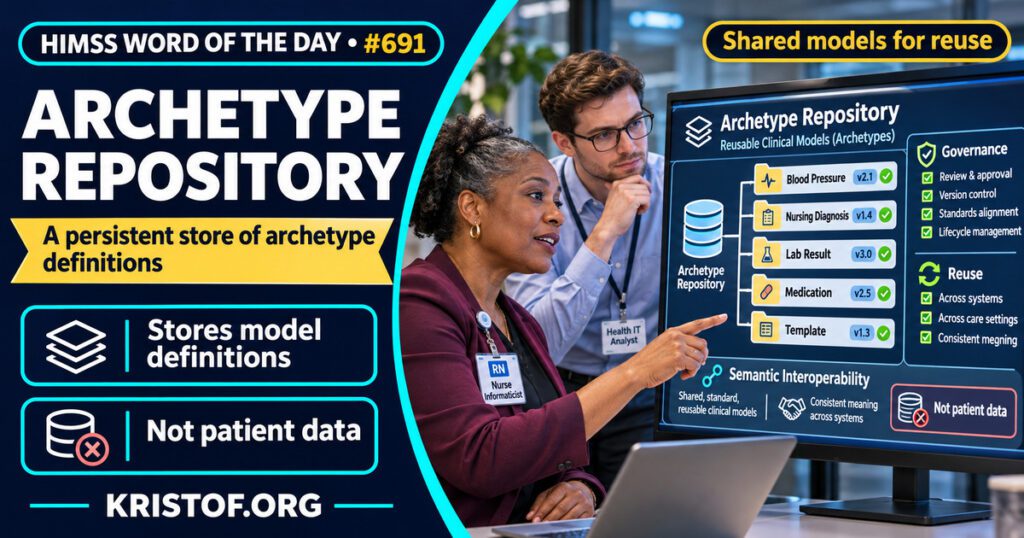
The HIMSS Dictionary describes an archetype repository as a persistent store of archetype definitions. A client authoring tool can reach it, and so can a run-time component inside an electronic health record service. An archetype, in the openEHR approach, is a formal model of one clinical concept, so the repository is where those models are kept and found. It is not where patient records are kept.
The studies below look at a repository from four angles: what its models cover, how they are reviewed, how often they are reused, and whether nursing content can be modeled in them.
| Piece | What it does | Study in this post |
|---|---|---|
| Archetype repository | Holds archetype definitions for authoring tools and run-time components | Yu et al. |
| Governance and review | Checks that archetypes are technically and clinically sound | Garde et al.; Wulff et al. |
| Reuse in templates | Combines existing archetypes into data sets for a use case | Leslie |
| Nursing content | Models nursing diagnoses and interventions as archetypes | Gomes et al. |
⚠️ Exam Alert: An archetype repository stores definitions of data structures, not patient data. A clinical data repository holds patient data, and a terminology such as SNOMED CT supplies codes. An archetype describes one clinical concept, and a template combines archetypes for a particular use, which is how the 2020 reuse study describes them. Expect questions that test whether the learner can tell a model store from a data store and a code set.
🌐 Why It Matters: Real-World Healthcare IT Context
Where it shows up. The openEHR community publishes shared models through its Clinical Knowledge Manager. The openEHR page describes that tool as a platform for creating, managing, reviewing, and publishing clinical models, including archetypes and templates. That page does not call the platform a repository, so this post uses “repository” only in the dictionary’s sense and does not claim the dictionary entry describes that product. The five studies below were read as abstracts only.
Coverage is uneven. Yu et al. (2012) mapped the archetypes in a national repository, the National Health Service Connecting for Health archetype repository, to SNOMED CT concepts to see which clinical areas the models cover. They report that coverage was not balanced across SNOMED CT categories. Well-covered categories included Attributes and Qualifier value, under-covered ones included Microorganism and Kingdom animalia, and Cardiovascular drug (product) was not covered at all. The authors present the result as guidance for archetype authors on where to model next. It is a 2012 snapshot of one repository.
Review keeps the models trustworthy. Garde et al. (2009) describe a web-based review process for archetypes that allows international involvement and aims to make sure released archetypes are technically and clinically correct. They also describe validation tools, templates, and compliance templates. The abstract describes the approach and does not report measured outcomes.
Governance is work. Wulff et al. (2019) report on archetype modelling in HiGHmed, a nationwide data infrastructure project that relies on a knowledge governance framework and continuous monitoring. At the time of the report, 25 modellers and 17 domain experts were taking part, and 79 archetypes had been identified, 69 of them already published internationally. The authors say completion rates of review rounds were satisfying but could be improved, and that the framework helped make the activities manageable and sped up modelling. It is a progress report on one project.
Reuse is plausible, within limits. Leslie (2020) studied seven openEHR templates created independently between February and July 2020 to represent COVID-19 data sets for symptom screening, infection reporting, decision support, and research. Each template prioritized reuse of existing use-case-agnostic archetypes from the openEHR International Clinical Knowledge Manager. Across the seven templates, 203 archetype instances came from 58 unique archetypes. Existing archetype reuse ranged from 40% to 90% by template, and total reuse ranged from 40% to 100%. The author describes this as an initial look at reuse, based on seven templates from one period.
Nursing content can be modeled. Gomes et al. (2021) built two archetypes, one for the nursing diagnosis concept and one for the nursing intervention concept, following ISO 18104:2014 and using the Ocean Archetype Editor. They reused existing archetypes from the Clinical Knowledge Manager in the modeling. The authors conclude that representing nursing diagnoses and interventions in the openEHR standard helps represent nursing care phenomena and needs in health information systems. It is a development study, and the abstract reports no clinical results.
What I could not confirm. None of the five studies measured patient outcomes, clinician workload, or time saved. I did not find a recent study comparing repositories, and I did not confirm the current status of the repository analyzed in 2012. I did not review openEHR specification documents beyond the pages cited below, and I did not verify how any given EHR product stores or retrieves archetypes at run time.
Common archetype repository problems:
- Uneven clinical coverage, with some areas modeled well and others not at all, as in the 2012 analysis
- Review rounds that finish more slowly than hoped, as the 2019 report notes
- Models that are too specific to one use case to be reused elsewhere
- Confusing the model store with the store of patient data
- Keeping nursing concepts out of shared models because no one modeled them
What supports an archetype repository:
- A shared, persistent place for models that authoring tools and run-time components can reach, as the dictionary describes
- A review process meant to make released models technically and clinically correct
- Reuse of existing archetypes across data sets for different purposes, as the 2020 case study found
- A governance framework that makes modelling activity manageable, according to the 2019 authors
- Room for nursing diagnoses and interventions, as the 2021 modeling study showed
🏥 The Nurse’s Perspective: Clinical, Bedside, & Workflow
None of the five studies measured effects on nurses at the bedside, so this section is workflow context and not evidence.
At the Bedside
Nurses do not usually open a repository. They meet its work as the structure of a documentation field, such as which pieces of information a nursing diagnosis or intervention entry holds. The 2021 study shows that those concepts can be written down as shared models, which is what lets different systems describe the same nursing phenomenon the same way. Whether any given hospital’s screens come from such models could not be confirmed here.
In Clinical Workflow
A model that includes nursing content only helps if nurses were part of building it. The governance papers describe review by domain experts, and a nursing representative on that review is the way bedside documentation needs get into the model. Neither abstract says how many nurses took part.
In EHR Implementation (Go-Live Perspective)
During an Epic Go-Live, analysts and at-the-elbow support staff see documentation build decisions turn into daily work. When two systems or two units name or structure the same nursing concept differently, the difference shows up as questions at the elbow. Shared, reviewed models are one way to reduce that, but the studies reviewed here do not examine go-lives.
🎓 CAHIMS / CPHIMS & HIMSS Perspective
CAHIMS Exam Domain Mapping
Archetype repository appears in questions about standards, data models, and information governance:
| CAHIMS Domain | How Archetype Repository Appears |
|---|---|
| Healthcare & Technology Environments | Standards and the shared models behind EHR content |
| Clinical Informatics | Clinical concepts, nursing content, and documentation structure |
| Healthcare Information & Systems Management | Governance and review of shared models |
| Management & Leadership | Coordinating clinical experts across a standards effort |
Key Terms to Know Alongside Archetype Repository
- Archetype — a formal model of a clinical concept in the openEHR approach
- Archetype model — the modeling framework that defines how archetypes are expressed
- Detailed clinical model — a structured description of clinical information that can be reused across systems
- Clinical data repository — a store of patient data, not of model definitions
- Semantic interoperability — exchange in which both sides share the meaning of the data
- Clinical terminology — a coded vocabulary, such as SNOMED CT, that archetypes can reference
HIMSS Organizational Position
HIMSS offers education and research on health information and technology topics through its Resource Center. Members can find related information on the HIMSS Resource Center page.
🧭 More HIMSS Word of The Day Terms
Related terms in the Interoperability and Standards series:
- Health Information Exchange (HIE)
- Key Management Services
- RIM (Reference Information Model)
- VMR (Virtual Medical Record)
Browse all Interoperability and Standards terms or the A–Z glossary.
🔗 Explore Further: External References
- openEHR — Clinical Knowledge Manager https://ckm.openehr.org/ckm/
- Yu et al. (2012), Journal of Biomedical Informatics — Clinical coverage of an archetype repository over SNOMED-CT. https://pubmed.ncbi.nlm.nih.gov/22200680/
- Garde et al. (2009), Studies in Health Technology and Informatics — Archetype-based knowledge management for semantic interoperability of electronic health records. https://pubmed.ncbi.nlm.nih.gov/19745465/
- Wulff et al. (2019), Studies in Health Technology and Informatics — A Report on Archetype Modelling in a Nationwide Data Infrastructure Project. https://pubmed.ncbi.nlm.nih.gov/30942733/
- Leslie (2020), Journal of Medical Internet Research — openEHR Archetype Use and Reuse Within Multilingual Clinical Data Sets: Case Study. https://pubmed.ncbi.nlm.nih.gov/33035176/
- Gomes et al. (2021), Applied Clinical Informatics — Representation of Diagnosis and Nursing Interventions in OpenEHR Archetypes. https://pubmed.ncbi.nlm.nih.gov/33853142/
- HIMSS — Resource Center https://www.himss.org/resource-center
Term source: HIMSS Dictionary of Health Information and Technology Terms, Acronyms, and Organizations, 6th Edition (2025). All definitions in this series are paraphrased for editorial purposes. Readers are encouraged to consult the primary source for exact language.
Eric Andrew Kristof, RN, CAHIMS is a Healthcare IT professional and HIMSS Arkansas Chapter member based in Hot Springs Village, AR, with hands-on Epic Go-Live experience and a diverse healthcare and IT background. He writes at kristof.org at the intersection of clinical care and healthcare technology.
Leave a Reply