By Eric Andrew Kristof, RN, CAHIMS | Healthcare IT Professional | HIMSS Arkansas Chapter Member
About This Series: The HIMSS Word of The Day is a running blog series drawing from the HIMSS Dictionary of Health Information and Technology Terms, Acronyms, and Organizations, 6th Edition (2025) — the authoritative reference for healthcare IT professionals and the primary study resource for CAHIMS and CPHIMS certification. Each post paraphrases the term in plain language, grounds it in real-world healthcare IT context, and adds a bedside nursing perspective you won’t find in a textbook.
📖 The Term: Knowledge Representation
Source: HIMSS Dictionary of Health Information and Technology Terms, Acronyms, and Organizations, 6th Edition (2025)
🔍 Plain-Language Definition
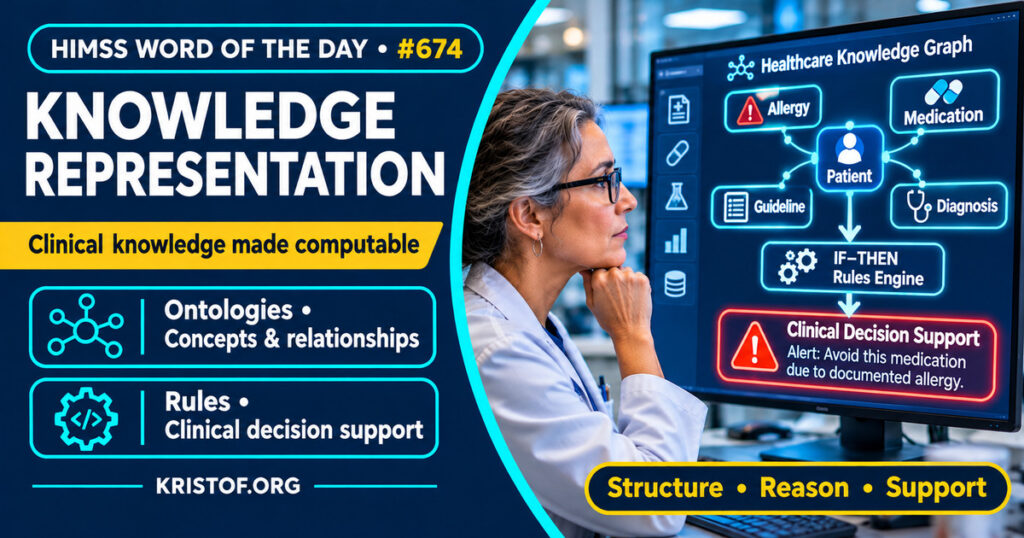
The HIMSS Dictionary gives knowledge representation two senses. First, it is the process, and the result, of formalizing knowledge so that software can use it automatically for problem solving. Second, it is an AI-related field concerned with how a system presents knowledge, typically inside a closed system, with technical staff and others watching and assessing the system to see how closely it mimics human knowledge or how it handles its input data.
In plain terms, knowledge representation is about writing knowledge down in a structured form that a computer can interpret and act on, not just store. A clinical guideline in a PDF is knowledge, but software cannot apply it until the content is encoded in a computable form.
A 2019 review of health care knowledge representation work (Riano et al.) grouped the methods authors used. The figures below are the share of 112 papers accepted at one workshop between 2009 and 2018, as the authors classified them.
| Method | What it does (my plain-language description) | Share of papers |
|---|---|---|
| Ontologies | Define concepts and the relationships among them | 31% |
| Semantic web formalisms | Use web-based standards to link and share structured meaning | 26% |
| Decision tables and rules | Express if-then logic for decisions | 19% |
| Logic | Use formal logic to support reasoning | 14% |
| Probabilistic models | Represent uncertainty with probabilities | 10% |
⚠️ Exam Alert: Knowledge representation is not the same as data storage or a data standard. A database stores facts, and a terminology names concepts, while knowledge representation structures knowledge so software can reason with it. Ontologies, rules, and computer-interpretable guidelines are examples of methods, not synonyms for the whole field.
🌐 Why It Matters: Real-World Healthcare IT Context
Where it shows up. Knowledge representation sits behind clinical decision support, such as alerts and guideline logic, and behind efforts to share structured data across health systems. The studies below give a sense of what has been tried. Most are descriptive, single-site, or reviews, so none shows that a particular method improves patient outcomes.
A map of the field, with a maturity gap. Riano et al. (2019) reviewed titles, abstracts, and keywords of the 112 papers accepted to the Knowledge Representation for Health Care workshop from 2009 to 2018. From a medical informatics perspective, knowledge was most often represented as computer-interpretable clinical guidelines (43%), medical domain ontologies (26%), and electronic health records (22%). By development level, 22% of papers were at a formal level, 52% at implementation, 13% at testing, and 2% at deployment. This reflects one workshop community and was based on titles, abstracts, and keywords, not full papers, so it is not a census of the whole field.
An ontology-based alert system in a hospital. Calvo-Cidoncha et al. (2022) built OntoPharma, a clinical decision support system for medication prescribing errors that uses ontologies rather than relational databases. Its ontologies covered four use cases: maximum dosage alerts, drug-drug interactions, renal failure adjustment, and drug allergy checks. The three ontologies contained 34,938 classes, 16,672 individuals, and 82 properties. Between July 2020 and November 2021, the system generated 823 alerts in 1,046 patients, and 401 (48.7%) were accepted. The authors state that it represents medication knowledge in a more intuitive, extensible, and maintainable way than relational-database systems, but the abstract reports no head-to-head comparison and no outcome data, so I would treat that as the authors’ claim. It was implemented at a single hospital.
Semantic tools for guideline-based support. Seneviratne et al. (2023) describe ontologies and a knowledge graph framework to model guidelines, attach provenance to recommendations, and link study cohorts to relevant publications. The abstract describes the approach and software, and it does not report clinical results.
Sharing knowledge across EHRs. Rosenbloom et al. (2017) reviewed common data models, including OMOP and PCORnet, and the HL7 FHIR standard, as approaches to representing knowledge from different EHR systems in a uniform way. It is a narrative review, and its conclusion that these approaches point toward more available high-quality data is a forward-looking statement.
The newest survey. Bona (2024) searched PubMed for knowledge representation and management work published in 2022 and 2023, retrieved 8,706 publications, and selected 15 on two themes: long COVID and combining knowledge representation with generative large language models. That is a selective survey, so it shows where attention has gone, not what works.
What I could not confirm. I did not find evidence in these abstracts that knowledge representation methods improve patient outcomes, and I did not review the full text of any study. I could not verify the OntoPharma comparison with relational-database systems. I did not review the dictionary’s second sense in the literature, and I did not find a source for “closed system” monitoring of AI. The classification percentages come from one review of one workshop’s papers.
Common knowledge representation problems:
- Encoding knowledge that goes out of date as guidelines change
- Maintaining large ontologies over time
- Low alert acceptance (48.7% in the OntoPharma data, with reasons not given in the abstract)
- Different EHR systems representing the same knowledge differently
- Projects that stay at the design or prototype stage
What supports knowledge representation:
- Multidisciplinary teams, as in the OntoPharma design
- Shared standards and common data models
- Provenance that links a recommendation to its evidence
- Ontologies that are interoperable across systems
- Testing and deployment evaluation, which the maturity data suggest is the scarcer step
🏥 The Nurse’s Perspective: Clinical, Bedside, & Workflow
Most nurses never see knowledge representation directly, but they work with its products.
At the Bedside
Alerts for dosing, drug interactions, renal adjustment, or allergies depend on encoded medication knowledge. The OntoPharma study examined alerts shown when a prescribing error was identified, and its abstract does not describe nurse-facing alerts. How such knowledge reaches a bedside nurse depends on the local system.
In Clinical Workflow
When an alert is accepted about half the time, as in the OntoPharma data, it suggests users judge many alerts as not useful, which is a reading of mine, not a conclusion from the study. Nurses and nurse informaticists can help judge whether encoded knowledge matches local practice.
In EHR Implementation (Go-Live Perspective)
During an Epic Go-Live, analysts and at-the-elbow support staff see build decisions, such as order sets and alert logic, surface at the point of care. Knowledge representation is part of what sits behind that content. This is general workflow context, and none of the studies reviewed examines go-lives.
🎓 CAHIMS / CPHIMS & HIMSS Perspective
CAHIMS Exam Domain Mapping
Knowledge representation appears in questions about decision support, standards, and data models:
| CAHIMS Domain | How Knowledge Representation Appears |
|---|---|
| Healthcare & Technology Environments | Ontologies, standards, and computable knowledge |
| Clinical Informatics | Guideline encoding and clinical decision support logic |
| Healthcare Information & Systems Management | Maintaining knowledge content and common data models |
| Management & Leadership | Governance of clinical content and alert burden |
Key Terms to Know Alongside Knowledge Representation
- Ontology — a formal description of concepts and the relationships among them
- Clinical decision support — software that gives clinicians knowledge-based recommendations or alerts at the point of care
- Computer-interpretable guideline — a clinical guideline encoded so software can apply it
- Common data model — a standard structure for representing data from different sources, such as OMOP
- Provenance — the record of where a recommendation or data item came from
- Semantic web — web-based standards for linking data with shared meaning
HIMSS Organizational Position
HIMSS offers education and research on health information and technology topics through its Resource Center. Members can find related information on the HIMSS Resource Center page.
🧭 More HIMSS Word of The Day Terms
Related terms in the AI Tools and Models series:
Browse all AI Tools and Models terms or the A–Z glossary.
🔗 Explore Further: External References
- Riano et al. (2019), Artificial Intelligence in Medicine — Ten years of knowledge representation for health care (2009-2018): Topics, trends, and challenges. https://pubmed.ncbi.nlm.nih.gov/31607346/
- Calvo-Cidoncha et al. (2022), BMC Medical Informatics and Decision Making — OntoPharma: ontology based clinical decision support system to reduce medication prescribing errors. https://pubmed.ncbi.nlm.nih.gov/36088328/
- Seneviratne et al. (2023), Journal of Biomedical Semantics — Semantically enabling clinical decision support recommendations. https://pubmed.ncbi.nlm.nih.gov/37464259/
- Rosenbloom et al. (2017), Yearbook of Medical Informatics — Representing Knowledge Consistently Across Health Systems. https://pubmed.ncbi.nlm.nih.gov/29063555/
- Bona (2024), Yearbook of Medical Informatics — Knowledge Representation and Management in the Age of Long Covid and Large Language Models: a 2022-2023 Survey. https://pubmed.ncbi.nlm.nih.gov/40199308/
- HIMSS — Resource Center https://www.himss.org/resource-center
Term source: HIMSS Dictionary of Health Information and Technology Terms, Acronyms, and Organizations, 6th Edition (2025). All definitions in this series are paraphrased for editorial purposes. Readers are encouraged to consult the primary source for exact language.
Eric Andrew Kristof, RN, CAHIMS is a Healthcare IT professional and HIMSS Arkansas Chapter member based in Hot Springs Village, AR, with hands-on Epic Go-Live experience and a diverse healthcare and IT background. He writes at kristof.org at the intersection of clinical care and healthcare technology.
Leave a Reply