By Eric Andrew Kristof, RN, CAHIMS | Healthcare IT Professional | HIMSS Arkansas Chapter Member
About This Series: The HIMSS Word of the Day is a running blog series drawing from the HIMSS Dictionary of Health Information and Technology Terms, Acronyms, and Organizations, 6th Edition (2025) — the authoritative reference for healthcare IT professionals and the primary study resource for CAHIMS and CPHIMS certification. Each post paraphrases the term in plain language, grounds it in real-world healthcare IT context, and adds a bedside nursing perspective you won’t find in a textbook.
📖 The Term: Adverse Drug Event (ADE)
Source: HIMSS Dictionary of Health Information and Technology Terms, Acronyms, and Organizations, 6th Edition (2025)
🔍 Plain-Language Definition
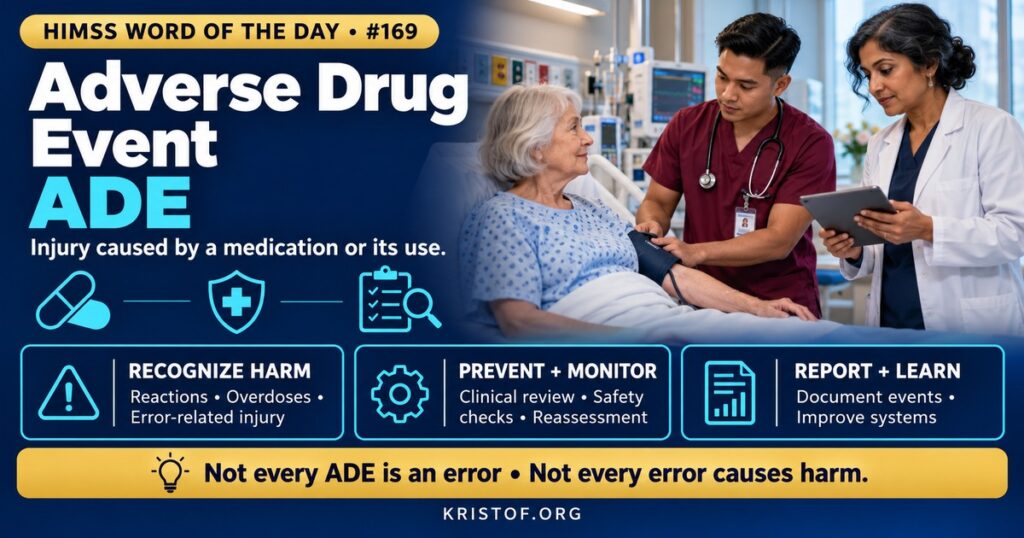
An adverse drug event (ADE) is any injury caused by a medication or its use. ADEs include adverse drug reactions, allergic reactions, overdoses, and harm caused by medication errors.
The HIMSS Dictionary defines an ADE as harm that follows from taking a drug, including harm caused by the drug itself, such as adverse reactions and overdoses, and harm from its use, including dose reductions and stopping therapy. It notes that ADEs may result from medication errors but that most do not, that they are injuries from drug-related medical interventions, and that they occur across inpatient, outpatient, and long-term care settings.
| Concept | What It Means | Example |
|---|---|---|
| Adverse Drug Event (ADE) | Any injury from medication use | Bleeding from an anticoagulant |
| Adverse Drug Reaction (ADR) | Harm from a drug used appropriately | A rash from a correctly prescribed antibiotic |
| Preventable ADE | Harm associated with an error | An overdose from a tenfold dosing error |
| Medication Error | A preventable mistake in medication use, with or without harm | Wrong time administration without injury |
| Potential ADE (Near Miss) | An error that could have caused harm but did not | A wrong dose intercepted by pharmacy |
⚠️ Exam Alert: Not every ADE is an error, and not every medication error causes an ADE. Preventable ADEs involve errors; non-preventable ADEs (adverse drug reactions) occur despite appropriate use. Near misses are errors caught before harm. ADEs can occur at prescribing, transcribing, dispensing, administering, or monitoring stages.
🌐 Why It Matters: Real-World Healthcare IT Context
ADEs are among the most common types of patient harm in healthcare. They affect patients in hospitals, clinics, nursing homes, and at home, and they contribute to emergency visits, hospital admissions, longer stays, and costs. AHRQ’s Patient Safety Network describes medication errors and ADEs as a major patient safety focus across settings.
Certain medications carry higher risk. Anticoagulants, insulin and other diabetes medications, opioids, and sedatives are frequently involved in serious ADEs. The Institute for Safe Medication Practices maintains lists of high-alert medications that warrant extra safeguards.
Risk factors include age, multiple medications, kidney or liver impairment, transitions of care, and communication failures. Look-alike, sound-alike drug names, complex dosing calculations, and unclear orders contribute to preventable events.
Health IT is a major prevention tool. Computerized provider order entry reduces illegible and incomplete orders. Clinical decision support checks for allergies, interactions, duplicate therapy, and dose ranges. Pharmacy verification systems add a second review. Barcode medication administration confirms the right patient, drug, dose, route, and time at the bedside. Smart infusion pumps with drug libraries help prevent programming errors. Electronic medication administration records improve documentation and timing.
Technology can also introduce new risks. Alert fatigue leads to overrides of important warnings. Poorly designed screens can cause wrong selections. Workarounds, such as scanning a copied barcode, bypass safety checks. Interface errors can transmit wrong information between systems.
Detection and reporting are essential for learning. Voluntary incident reports capture only a fraction of events, so organizations use trigger tools, such as orders for reversal agents like naloxone, to find possible ADEs in records. Automated surveillance can monitor lab values, such as rising creatinine or abnormal glucose, that suggest medication-related harm.
Reporting extends beyond the organization. Clinicians and patients can report serious adverse events to the FDA through MedWatch, and the FDA has been consolidating its adverse event databases into a unified Adverse Event Monitoring System to support safety surveillance. ISMP collects reports of medication errors to share lessons nationally.
Older adults face particular risk. Age-related changes in metabolism, multiple chronic conditions, and polypharmacy increase vulnerability, and tools such as lists of potentially inappropriate medications for older adults help prescribers and pharmacists choose safer alternatives. Deprescribing, the planned reduction of medications that no longer provide benefit, is an increasingly recognized strategy.
Transitions of care deserve special attention. Medication discrepancies at admission, transfer, and discharge are common, and medication reconciliation supported by complete medication histories reduces the risk of ADEs after discharge.
Common contributors to ADEs:
- High-alert medications without additional safeguards
- Incomplete medication histories and reconciliation
- Alert fatigue and overridden warnings
- Look-alike, sound-alike drug confusion
- Workarounds that bypass barcode scanning
- Inadequate monitoring after medication changes
Health IT and practice safeguards:
- CPOE with targeted, meaningful decision support
- Pharmacist verification and clinical review
- Barcode scanning at administration
- Smart pumps with current drug libraries
- Trigger tools and automated surveillance
- Medication reconciliation at every transition
🏥 The Nurse’s Perspective: Clinical, Bedside, & Workflow
Nurses are the last line of defense against many ADEs and often the first to recognize harm.
At the Bedside
Administering medications safely involves verifying the right patient, drug, dose, route, and time, using barcode scanning, and applying clinical judgment about whether a medication is appropriate given the patient’s current condition, such as holding an antihypertensive for low blood pressure.
Monitoring after administration detects ADEs early. Assessing sedation and respiratory status after opioids, checking glucose after insulin, and watching for allergic reactions after new medications allow quick intervention.
In Clinical Workflow
Medication reconciliation at admission, transfer, and discharge catches discrepancies before they cause harm. Nurses gathering medication histories from patients, families, and pharmacy data contribute critical information.
Reporting ADEs and near misses through organizational systems supports learning and system improvement. A culture that encourages reporting without blame leads to safer designs.
When alerts fire, nurses evaluate them thoughtfully rather than overriding by habit. Persistent low-value alerts should be reported so informatics teams can refine them.
Patient education about new medications, side effects, and when to seek help reduces ADEs after discharge.
Patients and families are partners in safety. Encouraging them to ask about unfamiliar pills or changes in appearance catches errors that systems sometimes miss.
In EHR Implementation (Go-Live Perspective)
During an Epic Go-Live, medication-related build, including order sets, dose checking, barcode scanning, and smart pump integration, receives intensive testing. Converted medication lists and allergies must be verified carefully.
At-the-elbow support analysts pay close attention to medication administration workflows, helping nurses with scanning issues and escalating any system behavior that could contribute to errors.
🎓 CAHIMS / CPHIMS & HIMSS Perspective
CAHIMS Exam Domain Mapping
ADEs appear in patient safety and clinical informatics questions:
| CAHIMS Domain | How ADEs Appear |
|---|---|
| Healthcare & Technology Environments | Medication safety organizations; FDA reporting; national safety priorities |
| Clinical Informatics | CPOE, BCMA, decision support, reconciliation, monitoring |
| Healthcare Information & Systems Management | Pharmacy systems, smart pump integration, surveillance tools, interfaces |
| Management & Leadership | Safety culture, reporting systems, high-alert medication policies |
Key Terms to Know Alongside ADE
- Adverse Drug Reaction (ADR) — harm from a drug used appropriately
- Medication Error — a preventable mistake in medication use
- High-Alert Medication — a drug with heightened risk of causing significant harm when used in error
- Trigger Tool — a method that uses clues in records to identify possible adverse events
- Medication Reconciliation — comparing medication lists to resolve discrepancies
- Pharmacovigilance — monitoring and evaluating drug safety after approval
HIMSS Organizational Position
HIMSS supports medication safety through clinical informatics education, research on decision support and barcode technology, and attention to usability and alert design. Members can find related education and research through the HIMSS Resource Center.
🔗 Explore Further: External References
- AHRQ PSNet — Medication Errors and Adverse Drug Events https://psnet.ahrq.gov/primer/medication-errors-and-adverse-drug-events
- ECRI and the Institute for Safe Medication Practices (ISMP) https://home.ecri.org/pages/ismp
- FDA — MedWatch Safety Information and Adverse Event Reporting Program https://www.fda.gov/safety/medwatch-fda-safety-information-and-adverse-event-reporting-program
- FDA — Adverse Event Monitoring System (AEMS) https://www.fda.gov/drugs/surveillance-post-drug-approval-activities/fda-adverse-event-monitoring-system-aems
- ONC — SAFER Guides https://healthit.gov/clinical-quality-and-safety/safer-guides/
- HIMSS — Nursing Informatics Community https://www.himss.org/networking/communities/nursing-informatics/
Term source: HIMSS Dictionary of Health Information and Technology Terms, Acronyms, and Organizations, 6th Edition (2025). All definitions in this series are paraphrased for editorial purposes. Readers are encouraged to consult the primary source for exact language.
Eric Andrew Kristof, RN, CAHIMS is a Healthcare IT professional and HIMSS Arkansas Chapter member based in Hot Springs Village, AR, with hands-on Epic Go-Live experience and a diverse healthcare and IT background. He writes at kristof.org at the intersection of clinical care and healthcare technology.
Leave a Reply