By Eric Andrew Kristof, RN, CAHIMS | Healthcare IT Professional | HIMSS Arkansas Chapter Member
About This Series: The HIMSS Word of The Day is a running blog series drawing from the HIMSS Dictionary of Health Information and Technology Terms, Acronyms, and Organizations, 6th Edition (2025) — the authoritative reference for healthcare IT professionals and the primary study resource for CAHIMS and CPHIMS certification. Each post paraphrases the term in plain language, grounds it in real-world healthcare IT context, and adds a bedside nursing perspective you won’t find in a textbook.
📖 The Term: Source Systems
Source: HIMSS Dictionary of Health Information and Technology Terms, Acronyms, and Organizations, 6th Edition (2025)
🔍 Plain-Language Definition
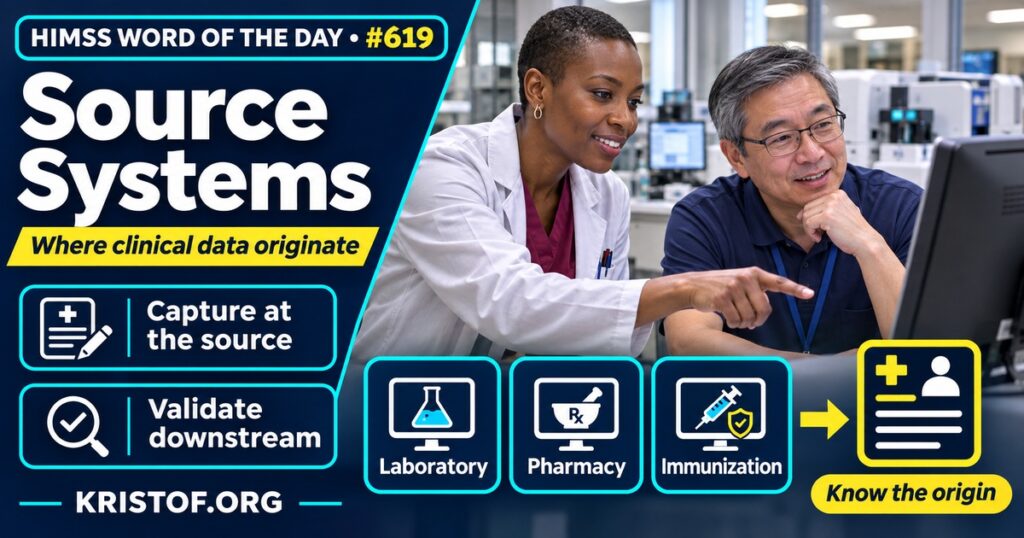
The HIMSS Dictionary describes source systems as the applications in which data about care encounters are first collected, with laboratory, pharmacy, and immunization systems given as examples. It says these clinical data are pulled out of the source system and transformed before they are used in the electronic health record, and it points readers to the related entry on feeder systems.
The research literature uses the same words a little more broadly. In the papers read for this post, source systems also include the EHRs themselves, because a research or analytics warehouse extracts data from them. The label therefore describes a role in a data flow, not a product category. This is an inference from how the papers use the term, so confirm local usage with the team involved.
| Item | Detail |
|---|---|
| What it is | An application where data about a care encounter are first captured |
| Examples in the dictionary | Laboratory, pharmaceutical, and immunization systems |
| What happens next | Data are extracted, then transformed before use elsewhere |
| Related terms | Feeder systems, ETL, data warehouse, and interface engine |
| Why the role matters | Errors or delays at the source can carry into every system downstream |
⚠️ Exam Alert: A source system is where data originate, a feeder system is the dictionary’s related entry for a system that supplies another, an interface engine moves messages between systems, and ETL extracts, transforms, and loads data into a target such as a data warehouse. Questions often test which role a system plays in a given data flow.
🌐 Why It Matters: Real-World Healthcare IT Context
Most of what clinicians see in a chart began somewhere else. A lab value begins in a laboratory system, a dispensed medication in a pharmacy system, and an immunization in an immunization system. Understanding the source helps explain why two screens can show different values or timestamps.
What the research literature shows. Several papers describe moving data out of source systems into warehouses. These are mostly single-institution descriptions, and the figures below come from the abstracts, so check them in the papers.
- Denney and colleagues (2016) validated the extract, transform, and load process behind a research data warehouse at one clinical and translational science institute, which drew on two EHR systems. They compared 498 randomly selected observations against the source EHRs and found 479 concordant and 19 discordant. The discordances fell into three groups: design decision differences, timing differences, and user interface settings. After resolving them, the authors report the repository was 100 percent accurate relative to its sources. This is one institution and a sample of observations, so it does not show that any other extraction is accurate.
- Post and colleagues (2017) compared full reloads of a research warehouse with incremental updating. They report that full reloads can place a substantial burden on source systems and can leave data outdated, while incremental updating needs substantial up-front development and can expose provisional data to investigators. This is a description of one institution’s choices.
- Sholle and colleagues (2017) describe an approach that gathers raw data from source systems, skips the initial modeling typical of clinical data warehouses, and transforms the data downstream for specific research needs. The authors present it as meeting investigator needs at their institution. It is a methods description, not a comparison of approaches.
- Visweswaran and colleagues (2022) describe a research data warehouse whose atomic design stores data at the granularity found in the source systems, and which integrates EHR, health plan, and research study data. It reports data for more than 5 million patients. This is a design and implementation report from one large health system.
- Chelico and colleagues (2016) describe a virtual data warehouse at NewYork Presbyterian Hospital that brings together data from several source systems to support quality improvement. It is a design description, with no outcome figures in the abstract.
What the papers do not settle. Because the studies come from academic research settings, they say less about how routine clinical feeds from laboratory or pharmacy systems behave inside a hospital EHR. The dictionary’s framing, extraction and transformation before data reach the EHR, was not tested in these papers, which focus on warehouses.
Common source system problems:
- Treating the EHR display as if it were the original record from the source
- Timing differences between when an event occurs and when it appears downstream
- Local codes and units that change meaning when transformed
- Design decisions that differ between the source and the target, such as how a value is stored
- Heavy extraction jobs that burden a live source system
- Provisional data that appear in a warehouse before they are final
What supports good source system data flows:
- A clear inventory of which system is the source for each data element
- Documented mappings between source codes and target codes
- Validation that compares a sample of extracted data against the source
- Scheduled extraction that limits the burden on live systems
- Shared definitions between clinical, analytics, and IT teams
🏥 The Nurse’s Perspective: Clinical, Bedside, & Workflow
Nurses meet source systems whenever a result, medication record, or immunization appears in the chart and the next question is where it came from.
At the Bedside
A value on a screen may be a copy of something recorded elsewhere, so a nurse who suspects an error often needs to know which system originated it. The Denney validation study is a reminder that timing and display settings, not only wrong data, can explain why two views differ.
In Clinical Workflow
Nurse informaticists help clinicians describe what they saw, which helps analysts trace the data back to its origin. Clear descriptions of the source, the time, and the screen shorten that trace. Warehouse reports built from source systems can also differ from bedside views for the reasons the studies describe, so definitions should be agreed before the numbers are used.
In EHR Implementation (Go-Live Perspective)
During an Epic Go-Live, at-the-elbow analysts commonly hear that a result is missing or looks different from the lab report. Knowing whether the issue sits in the source system, the interface, or the EHR display helps route the ticket to the right team. This post does not claim that any specific go-live had a source system problem.
🎓 CAHIMS / CPHIMS & HIMSS Perspective
CAHIMS Exam Domain Mapping
Source systems support data flow and integration knowledge:
| CAHIMS Domain | How Source Systems Appear |
|---|---|
| Healthcare & Technology Environments | Clinical applications and how data move among them |
| Clinical Informatics | Where clinical data originate and how they are interpreted |
| Healthcare Information & Systems Management | Extraction, data quality, and warehouse design |
| Management & Leadership | Ownership of data and agreement on definitions |
Key Terms to Know Alongside Source Systems
- ETL — extraction, transformation, and loading of data from sources into a target
- Data warehouse — a repository that integrates data from one or more sources for reporting and analysis
- Feeder systems — the dictionary’s related entry for systems that supply data to another system
- Interface engine — software that routes and translates messages between systems
- Data mapping — linking data elements or codes in one system to those in another
- Laboratory Information System — a common example of a source system
HIMSS Organizational Position
HIMSS offers education and research on health information and technology topics through its Resource Center. Members can find related information on the HIMSS Resource Center page.
🔗 Explore Further: External References
- Denney et al. (2016), International journal of medical informatics — Validating the extract, transform, load process used to populate a large clinical research database. https://pubmed.ncbi.nlm.nih.gov/27506144/
- Post et al. (2017), AMIA Annual Symposium proceedings — Architecting the Data Loading Process for an i2b2 Research Data Warehouse: Full Reload versus Incremental Updating. https://pubmed.ncbi.nlm.nih.gov/29854210/
- Sholle et al. (2017), AMIA Annual Symposium proceedings — Secondary Use of Patients’ Electronic Records (SUPER): An Approach for Meeting Specific Data Needs of Clinical and Translational Researchers. https://pubmed.ncbi.nlm.nih.gov/29854228/
- Visweswaran et al. (2022), Journal of the American Medical Informatics Association — An atomic approach to the design and implementation of a research data warehouse. https://pubmed.ncbi.nlm.nih.gov/34613409/
- Chelico et al. (2016), AMIA Annual Symposium proceedings — Designing a Clinical Data Warehouse Architecture to Support Quality Improvement Initiatives. https://pubmed.ncbi.nlm.nih.gov/28269833/
- HIMSS — Resource Center https://www.himss.org/resource-center
Term source: HIMSS Dictionary of Health Information and Technology Terms, Acronyms, and Organizations, 6th Edition (2025). All definitions in this series are paraphrased for editorial purposes. Readers are encouraged to consult the primary source for exact language.
Eric Andrew Kristof, RN, CAHIMS is a Healthcare IT professional and HIMSS Arkansas Chapter member based in Hot Springs Village, AR, with hands-on Epic Go-Live experience and a diverse healthcare and IT background. He writes at kristof.org at the intersection of clinical care and healthcare technology.
Leave a Reply