By Eric Andrew Kristof, RN, CAHIMS | Healthcare IT Professional | HIMSS Arkansas Chapter Member
About This Series: The HIMSS Word of The Day is a running blog series drawing from the HIMSS Dictionary of Health Information and Technology Terms, Acronyms, and Organizations, 6th Edition (2025) — the authoritative reference for healthcare IT professionals and the primary study resource for CAHIMS and CPHIMS certification. Each post paraphrases the term in plain language, grounds it in real-world healthcare IT context, and adds a bedside nursing perspective you won’t find in a textbook.
📖 The Term: ANI (Alliance for Nursing Informatics)
Source: HIMSS Dictionary of Health Information and Technology Terms, Acronyms, and Organizations, 6th Edition (2025)
🔍 Plain-Language Definition
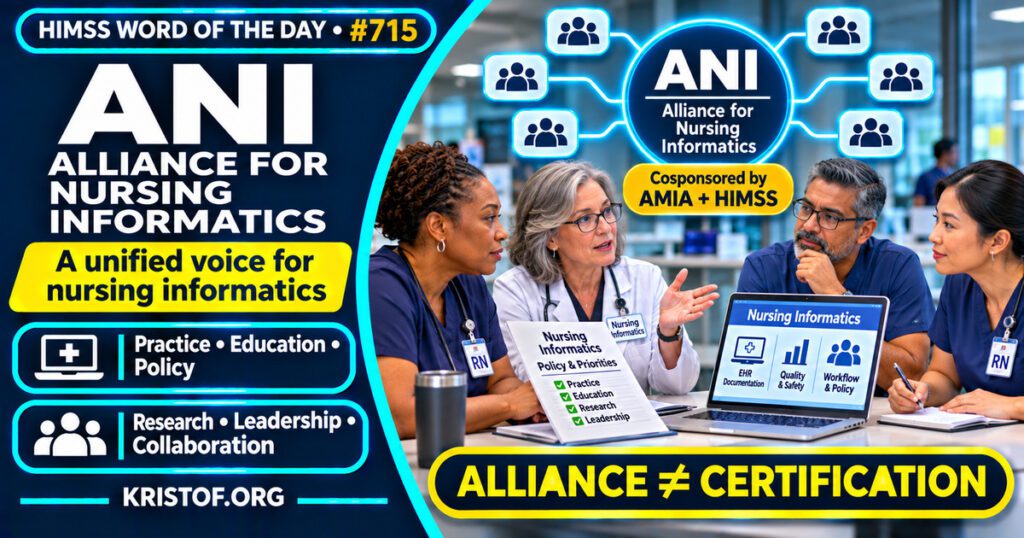
The HIMSS Dictionary lists ANI (Alliance for Nursing Informatics) in its organizations appendix as a membership organization made up of nursing informatics associations and groups.
ANI’s own website says its vision is to transform health and health care through nursing informatics. It says its mission is to advance nursing informatics practice, education, policy, research, and leadership through a unified voice of nursing informatics organizations, and that it is cosponsored by AMIA and HIMSS. These are ANI’s statements about itself, and the pages I read are undated.
| Item | Detail |
|---|---|
| Type | Collaboration of nursing informatics organizations |
| Cosponsors | AMIA and HIMSS (ANI’s website) |
| Size, per ANI | 28 nursing informatics groups worldwide, representing more than 25,000 nurse informaticists (ANI’s website) |
| Size, per AMIA | Over 30 nursing informatics groups (AMIA’s page) |
| Earliest account found | 2004: 18 groups and more than 2,000 nurses (AuntMinnie.com, October 19, 2004) |
| Membership | Organizations that focus entirely or partly on nursing informatics (AMIA’s page) |
| Relation to HIMSS | HIMSS is a cosponsor, and HIMSS separately offers CAHIMS and CPHIMS |
⚠️ Exam Alert: ANI is an alliance of organizations, so individual nurses join one of its member groups and not ANI itself. AMIA is an informatics association, HIMSS is the society behind CAHIMS and CPHIMS, and both cosponsor ANI. Nursing informatics is the field, and ANI is one organization that speaks for parts of it. The pages reviewed describe no ANI certification program, so ANI is not a credentialing body.
🌐 Why It Matters: Real-World Healthcare IT Context
Because ANI is an organization and not a research topic, this section draws on ANI’s own website, AMIA’s page about ANI, a 2004 trade report on its start, and two peer-reviewed papers on nursing informatics. None of the papers evaluates ANI, and ANI’s pages are not an independent evaluation.
What ANI says about itself. ANI’s website describes a collaboration of organizations that represents more than 25,000 nurse informaticists and brings together 28 distinct nursing informatics groups worldwide. It says ANI crosses academia, practice, industry, and nursing specialty lines and works with more than 4 million nurses in practice. It says ANI periodically takes part in comment periods and other activities and helps its members reach consensus on nursing informatics policy issues. Two examples appear on the site. One is a statement supporting documentation recommendations for the adult head-to-toe assessment, developed by the Documentation Workgroup of the Nursing Knowledge: Big Data Science Initiative. The other is a recommendation, made with that initiative’s Policy and Advocacy Workgroup, that stakeholders use the NCSBN ID as a nurse identifier to support research and fuller EHR documentation. I did not review the statements themselves.
What AMIA says. AMIA’s page describes ANI as a unified voice for nursing informatics and as a single point of connection for nursing informatics people and groups. It says ANI supports individual membership in its affiliated organizations and that organizations may join if they focus entirely on nursing informatics or have a component that does. It lists goals that include expanding outreach, promoting professional practice, supporting research, and leading on national health IT issues. It says ANI brings together over 30 groups, which does not match the 28 on ANI’s own site. Both pages are undated, and I cannot say which is more recent.
Where it started. A trade report dated October 19, 2004 says HIMSS and AMIA agreed to provide support, coordination, and leadership to ANI. It describes 18 distinct nursing informatics groups in the United States representing more than 2,000 nurses. Today’s pages describe groups worldwide and far larger nurse counts. The scope is described differently, so I did not treat the change as measured growth.
What the literature shows. No paper reviewed here studies ANI. Kleib et al. (2021) ran a scoping review of how nursing informatics competencies are defined and assessed, and included 52 papers. They report that 34 of them identified competencies, grouped into four categories. Taylor Pearson et al. (2026) present five strategies and implementation activities for collaboration among academic institutions, hospitals, health IT vendors, and professional organizations, aimed at preparing practice-ready nurses. That is a practice article that proposes strategies and does not test them.
What I could not confirm. I could not confirm ANI’s founding date from its own pages, and the 2004 report is the earliest account I found. I could not reconcile the 28 and over 30 group counts or the nurse counts. I did not find ANI’s leadership, member list, funding, or governance, and a fetch of one more ANI page failed. I read ANI’s and AMIA’s pages through a summarizing tool, and I did not review ANI’s statements. I found no independent evaluation of ANI’s impact, and I read abstracts for the two papers, not full texts.
Common ANI mix-ups:
- Treating ANI as a group that individual nurses join directly
- Confusing ANI with AMIA or HIMSS, which cosponsor it
- Assuming ANI issues a certification
- Quoting its group and nurse counts without noting that the sources differ
- Reading ANI’s position statements as formal standards
What ANI offers:
- A unified voice for nursing informatics organizations
- Participation in comment periods and position statements
- A single point of connection for nursing informatics groups, per AMIA
- Support for individual membership in affiliated organizations
- A forum for consensus on nursing informatics policy issues
🏥 The Nurse’s Perspective: Clinical, Bedside, & Workflow
No study reviewed for this post evaluated ANI, so the points below are workflow context and not research findings.
At the Bedside
A nurse’s documentation is the raw material behind several of the topics ANI says it has addressed, such as head-to-toe assessment recommendations and a nurse identifier for research. How an assessment is charted decides what can be counted later. That connection is an inference from ANI’s descriptions, not a finding.
In Clinical Workflow
Nurse informaticists who want a voice in national policy have a practical route through the member groups of an alliance like ANI. AMIA’s page says ANI supports individual membership in affiliated organizations, so the first step is usually joining one of those groups. The Kleib review also suggests that the competencies expected of nurses are defined in several ways, which is one reason shared positions on competencies would matter. That is an inference from the review, which does not state it.
In EHR Implementation (Go-Live Perspective)
During an Epic Go-Live, analysts and at-the-elbow support staff with nursing backgrounds see how documentation design affects time at the bedside. Topics that ANI says it takes positions on, such as documentation recommendations, can inform what those analysts ask for in design sessions. This is context from workflow experience, and the sources reviewed do not examine go-lives.
🎓 CAHIMS / CPHIMS & HIMSS Perspective
CAHIMS Exam Domain Mapping
ANI connects the nursing informatics field, its professional groups, and policy discussions:
| CAHIMS Domain | How ANI Appears |
|---|---|
| Healthcare & Technology Environments | Professional organizations and policy input in health IT |
| Clinical Informatics | Nursing documentation, competencies, and data standards |
| Healthcare Information & Systems Management | Nurse input into system design and documentation recommendations |
| Management & Leadership | Collaboration among professional groups and academic-practice partners |
Key Terms to Know Alongside ANI
- Nursing Informatics — the field that applies informatics to nursing practice, education, and research
- Clinical Informatics — the use of information and technology to support care delivery
- Nursing Minimum Data Set — a standardized set of nursing data elements
- Electronic Health Record — the record system where nursing documentation is kept
- AMIA — the informatics association that cosponsors ANI with HIMSS
HIMSS Organizational Position
HIMSS offers education and research on health information and technology topics through its Resource Center. Members can find related information on the HIMSS Resource Center page.
🧭 More HIMSS Word of The Day Terms
Related terms in the Clinical Informatics series:
Browse all Clinical Informatics terms or the A–Z glossary.
🔗 Explore Further: External References
- Alliance for Nursing Informatics — Home https://www.allianceni.org/
- AMIA — Alliance for Nursing Informatics (ANI) https://amia.org/communities/nursing-informatics/alliance-nursing-informatics-ani
- AuntMinnie.com — HIMSS, AMIA to support ANI (October 19, 2004) https://www.auntminnie.com/imaging-informatics/enterprise-imaging/is/article/15570038/himss-amia-to-support-ani
- Kleib et al. (2021), JBI Evidence Synthesis — Approaches for defining and assessing nursing informatics competencies: a scoping review. https://pubmed.ncbi.nlm.nih.gov/33625068/
- Taylor Pearson et al. (2026), Computers, Informatics, Nursing — The Five Pillars of Nursing Informatics Collaboration. https://pubmed.ncbi.nlm.nih.gov/41493862/
- HIMSS — Resource Center https://www.himss.org/resource-center
Term source: HIMSS Dictionary of Health Information and Technology Terms, Acronyms, and Organizations, 6th Edition (2025). All definitions in this series are paraphrased for editorial purposes. Readers are encouraged to consult the primary source for exact language.
Eric Andrew Kristof, RN, CAHIMS is a Healthcare IT professional and HIMSS Arkansas Chapter member based in Hot Springs Village, AR, with hands-on Epic Go-Live experience and a diverse healthcare and IT background. He writes at kristof.org at the intersection of clinical care and healthcare technology.
Leave a Reply