By Eric Andrew Kristof, RN, CAHIMS | Healthcare IT Professional | HIMSS Arkansas Chapter Member
About This Series: The HIMSS Word of The Day is a running blog series drawing from the HIMSS Dictionary of Health Information and Technology Terms, Acronyms, and Organizations, 6th Edition (2025) — the authoritative reference for healthcare IT professionals and the primary study resource for CAHIMS and CPHIMS certification. Each post paraphrases the term in plain language, grounds it in real-world healthcare IT context, and adds a bedside nursing perspective you won’t find in a textbook.
📖 The Term: Wireless Technology
Source: HIMSS Dictionary of Health Information and Technology Terms, Acronyms, and Organizations, 6th Edition (2025)
🔍 Plain-Language Definition
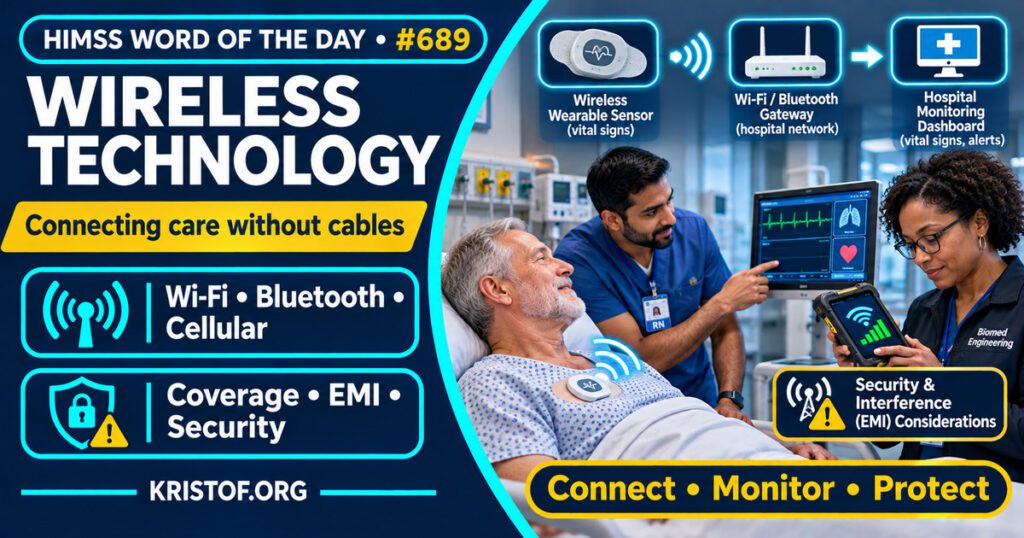
The HIMSS Dictionary describes wireless technology as an umbrella term for the many ways of communicating that send data through the air by means of radio, microwave, and other electromagnetic signals instead of a physical cable. The dictionary says the communication can be between people, and it can also be between devices and other technologies.
In the studies below, the term covers wireless local area networks, mobile phones and two-way radios, wireless communication devices carried by nurses, wireless wearable sensors, and connected medical devices.
| Example in the studies | What it does | Study in this post |
|---|---|---|
| Wireless local area network | Connects devices to a network without cables | Hanada et al. |
| Mobile phones and two-way radios | Carry voice and data by radio | Boyle; Baranchuk et al. |
| Wireless communication devices | Hand-carried devices for staff communication | Wilson et al. |
| Wireless wearable sensors | Send patient measurements without a bedside cable | Kooij et al. |
| Connected medical devices | Link devices to other devices and networks | Cuningkin et al. |
⚠️ Exam Alert: Wireless technology is a broad category, not a single standard. Wi-Fi, Bluetooth, and cellular networks are different technologies within it. A wireless signal can also interfere with other equipment, which is called electromagnetic interference, and wireless links carry security risks that wired links do not remove.
🌐 Why It Matters: Real-World Healthcare IT Context
Where it shows up. In my searches, the hospital studies of wireless technology were often about interference with medical equipment, and several are old. The six studies below range from 2004 to 2022, are mostly small or single-site, and I read abstracts only.
A review of wireless devices and patient safety. Boyle (2006) reviewed the safety of wireless communication devices within hospitals, targeting electromagnetic interference with medical devices, and summarized recommendations from published reports and international standards. The review reports consensus that the highest risk of interference comes from two-way radios used by emergency crews, followed by mobile phones, while radio local area networks produce negligible interference. It concludes that wireless technologies are suitable for use throughout hospital areas, including intensive care units and operating rooms, if recommended separation distances from medical equipment are observed. It is a 2006 review by one author, and the devices it covers are older than today’s.
Testing phones and a wireless network on ECG machines. Baranchuk et al. (2009) tested a GSM receiver, a CDMA receiver, an analog phone, a wireless local area network, and a pager on three ECG machines at several distances. Interference appeared on one machine, the MAC 5000, when activated GSM, CDMA, and analog phones were placed on top of the acquisition module, and none appeared on the other machines or when the phones were farther away or deactivated. In a reading exercise with a mixed group of clinical providers, interference was incorrectly diagnosed in 18% of cases, most often confused with atrial fibrillation or flutter. The abstract does not report interference from the wireless local area network, and the test used three ECG machines.
Testing wireless LAN signals on equipment. Hanada et al. (2004) irradiated ten types of medical electronic equipment with wireless LAN radio waves in an anechoic chamber and observed interference on three. They also found that microwave ovens emit at nearly the same center frequency as an IEEE 802.11b channel. The authors note that the number of devices was small and advise hospital administrators to consider electromagnetic wave testing of equipment to be used in areas of common wireless LAN use when planning an installation. It is a 2004 test of a small set of devices.
Nurses and wireless communication devices. Wilson et al. (2014) surveyed nurses in an intensive care unit before and after wireless communication devices were introduced, using the Theory of Planned Behaviour. Attitudes and subjective norms predicted intent to use the devices before implementation but not after. The authors suggest that differences between the ICU and the surgical unit may relate to the critical care environment and to the lack of a comprehensive preimplementation strategy, and they say attention to the implementation process may improve adoption. The abstract does not give sample sizes, and it measures intent to use and not outcomes.
Nurses and wireless wearable sensors. Kooij et al. (2022) interviewed 16 nurses from three teaching hospitals in the Netherlands about continuous monitoring with wireless wearable sensors. The authors report five constructs with a strong positive influence in the experience of at least 8 nurses, including relative advantage such as early detection of deterioration, and five with a strong negative influence, including complexity, poor sensor quality, a change in work, and facilitating conditions such as the Wi-Fi connection. Nurses expected home use to be hindered by compatibility with work processes. It is a qualitative study of 16 nurses in one country.
Security of connected devices. Cuningkin et al. (2021) is a nursing journal article saying that greater connectivity of medical devices raises security risks, that many clinicians and patients are unaware of them, and describing cyberattacks such as medjacking, hacking, and ransomware and what nurses can do to guard against them and educate patients. The abstract describes connectivity in general and not wireless links specifically, and it reports no data.
What I could not confirm. I did not find a recent study of interference from current Wi-Fi, cellular, or Bluetooth equipment in hospitals, and the interference studies above use older technologies. I did not review current standards, regulatory guidance, or spectrum rules. The studies do not measure patient outcomes, and I did not review network performance, coverage design, or Wi-Fi capacity planning. I did not confirm that any study’s findings apply to a specific hospital.
Common wireless technology problems:
- Electromagnetic interference with medical equipment, which the older tests found in some of the devices tested
- Weak or unreliable Wi-Fi connection, which nurses named as a barrier for wearable sensors
- Poor sensor quality and added process steps
- Low acceptance before and after rollout when there is no comprehensive preimplementation strategy
- Security risks from connected devices
What supports wireless technology:
- Reported low interference risk from radio local area networks when separation distances are observed
- Early detection of deterioration, cited by nurses for wearable sensors
- Communication devices that staff may adopt with a structured implementation
- Testing equipment in the intended areas before installing a network
- Nurse education about device security
🏥 The Nurse’s Perspective: Clinical, Bedside, & Workflow
Nurses are the participants or the intended audience in three of the six studies.
At the Bedside
In the Dutch interviews, early detection of deterioration was cited as a benefit of wireless wearable sensors, and the Wi-Fi connection and poor sensor quality were cited as problems. The ECG study shows that interference, when it occurs, can resemble a rhythm problem, and in its reading exercise medical students and non-cardiology residents performed significantly worse.
In Clinical Workflow
Nurses in the ICU study were asked about wireless communication devices, and the authors found that attitudes and norms predicted intent to use them before implementation but not after, and point to the quality of the implementation. The security article says nurses can help protect connected devices and educate patients, though its abstract gives no detail on how.
In EHR Implementation (Go-Live Perspective)
During an Epic Go-Live, analysts and at-the-elbow support staff depend on working network coverage for handheld devices and workstations on wheels. That is general workflow context, and none of the studies reviewed examines go-lives.
🎓 CAHIMS / CPHIMS & HIMSS Perspective
CAHIMS Exam Domain Mapping
Wireless technology appears in questions about networks, device safety, and information security:
| CAHIMS Domain | How Wireless Technology Appears |
|---|---|
| Healthcare & Technology Environments | Networks, spectrum, and medical device environments |
| Clinical Informatics | Wireless sensors, mobile devices, and monitoring workflows |
| Healthcare Information & Systems Management | Coverage, interference, security, and implementation |
| Management & Leadership | Policy for wireless devices and rollout strategy |
Key Terms to Know Alongside Wireless Technology
- Wi-Fi — wireless networking based on the IEEE 802.11 family, the kind of network some studies above tested
- WLAN — a wireless local area network, which connects devices in a limited area without cables
- EMI — electromagnetic interference, the unwanted effect of one signal on another device
- Bluetooth — a short-range wireless standard commonly used for nearby devices
- RFID — radio frequency identification, which uses radio signals to identify tagged items
- Mobile device — a portable computing or communication device, such as a phone or handheld
HIMSS Organizational Position
HIMSS offers education and research on health information and technology topics through its Resource Center. Members can find related information on the HIMSS Resource Center page.
🧭 More HIMSS Word of The Day Terms
Related terms in the IT Infrastructure series:
Browse all IT Infrastructure terms or the A–Z glossary.
🔗 Explore Further: External References
- Boyle (2006), Telemedicine Journal and e-Health — Wireless technologies and patient safety in hospitals. https://pubmed.ncbi.nlm.nih.gov/16796507/
- Baranchuk et al. (2009), Clinical Cardiology — Electromagnetic interference of communication devices on ECG machines. https://pubmed.ncbi.nlm.nih.gov/19824066/
- Hanada et al. (2004), Studies in Health Technology and Informatics — Safe introduction of in-hospital wireless LAN. https://pubmed.ncbi.nlm.nih.gov/15361050/
- Wilson et al. (2014), Journal for Healthcare Quality — Wireless communication in clinical environments with unique needs. https://pubmed.ncbi.nlm.nih.gov/24033884/
- Kooij et al. (2022), BMC Nursing — Remote continuous monitoring with wireless wearable sensors in clinical practice, nurses perspectives on factors affecting implementation: a qualitative study. https://pubmed.ncbi.nlm.nih.gov/35255894/
- Cuningkin et al. (2021), The American Journal of Nursing — Preventing Medjacking. https://pubmed.ncbi.nlm.nih.gov/34554984/
- HIMSS — Resource Center https://www.himss.org/resource-center
Term source: HIMSS Dictionary of Health Information and Technology Terms, Acronyms, and Organizations, 6th Edition (2025). All definitions in this series are paraphrased for editorial purposes. Readers are encouraged to consult the primary source for exact language.
Eric Andrew Kristof, RN, CAHIMS is a Healthcare IT professional and HIMSS Arkansas Chapter member based in Hot Springs Village, AR, with hands-on Epic Go-Live experience and a diverse healthcare and IT background. He writes at kristof.org at the intersection of clinical care and healthcare technology.
Leave a Reply