By Eric Andrew Kristof, RN, CAHIMS | Healthcare IT Professional | HIMSS Arkansas Chapter Member
About This Series: The HIMSS Word of The Day is a running blog series drawing from the HIMSS Dictionary of Health Information and Technology Terms, Acronyms, and Organizations, 6th Edition (2025) — the authoritative reference for healthcare IT professionals and the primary study resource for CAHIMS and CPHIMS certification. Each post paraphrases the term in plain language, grounds it in real-world healthcare IT context, and adds a bedside nursing perspective you won’t find in a textbook.
📖 The Term: Benchmarking
Source: HIMSS Dictionary of Health Information and Technology Terms, Acronyms, and Organizations, 6th Edition (2025)
🔍 Plain-Language Definition
The HIMSS Dictionary describes benchmarking as measuring how a product or service performs relative to a reference point, to show how much better or worse it is than other products. For technology in particular, the dictionary says comparison with competing products is often the main way to get an objective quality measure, because successive versions from one vendor tend to improve so fast that version-to-version comparisons say little.
In healthcare, the word covers a wider set of uses. Hospitals compare outcomes with peers. Infection prevention teams compare rates with national figures. IT teams compare system response times against targets. Researchers test software, including large language models (LLMs), against standard question sets.
| Use | What is compared | Example from the sources below |
|---|---|---|
| Quality benchmarking | Process or outcome measures across organizations | Systematic review of benchmarking and quality improvement |
| Risk-adjusted benchmarking | Observed outcomes against those expected for the patient mix | Septic shock surveillance in Catalonia |
| Infection benchmarking | Local infection rates against national or international rates | Healthcare-associated infection benchmarks |
| IT benchmarking | Information system performance indicators | Indicators for hospital information systems |
| Model benchmarking | Software or AI tested against standard test sets | LLM health benchmarks |
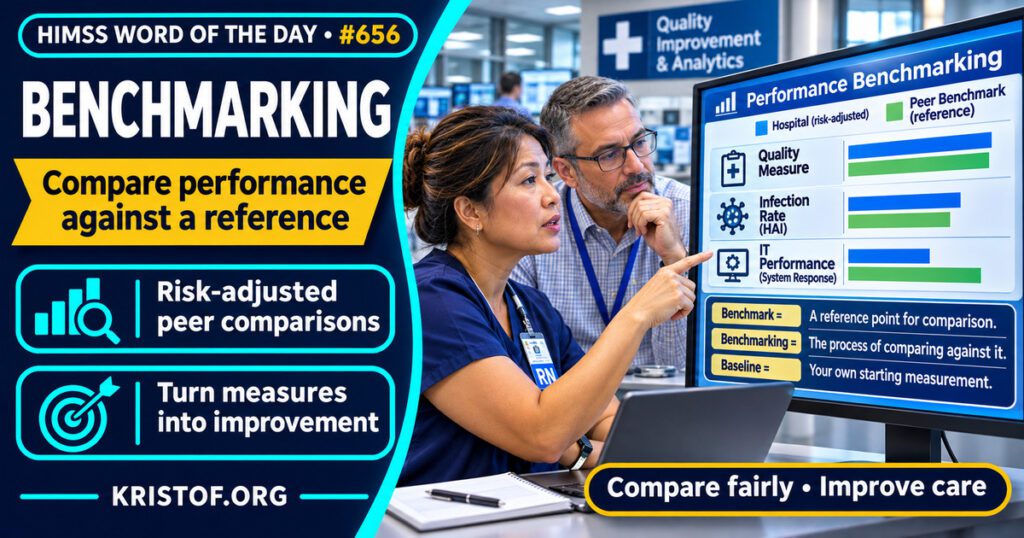
⚠️ Exam Alert: Keep three words apart. A benchmark is the reference point. Benchmarking is the process of comparing against it. A baseline is a starting measurement of your own performance, not someone else’s.
🌐 Why It Matters: Real-World Healthcare IT Context
Benchmarking sounds simple, but the published studies show that the comparison itself needs care. The five sources below are a systematic review, a narrative review, a qualitative study, a registry analysis, and an AI evaluation. Together they show benefits and limits, but none proves that benchmarking alone causes better care.
Association with quality improvement. Willmington and colleagues (2022) searched three databases for studies of benchmarking’s effect on quality of care and found 17 articles. All reported a positive association between benchmarking and improved processes (10 studies), outcomes (13 studies), or both (7 studies). In 12 studies, at least one other intervention accompanied benchmarking, such as meetings, quality improvement plans, or financial incentives. The authors conclude that benchmarking may stimulate improvement, that complementary interventions seem to reinforce it, and that more research is needed. With only 17 studies and mostly combined interventions, the review cannot separate the effect of benchmarking from the other actions.
Crude comparisons mislead. El-Saed and colleagues (2013) reviewed benchmarking of healthcare-associated infections. They warn that comparing overall (crude) infection metrics without adjusting for confounders can lead to misleading conclusions, and they list common risk adjustment methods: regression, stratification, indirect standardization, and restriction. They add that a chosen benchmark should use similar data collection and presentation methods. The paper is a 2013 review focused on Gulf Cooperation Council countries, so its regional details may not transfer.
Risk-adjusted hospital comparison. Reina-Aguilar and colleagues (2026) built a septic shock surveillance system from administrative discharge data in Catalonia, covering 2018 to 2024 and 37,855 episodes. Hospital benchmarking used observed-to-expected mortality ratios, and the authors report substantial variation in outcomes across hospitals and territorial clusters. The mortality model had an AUROC of 0.739, which the authors call acceptable. This is a retrospective study of administrative codes, so coding differences between hospitals could affect comparisons, and the abstract does not address that.
Benchmarking the information system itself. Ehteshami and colleagues (2025) developed key benchmarking indicators for hospital information systems at academic hospitals of one Iranian university. They interviewed 14 experts and used two Delphi rounds to prioritize 76 indicators across technical, human and organizational, and financial themes. User-friendliness and response time scored 100 percent in importance. The study is qualitative, based on expert opinion at one university, and the abstract does not test the indicators against outcomes.
Static benchmarks can fail. Pan and colleagues (2026) tested 15 large language models and reported a gap between static benchmark scores and dynamic reliability. They report that median accuracy on MedQA exceeded 80 percent, yet 94 percent of previously correct answers failed under dynamic robustness testing. They also report privacy leaks in 86 percent of scenarios and hallucination rates above 74 percent in widely used models. These are the authors’ own audit results, and I have not seen them replicated.
What I could not confirm. I did not confirm that benchmarking itself caused the improvements in the reviewed studies. I did not find a single accepted list of benchmark indicators for hospital information systems. I read abstracts only, not full texts.
Common benchmarking problems:
- Comparing crude rates without adjusting for patient mix
- Choosing a comparator with different data definitions or collection methods
- Reporting numbers without any action to follow up
- Relying on a static test that models or teams can learn to pass
- Treating one organization’s expert-ranked indicators as universal
What supports useful benchmarking:
- Risk adjustment or stratification before comparing
- Comparators that use the same definitions and data collection
- Linking results to improvement actions, as the review found in most studies
- Refreshing tests and indicators over time
- Stating the data source and its known limits
🏥 The Nurse’s Perspective: Clinical, Bedside, & Workflow
Nurses meet benchmarking as unit dashboards, infection rates, and quality reports that compare their unit with others.
At the Bedside
A nurse who documents consistently supports every benchmark that depends on charted data. When a comparison relies on administrative or documented data, missing or inconsistent entries can change the result. This is a general observation, not a finding from the abstracts above.
In Clinical Workflow
Infection prevention and quality nurses use benchmarks to judge whether a rate is high or low. The 2013 review’s warning about crude comparisons applies to any unit-level report: a unit with sicker patients can look worse without being worse. Nurse leaders who understand risk adjustment can ask the right questions before a comparison drives a decision.
In EHR Implementation (Go-Live Perspective)
During an Epic Go-Live, response time and ease of use are everyday concerns for nurses at the bedside. In the Iranian Delphi study, experts rated response time and user-friendliness at 100 percent in importance among hospital information system indicators, which is consistent with bedside concerns though it comes from a single setting. Analysts can track agreed response-time and usability measures during go-live and compare them with targets set beforehand.
🎓 CAHIMS / CPHIMS & HIMSS Perspective
CAHIMS Exam Domain Mapping
Benchmarking appears across measurement and management topics:
| CAHIMS Domain | How Benchmarking Appears |
|---|---|
| Healthcare & Technology Environments | Comparing systems and vendors against reference points |
| Clinical Informatics | Quality measures, risk adjustment, and outcome comparison |
| Healthcare Information & Systems Management | Performance indicators for systems, response times, and uptime |
| Management & Leadership | Using comparisons to set targets and drive improvement |
Key Terms to Know Alongside Benchmarking
- Key performance indicator (KPI) — a measure used to track progress toward a goal
- Risk adjustment — a statistical method that accounts for differences in patient mix before comparing outcomes
- Observed-to-expected ratio — actual outcomes divided by the outcomes predicted for the same patient mix
- Quality improvement — systematic efforts to improve care processes and outcomes
- Dashboard — a display that summarizes key measures in one view
- Service level agreement — a documented commitment to a level of service, such as system response time
HIMSS Organizational Position
HIMSS offers education and research on health information and technology topics through its Resource Center. Members can find related information on the HIMSS Resource Center page.
🧭 More HIMSS Word of The Day Terms
Related terms in the Data and Analytics series:
Browse all Data and Analytics terms or the A–Z glossary.
🔗 Explore Further: External References
- Willmington et al. (2022), BMC Health Services Research — The contribution of benchmarking to quality improvement in healthcare. A systematic literature review https://pubmed.ncbi.nlm.nih.gov/35109824/
- El-Saed et al. (2013), Journal of Infection and Public Health — Benchmarking local healthcare-associated infections: available benchmarks and interpretation challenges https://pubmed.ncbi.nlm.nih.gov/23999329/
- Reina-Aguilar et al. (2026), Medical Sciences — RADAR-Septic Shock: A Population-Based Surveillance and Risk-Adjusted Benchmarking System for Septic Shock in Catalonia https://pubmed.ncbi.nlm.nih.gov/42930535/
- Ehteshami et al. (2025), BMC Medical Informatics and Decision Making — Framework for key benchmarking indicators in hospital information system https://pubmed.ncbi.nlm.nih.gov/40598041/
- Pan et al. (2026), Nature Health — Addressing benchmarking gaps in large language models for health and medicine with dynamic red-teaming https://pubmed.ncbi.nlm.nih.gov/42978863/
- HIMSS — Resource Center https://www.himss.org/resource-center
Term source: HIMSS Dictionary of Health Information and Technology Terms, Acronyms, and Organizations, 6th Edition (2025). All definitions in this series are paraphrased for editorial purposes. Readers are encouraged to consult the primary source for exact language.
Eric Andrew Kristof, RN, CAHIMS is a Healthcare IT professional and HIMSS Arkansas Chapter member based in Hot Springs Village, AR, with hands-on Epic Go-Live experience and a diverse healthcare and IT background. He writes at kristof.org at the intersection of clinical care and healthcare technology.
Leave a Reply