By Eric Andrew Kristof, RN, CAHIMS | Healthcare IT Professional | HIMSS Arkansas Chapter Member
About This Series: The HIMSS Word of The Day is a running blog series drawing from the HIMSS Dictionary of Health Information and Technology Terms, Acronyms, and Organizations, 6th Edition (2025) — the authoritative reference for healthcare IT professionals and the primary study resource for CAHIMS and CPHIMS certification. Each post paraphrases the term in plain language, grounds it in real-world healthcare IT context, and adds a bedside nursing perspective you won’t find in a textbook.
📖 The Term: GS1 Standards
Source: HIMSS Dictionary of Health Information and Technology Terms, Acronyms, and Organizations, 6th Edition (2025)
🔍 Plain-Language Definition
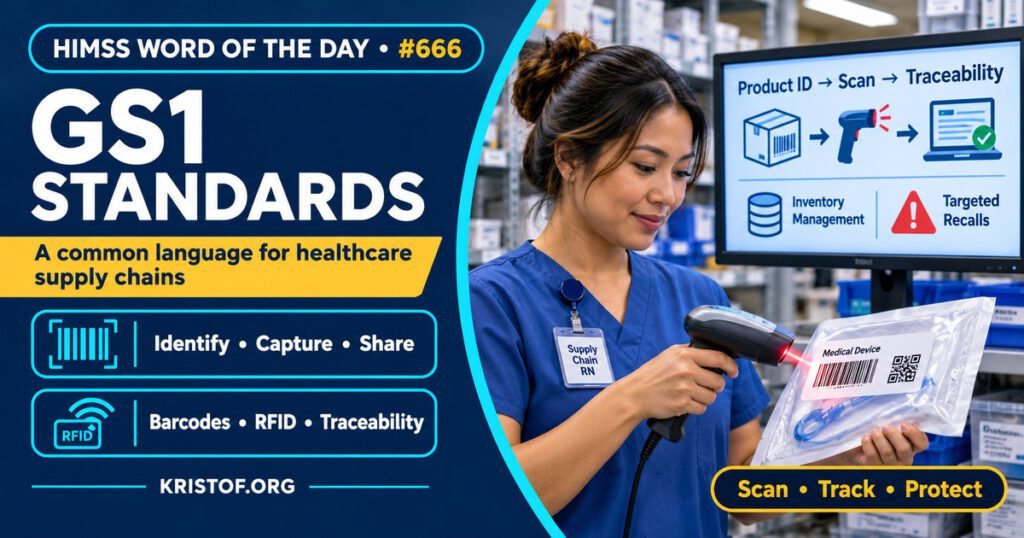
The HIMSS Dictionary describes GS1 standards as a set of standards that gives organizations a shared language, so businesses can identify, capture, and share information consistently around the world. It names the UPC barcode as a familiar example of a GS1 standard.
GS1’s own standards page gives a similar description. It says they give businesses a common language to identify, capture, and share supply chain data, that they uniquely identify products, places, and things, that identity can be captured in a barcode or an RFID tag, and that the data can be shared with trading partners, consumers, and patients. The page says GS1 helps in over 100 countries.
| Function | What it means | Source |
|---|---|---|
| Identify | Give products, places, and things unique identifiers | GS1 standards page |
| Capture | Carry the identifier in a barcode or an RFID tag | GS1 standards page |
| Share | Exchange the data with trading partners, consumers, and patients | GS1 standards page |
| Healthcare uses | Point-of-care scanning, targeted recalls, traceability, and supply chain processes | GS1 healthcare page |
⚠️ Exam Alert: GS1 standards are about identifying and tracking things, such as products, locations, and shipments. They are not clinical messaging standards like HL7. Keep GS1 (an organization and its identification standards) separate from UDI (the FDA system for device identification), because FDA says it has accredited three organizations as UDI issuing agencies, and GS1 is one of them.
🌐 Why It Matters: Real-World Healthcare IT Context
This section combines GS1’s own statements, an FDA document, and published studies.
GS1’s healthcare claims. GS1’s healthcare page says its standards support point-of-care scanning, which it says helps reduce medical errors, faster and more accurate recording of data in clinical systems, identification of products down to batch or serial number to support targeted recalls, and traceability that can help prevent falsified and substandard medicines. It also lists procurement, warehousing, payment, and inventory management. These are GS1’s statements about its own standards, and the page does not give evidence for them.
The link to FDA. An FDA document, UDI Formats by FDA-Accredited Issuing Agency (version 1.4, September 1, 2025), states that FDA has accredited three organizations as UDI issuing agencies: GS1, the Health Industry Business Communications Council, and the International Council for Commonality in Blood Banking Automation. It says each agency has a UDI format reviewed and approved by FDA, and that any change to a format must be approved by FDA before implementation.
National adoption in England. Snowdon and Wright (2018) present a case study of the Scan4Safety program in six English NHS Trusts. They report that all 154 Trusts were mandated in 2014 to adopt GS1 global standards for supply chain processes, along with Pan-European Public Procurement On-Line standards, and that outcomes from early implementation in surgical theatre and cardiac programs included a 4:1 return on investment and projected savings of 1 billion pounds if scaled across the NHS. The savings are a projection from early implementation, not a measured national result, and I read only the abstract. Lichtner and colleagues (2026) interviewed 19 stakeholders and reviewed 67 documents at one Scan4Safety demonstrator site. They report enablers such as allocated funding, executive buy-in, and data linkage, and challenges mainly involving data quality, work-as-done, and trade-offs. For device traceability, they note that the benefits depend on how many items are tracked in inventory and on consistent barcode scanning at the point of care. This is a single-site qualitative study.
A device traceability system. Konishi and colleagues (2025) describe a system that links GS1 barcodes on device packaging to RFID tags and records device use in catheterization laboratories, integrated with a radiology information system and a medical device master database. They report use in more than 500 catheterization procedures, and in an analysis of 16 percutaneous coronary intervention procedures, a mean rank correlation of 0.95 with a standard deviation of 0.12 for the order of device use, with some discrepancies when non-stock devices were used. This is a development report from one setting with a small analysis sample.
Barcode usability. Panich and colleagues (2026) surveyed investigational compounded sterile product vials at one institution. They found that 66.9 percent had barcodes, but the numbers embedded varied from vial to vial, did not match the GS1-128 structure seen on FDA-approved products, and contained no usable drug identifier in the opinion of the team’s informatics pharmacist. This is a single-site project, and it shows that a barcode being present does not mean a system can use it.
What I could not confirm. The GS1 pages I read do not define identifiers such as GTIN, GLN, or SSCC, so the Key Terms below use standard industry meanings that I did not verify on GS1’s site in this session. I did not find a controlled study showing that GS1 adoption by itself improves patient outcomes. I read abstracts and GS1 summary pages, not full texts.
Common GS1 problems:
- Assuming a barcode on a package is usable by the receiving system
- Inconsistent scanning at the point of care
- Poor master data, so identifiers do not match records
- Items that are not tracked in inventory
- Treating GS1 as a clinical messaging standard
What supports GS1 adoption:
- Allocated funding and executive buy-in
- Data linkage between supply, clinical, and patient systems
- Consistent scanning at the point of care
- Quality checks on barcode content and master data
- Using FDA-accredited issuing agency formats for device identifiers
🏥 The Nurse’s Perspective: Clinical, Bedside, & Workflow
Nurses are the people who scan, so the quality of the identifier and the consistency of the scan matter at the bedside.
At the Bedside
Point-of-care scanning depends on a readable barcode that the system can match to a record. Lichtner and colleagues (2026) note that traceability benefits depend on consistent scanning at the point of care. A nurse who finds a barcode that will not scan or does not match reports it, so the data problem can be fixed upstream.
In Clinical Workflow
When items are tracked from receiving to use, nurses and technicians may spend less time on manual counts and supply requests. That is an inference from the purpose of tracking, and the studies above do not measure nurse time. The cath lab system described by Konishi and colleagues (2025) recorded device use as devices were scanned during procedures, so scanning becomes part of the procedure workflow.
In EHR Implementation (Go-Live Perspective)
During an Epic Go-Live, analysts and at-the-elbow support staff test scanners, labels, and item records. The pharmacy project by Panich and colleagues (2026) is a reminder that a barcode can be present yet unusable, so testing real packages with the real scanner and software before go-live is worth the time. This is a workflow suggestion, not a finding from the studies.
🎓 CAHIMS / CPHIMS & HIMSS Perspective
CAHIMS Exam Domain Mapping
GS1 standards connect supply chain, devices, and clinical systems:
| CAHIMS Domain | How GS1 Standards Appear |
|---|---|
| Healthcare & Technology Environments | Barcodes, RFID, scanners, and device identification |
| Clinical Informatics | Point-of-care scanning and linking products to patients and procedures |
| Healthcare Information & Systems Management | Item master data, traceability, and recall management |
| Management & Leadership | Standards adoption, funding, and supply chain strategy |
Key Terms to Know Alongside GS1 Standards
- Unique device identifier (UDI) — an FDA system for identifying medical devices through their labels
- Global Trade Item Number (GTIN) — a GS1 identifier for trade items, in standard industry usage
- Global Location Number (GLN) — a GS1 identifier for locations, in standard industry usage
- Barcode — a machine-readable pattern that encodes an identifier
- Radio frequency identification (RFID) — use of radio signals to identify tagged items
- Traceability — the ability to follow a product through its supply chain and use
HIMSS Organizational Position
HIMSS offers education and research on health information and technology topics through its Resource Center. Members can find related information on the HIMSS Resource Center page.
🧭 More HIMSS Word of The Day Terms
Related terms in the Interoperability and Standards series:
- Health Information Exchange (HIE)
- DSM (Diagnostic and Statistical Manual of Mental Disorders)
- JASON
- The Sequoia Project
Browse all Interoperability and Standards terms or the A–Z glossary.
🔗 Explore Further: External References
- GS1 — Healthcare https://www.gs1.org/industries/healthcare
- FDA — UDI Formats by FDA-Accredited Issuing Agency (version 1.4, September 1, 2025) https://www.fda.gov/media/96648/download
- Snowdon and Wright (2018), Healthcare Quarterly — Case Study: Supply Chain Transformation in the UK National Health Service https://pubmed.ncbi.nlm.nih.gov/30741151/
- Lichtner et al. (2026), BMJ Health & Care Informatics — Complexities and capabilities of Scan4Safety in NHS hospitals: a qualitative study of a national demonstrator site https://pubmed.ncbi.nlm.nih.gov/41534951/
- Konishi et al. (2025), Studies in Health Technology and Informatics — GS1 and RFID Integration for Enhanced Medical Device Traceability in Catheterisation Laboratories https://pubmed.ncbi.nlm.nih.gov/40775874/
- Panich et al. (2026), American Journal of Health-System Pharmacy — Determining whether barcodes on investigational compounded sterile products are scannable by an IV workflow management system https://pubmed.ncbi.nlm.nih.gov/42269100/
- HIMSS — Resource Center https://www.himss.org/resource-center
Term source: HIMSS Dictionary of Health Information and Technology Terms, Acronyms, and Organizations, 6th Edition (2025). All definitions in this series are paraphrased for editorial purposes. Readers are encouraged to consult the primary source for exact language.
Eric Andrew Kristof, RN, CAHIMS is a Healthcare IT professional and HIMSS Arkansas Chapter member based in Hot Springs Village, AR, with hands-on Epic Go-Live experience and a diverse healthcare and IT background. He writes at kristof.org at the intersection of clinical care and healthcare technology.
Leave a Reply