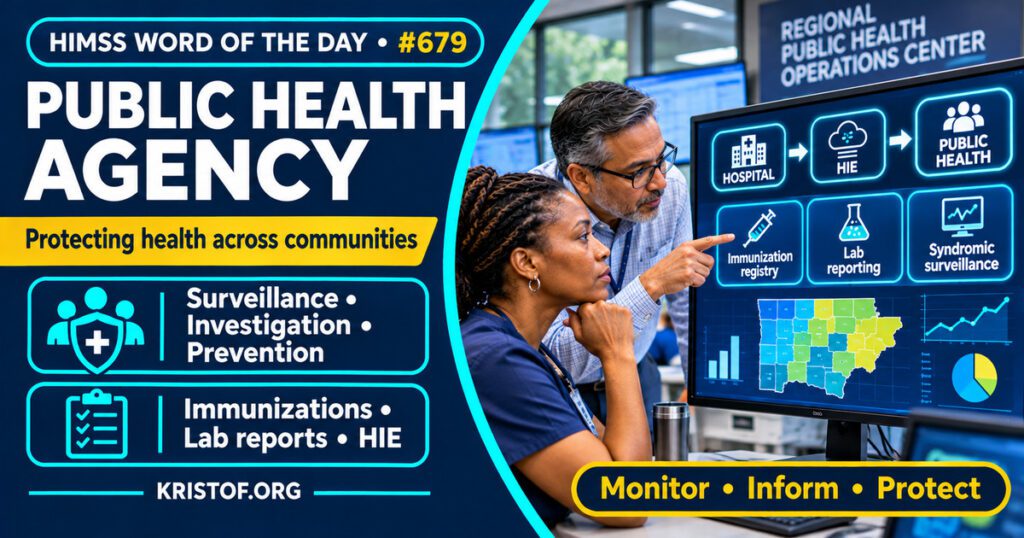
By Eric Andrew Kristof, RN, CAHIMS | Healthcare IT Professional | HIMSS Arkansas Chapter Member
About This Series: The HIMSS Word of The Day is a running blog series drawing from the HIMSS Dictionary of Health Information and Technology Terms, Acronyms, and Organizations, 6th Edition (2025) — the authoritative reference for healthcare IT professionals and the primary study resource for CAHIMS and CPHIMS certification. Each post paraphrases the term in plain language, grounds it in real-world healthcare IT context, and adds a bedside nursing perspective you won’t find in a textbook.
📖 The Term: Public Health Agency
Source: HIMSS Dictionary of Health Information and Technology Terms, Acronyms, and Organizations, 6th Edition (2025)
🔍 Plain-Language Definition
The HIMSS Dictionary defines a public health agency by its activities: any agency that carries out at least one of a set of essential public health functions. The dictionary lists ten, which I paraphrase below.
| # | Function (paraphrased from the dictionary) |
|---|---|
| 1 | Track community health status to spot problems |
| 2 | Investigate and identify community health threats and hazards |
| 3 | Inform, educate, and empower people on health matters |
| 4 | Mobilize community partnerships to solve problems |
| 5 | Create policies and plans that back individual and community health |
| 6 | Enforce rules and statutes meant to safeguard public health and safety |
| 7 | Connect people with the personal health services they need, and make sure care is provided where it would not otherwise be |
| 8 | Maintain a capable workforce across public health and personal care |
| 9 | Assess how well services work, who can reach them, and their quality, for individuals and populations |
| 10 | Pursue research for new insights and solutions |
A version note. CDC’s page on the 10 Essential Public Health Services says the framework was originally released in 1994 and updated in 2020, and a CDC page says the revised framework was released on September 9, 2020. I did not retrieve the 1994 wording in this session, so I cannot confirm whether the dictionary reproduces the original list or something else. Readers who need the current framework should check CDC’s current page.
⚠️ Exam Alert: The dictionary term describes functions, not a legal status. Do not assume a “public health agency” here is the same as a legal term in a specific law, such as a public health authority defined in a privacy regulation, which I did not review. Also do not confuse a public health agency with a health care provider: the 2021 editorial cited below describes the framework as showing how public health differs from health care.
🌐 Why It Matters: Real-World Healthcare IT Context
Why health IT touches it. Several of the dictionary’s functions depend on data, including tracking community health, investigating hazards, and evaluating services. The studies below look at how hospitals and exchange organizations connect to public health agencies. They are cross-sectional surveys, a review, and one qualitative study, and none measures health outcomes.
The framework behind the list. According to CDC, the Essential Public Health Services framework was developed in 1994 and updated in 2020, and the revision was a collaborative effort by the Public Health National Center for Innovations and the de Beaumont Foundation with a task force of experts, including federal agency experts. A 2021 editorial in the American Journal of Public Health by Castrucci says the framework is organized around three core functions, assessment, policy development, and assurance, with ten responsibilities, and that the biggest change in 2020 was an explicit focus on equity. The author is from de Beaumont Foundation, which took part in the revision, so the editorial is not independent of the framework.
Hospital reporting capability, circa 2012 to 2013. Walker and Diana (2016) analyzed 2,841 US acute care general hospitals using American Hospital Association surveys from 2012 and 2013. Weighted results showed 62.7% could electronically submit to immunization registries, 56.6% could electronically report laboratory results, and 54.4% could electronically report syndromic surveillance. Small, rural hospitals and hospitals without electronic health record systems lagged. These data are more than a decade old, and the abstract ties the study to Meaningful Use incentives of that period.
Exchange organizations as a bridge. Rosenthal et al. (2024) surveyed health information exchange organizations (HIOs) between January and July 2023. Of 135 potential HIOs, 90 met the authors’ definition and 77 completed the survey. Sixty-six (86%) of the responding HIOs, in 45 states, were electronically connected to at least one public health agency, for 187 connections in all. The most common reporting types were immunization registry, electronic laboratory results, and syndromic surveillance. Reported barriers included limited public health agency funding (32%) and competing priorities (23%). The authors note that the pandemic exposed gaps in agencies’ data and reporting infrastructure, and the survey describes capabilities, not whether data exchange improved response.
What a review found. Williams et al. (2019) reviewed 60 articles from searches covering January 2000 to March 2016 on informatics and technology in public health delivery. They report a surge in adoption, along with continuing obstacles including interoperability, data standardization, privacy, and technology transfer, and they call for workforce investment in informatics education and training. The search ended in 2016, so it predates later developments.
A look from Canada. Zinszer et al. (2013) interviewed 24 stakeholders in Canada’s national and provincial health information technology policy organizations. Benefits included improved communication among jurisdictions, more awareness of the need for interoperable systems, and better data standardization, while barriers included a lack of national vision and leadership and insufficient investment. The authors recommend that the Public Health Agency of Canada develop expertise to lead public health technology policy. That study concerns Canada’s system, not the US, and it is a small qualitative study.
What I could not confirm. CDC’s pages returned no body text to my fetch tool, so I relied on the page text shown in search results for the dates and developers of the 2020 update. I did not read the revised ten services as CDC words them, and I did not retrieve the 1994 wording. I did not review any law that defines a public health agency or public health authority. I found no evidence in these studies that connections to public health agencies improved health outcomes.
Common public health agency problems:
- Treating the dictionary’s ten functions as the current framework without checking
- Confusing a public health agency with a health care provider
- Assuming a legal definition of a public health authority is the same as the dictionary’s functional one
- Assuming hospital reporting capability data from 2012 and 2013 describes today
- Assuming every health information exchange organization is connected to a public health agency
What supports public health agency work in health IT:
- Electronic reporting for immunizations, laboratory results, and syndromic surveillance
- Health information exchange organizations that connect to agencies
- Interoperability and data standardization
- Funding and priority-setting, which the 2024 survey names as barriers when lacking
- Informatics education and workforce development, as the review recommends
🏥 The Nurse’s Perspective: Clinical, Bedside, & Workflow
Public health nurses, school nurses, and hospital nurses all touch public health agencies, sometimes without knowing it.
At the Bedside
Hospital reporting to immunization registries and for reportable laboratory results is part of the data flow the studies describe. The abstracts do not say how nurses take part in that reporting, so a nurse’s role depends on the organization.
In Clinical Workflow
The 2024 survey described pandemic-era gaps in public health agencies’ data and reporting infrastructure. Accurate and timely documentation in the record is one input that such reporting depends on, which is an inference from how reporting works and not a finding of the studies.
In EHR Implementation (Go-Live Perspective)
During an Epic Go-Live, analysts and at-the-elbow support staff work with build content that may feed public health reporting, such as immunization documentation. Whether and how a given hospital reports electronically is a local matter. None of the studies reviewed examines go-lives.
🎓 CAHIMS / CPHIMS & HIMSS Perspective
CAHIMS Exam Domain Mapping
Public health agencies appear in questions about reporting, policy, and information exchange:
| CAHIMS Domain | How Public Health Agencies Appear |
|---|---|
| Healthcare & Technology Environments | Public health roles and the health care landscape |
| Clinical Informatics | Reporting to registries and surveillance systems |
| Healthcare Information & Systems Management | Exchange connections, data standards, and interfaces |
| Management & Leadership | Policy, funding, and cross-sector partnerships |
Key Terms to Know Alongside Public Health Agency
- Essential Public Health Services — the framework of public health activities that CDC says was first released in 1994 and updated in 2020
- Public health informatics — the use of information technology and data to support public health practice, a general definition
- Syndromic surveillance — monitoring health-related data for signs of an outbreak or health event
- Immunization registry — a system that records vaccinations, one of the reporting types in the studies above
- Health information exchange organization — an organization that enables sharing of health information across organizational boundaries
- Electronic laboratory reporting — sending laboratory results electronically to public health agencies
HIMSS Organizational Position
HIMSS offers education and research on health information and technology topics through its Resource Center. Members can find related information on the HIMSS Resource Center page.
🧭 More HIMSS Word of The Day Terms
Related terms in the Healthcare Policy series:
Browse all Healthcare Policy terms or the A–Z glossary.
🔗 Explore Further: External References
- CDC — 10 Essential Public Health Services https://www.cdc.gov/public-health-gateway/php/about
- Castrucci (2021), American Journal of Public Health — The “10 Essential Public Health Services” Is the Common Framework Needed to Communicate About Public Health. https://pubmed.ncbi.nlm.nih.gov/33689415/
- Walker and Diana (2016), Journal of Public Health Management and Practice — Hospital Adoption of Health Information Technology to Support Public Health Infrastructure. https://pubmed.ncbi.nlm.nih.gov/26811967/
- Rosenthal et al. (2024), JMIR Public Health and Surveillance — Public Health Data Exchange Through Health Information Exchange Organizations: National Survey Study. https://pubmed.ncbi.nlm.nih.gov/39588746/
- Williams et al. (2019), Perspectives in Public Health — Public health delivery in the information age: the role of informatics and technology. https://pubmed.ncbi.nlm.nih.gov/30758258/
- Zinszer et al. (2013), BMC Public Health — A qualitative study of health information technology in the Canadian public health system. https://pubmed.ncbi.nlm.nih.gov/23705692/
- HIMSS — Resource Center https://www.himss.org/resource-center
Term source: HIMSS Dictionary of Health Information and Technology Terms, Acronyms, and Organizations, 6th Edition (2025). All definitions in this series are paraphrased for editorial purposes. Readers are encouraged to consult the primary source for exact language.
Eric Andrew Kristof, RN, CAHIMS is a Healthcare IT professional and HIMSS Arkansas Chapter member based in Hot Springs Village, AR, with hands-on Epic Go-Live experience and a diverse healthcare and IT background. He writes at kristof.org at the intersection of clinical care and healthcare technology.
Leave a Reply