By Eric Andrew Kristof, RN, CAHIMS | Healthcare IT Professional | HIMSS Arkansas Chapter Member
About This Series: The HIMSS Word of The Day is a running blog series drawing from the HIMSS Dictionary of Health Information and Technology Terms, Acronyms, and Organizations, 6th Edition (2025) — the authoritative reference for healthcare IT professionals and the primary study resource for CAHIMS and CPHIMS certification. Each post paraphrases the term in plain language, grounds it in real-world healthcare IT context, and adds a bedside nursing perspective you won’t find in a textbook.
📖 The Term: ISO/TC 215 (Health Informatics Technical Committee)
Source: HIMSS Dictionary of Health Information and Technology Terms, Acronyms, and Organizations, 6th Edition (2025)
🔍 Plain-Language Definition
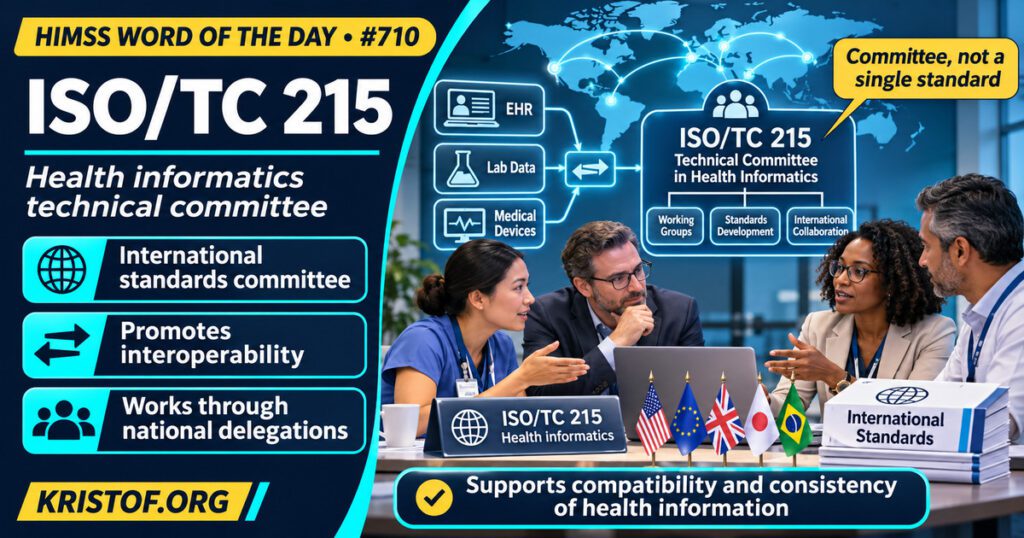
The HIMSS Dictionary describes ISO/TC 215 as the committee that works on standardization in the field of health information and health information and communications technology. Its stated aim is to promote interoperability between independent systems so that health information and data stay compatible and consistent, and to cut duplicated effort. In ISO’s naming, “TC” stands for technical committee, and 215 is its number.
ISO committees write international standards through national delegations, so the standards that come from ISO/TC 215 are voluntary documents that countries and organizations choose to adopt. The table summarizes what the sources read for this post say about the committee.
| Item | Detail |
|---|---|
| Type | A technical committee of the International Organization for Standardization (ISO) |
| Secretariat | ANSI (United States), per ISO’s committee page |
| Created | 1998, per ISO’s committee page |
| Scope | Standardization in health informatics, per ANSI’s description |
| U.S. role | ANSI administers the U.S. Technical Advisory Group (TAG) |
| Structure | Subcommittees, working groups, and task forces, for example on architecture, device interoperability, semantic content, and security |
⚠️ Exam Alert: ISO/TC 215 is a committee, while ISO is the organization that publishes standards and a standard such as ISO/IEEE 11073 is a document. CEN/TC 251 is the European committee for health informatics, and HL7 is a separate standards developer that submits some of its work to ISO. ANSI accredits U.S. standards developers and administers the U.S. TAG, but it does not write the standards. Questions may ask which body develops international health informatics standards.
🌐 Why It Matters: Real-World Healthcare IT Context
Because ISO/TC 215 is a standards body and not a clinical intervention, this section draws on ISO and ANSI pages, HL7‘s own statement, and four peer-reviewed papers read as abstracts. ISO’s own pages could not be fetched by my tool, so I read ISO’s committee page only through search-result text. I did not try to get around that.
Scope and structure. ANSI says the committee covers standardization in health informatics, with the goal of making health-related data, information, and knowledge easier to capture, exchange, and use across the health system. ANSI also says it administers the U.S. TAG for ISO/TC 215 and its two subcommittees, one on genomics and informatics and one on pharmacy and medicines business. ISO’s committee page, as the search results showed it, lists ANSI as secretariat, 1998 as the creation date, and working groups on architecture, frameworks and models, systems and device interoperability, semantic content, security, safety and privacy, and others. It also shows task forces on topics such as artificial intelligence in health informatics and telehealth and virtual care, and a joint working group with the IEC on safe, effective, and secure health software and health IT systems. The page also lists the number of standards the committee has contributed. I saw 293 in one search result and 280 in an older cached copy, so counts change and should be checked on the live page.
The U.S. role. The ANSI page says the U.S. TAG represents U.S. interests in health IT and health informatics standards at ISO, follows the principles of consensus, due process, and openness, and is open to any interested U.S. stakeholder who applies. I have no data on how many nurse informaticists take part.
Relationship to Europe. Klein (2003) described the European standardization effort, CEN/TC 251, as starting in 1990, and said the start of ISO/TC 215’s work had been welcomed in Europe. He wrote that European pre-standards had often been the basis for early international work, especially for medical device communication and health cards, and that the two bodies collaborate with DICOM, IEEE, and HL7. This is a 2003 view, so it describes the early relationship and not today’s. Blobel et al. (2023) report that ISO/TC 215 and CEN/TC 251 declared ISO 23903:2021 mandatory for all of their projects and standards that address more than one domain. That paper is a viewpoint by an author involved in the work, not an independent evaluation.
How its standards are used. Pedrera-Jiménez et al. (2023) used a panel of EHR standards experts to discuss OpenEHR, ISO 13606, and HL7 FHIR, and concluded that the three have different strengths in modeling, flexibility, and implementation resources. The authors say they should be applied for the needs they were designed for and can be fully compatible when combined. HL7 says it has an agreement with ISO under which it submits ANSI-approved standards and draft standards for trial use to ISO, and that HL7 Version 2 was published as an ISO standard in 2009. Those are HL7’s own statements from an undated page.
What I could not confirm. I could not read ISO’s pages directly, so the committee’s current officers, member countries, and live standards count are unverified. I did not confirm the current subcommittee names beyond ANSI’s description. I found no study that measures whether ISO/TC 215 standards improve interoperability or patient outcomes, and the four papers are a history, a viewpoint, and an expert-panel paper.
Common ISO/TC 215 problems:
- Treating the committee as a single standard instead of a body that produces many
- Confusing ISO/TC 215 with CEN/TC 251 or with ISO as a whole
- Assuming an ISO standard is legally required in the United States
- Quoting a standards count without checking the live page
- Assuming ANSI writes the standards because it runs the U.S. TAG
What supports ISO/TC 215:
- A consensus process with national delegations and an open U.S. route to participate
- Joint working groups with related bodies such as the IEC
- Coordination with CEN and with developers such as HL7
- Working groups on architecture, semantics, security, and device interoperability
- Task forces that take up newer topics such as artificial intelligence and telehealth
🏥 The Nurse’s Perspective: Clinical, Bedside, & Workflow
No study reviewed measured nurses’ experience with ISO/TC 215, so this section is workflow context and not evidence. A 2021 copy of ISO’s committee page, seen in search results, listed the International Council of Nurses among the committee’s liaison organizations, but that could not be confirmed from the live page.
At the Bedside
Bedside nurses see the work of standards committees indirectly. Device data that flow to the chart, patient identifiers on a wristband, and a result that lands in the right place all depend on standards, some of which come from international bodies. The sources reviewed do not trace any bedside experience to ISO/TC 215 specifically.
In Clinical Workflow
Nurse informaticists often evaluate vendor claims about standards, and knowing that the committee, its standards, and related bodies such as HL7 and CEN are different things makes those conversations clearer. ISO standards are voluntary documents that a country or a regulator may choose to adopt, so a vendor statement that a product “meets an ISO standard” needs a named standard and version.
In EHR Implementation (Go-Live Perspective)
During an Epic Go-Live, analysts and at-the-elbow support staff rarely hear about ISO/TC 215. They see the effects in interfaces, device integration, and terminology. The sources reviewed do not examine go-lives, so this is context only.
🎓 CAHIMS / CPHIMS & HIMSS Perspective
CAHIMS Exam Domain Mapping
ISO/TC 215 connects international standards to how health systems exchange information:
| CAHIMS Domain | How ISO/TC 215 Appears |
|---|---|
| Healthcare & Technology Environments | Standards bodies and how they relate |
| Clinical Informatics | Standards for health records, terminology, and devices |
| Healthcare Information & Systems Management | Standards selection and vendor evaluation |
| Management & Leadership | Governance and participation in standards work |
Key Terms to Know Alongside ISO/TC 215
- Standards Development Organization — a body that develops and maintains standards through a consensus process
- ANSI — the American National Standards Institute, which accredits standards developers
- HL7 — a standards developer that submits some of its work to ISO
- ISO/IEEE 11073 Standards — standards for communication between medical devices and other systems
- Interoperability — the ability of systems to exchange and use information
- Semantic interoperability — exchange in which the meaning of the data is preserved
HIMSS Organizational Position
HIMSS offers education and research on health information and technology topics through its Resource Center. Members can find related information on the HIMSS Resource Center page.
🧭 More HIMSS Word of The Day Terms
Related terms in the Interoperability and Standards series:
- Health Information Exchange (HIE)
- QRDA (Quality Reporting Data Architecture)
- PHIN (Public Health Information Network)
- Acquisition Modality
Browse all Interoperability and Standards terms or the A–Z glossary.
🔗 Explore Further: External References
- ANSI — U.S. TAG for ISO/TC 215, Health Informatics. https://www.ansi.org/iso/ansi-activities/ansi-administered-tags/tc-215-health-informatics
- ISO — ISO/TC 215 Health informatics (committee page, read through search-result text). https://www.iso.org/committee/54960.html
- HL7 Media Center — HL7 Backgrounder Brief https://media.hl7.org/hl7-backgrounder-brief/
- Klein (2003), Studies in Health Technology and Informatics — ISO and CEN standards for health informatics: synergy or competition. https://pubmed.ncbi.nlm.nih.gov/15061554/
- Pedrera-Jiménez et al. (2023), Journal of Medical Internet Research — Can OpenEHR, ISO 13606, and HL7 FHIR Work Together? An Agnostic Approach for the Selection and Application of Electronic Health Record Standards to the Next-Generation Health Data Spaces. https://pubmed.ncbi.nlm.nih.gov/38153779/
- Blobel et al. (2023), Journal of Personalized Medicine — Principles and Standards for Designing and Managing Integrable and Interoperable Transformed Health Ecosystems. https://pubmed.ncbi.nlm.nih.gov/38003894/
- HIMSS — Resource Center https://www.himss.org/resource-center
Term source: HIMSS Dictionary of Health Information and Technology Terms, Acronyms, and Organizations, 6th Edition (2025). All definitions in this series are paraphrased for editorial purposes. Readers are encouraged to consult the primary source for exact language.
Eric Andrew Kristof, RN, CAHIMS is a Healthcare IT professional and HIMSS Arkansas Chapter member based in Hot Springs Village, AR, with hands-on Epic Go-Live experience and a diverse healthcare and IT background. He writes at kristof.org at the intersection of clinical care and healthcare technology.
Leave a Reply