By Eric Andrew Kristof, RN, CAHIMS | Healthcare IT Professional | HIMSS Arkansas Chapter Member
About This Series: The HIMSS Word of The Day is a running blog series drawing from the HIMSS Dictionary of Health Information and Technology Terms, Acronyms, and Organizations, 6th Edition (2025) — the authoritative reference for healthcare IT professionals and the primary study resource for CAHIMS and CPHIMS certification. Each post paraphrases the term in plain language, grounds it in real-world healthcare IT context, and adds a bedside nursing perspective you won’t find in a textbook.
📖 The Term: QR Codes (Quick Response Codes)
Source: HIMSS Dictionary of Health Information and Technology Terms, Acronyms, and Organizations, 6th Edition (2025)
🔍 Plain-Language Definition
The HIMSS Dictionary describes QR codes, short for Quick Response codes, as two-dimensional barcodes that pack a lot of data into a small space and that mobile phones and computer cameras can read when the right software is present. The dictionary lists “Quick response codes” as an alias of the same entry.
A one-dimensional barcode is a row of lines, and a QR code is a square pattern that encodes data in two directions. In health care, the code often holds a link or an identifier, and the information it points to lives elsewhere.
| Use in the studies below | What the QR code does | Who scans it |
|---|---|---|
| Patient identification | Carries identifying data scanned for verification | Not specified in the abstract |
| Prescriptions | Carries prescription data from a hospital to a pharmacy | Read by a webcam at the pharmacy |
| Patient education | Links to instructions or health information | Patients and parents |
| Staff education | Links to learning content on a labeled device | Nurses |
⚠️ Exam Alert: QR codes are a data carrier, not a security or identity control by themselves. Scanning a code only retrieves what it points to. Do not confuse QR codes with one-dimensional barcodes, and expect questions about what a scanned code should be verified against.
🌐 Why It Matters: Real-World Healthcare IT Context
Where it shows up. QR codes appear in health care wherever a quick link between a physical object and digital information helps. The five studies below cover identification, prescription transmission, patient education, nurse learning, and waiting-room information. All are small or single-site, and they report acceptance, accuracy, or satisfaction more than patient outcomes.
Identification at the blood draw. Wu et al. (2022) compared 959 outpatients having blood drawn before an optimization with 1,011 after it. The new process used a call system to obtain patient information, scanning the QR code on a guide sheet for automatic verification, and then manual reconfirmation of patient information. The correct identification rate was 99.80% after optimization versus 98.02% before (p < 0.001), and waiting time and satisfaction also improved. QR scanning was one of several changes, so the study does not isolate its effect. The abstract’s date ranges for the two groups also appear inconsistent, listing the pre-optimization group as January to June 2020 and the post-optimization group as July to December 2019, while saying the change began in July 2020. I could not resolve that from the abstract, so the timing of the comparison is unclear.
Prescriptions in Taiwan. Lin et al. (2012) tested a QR-code prescription system in two hospitals and 85 community pharmacies, in which a webcam read the code and sent the data into the pharmacy’s computer system. The authors report that pharmacies appraised the accuracy of transmission highly and that prescriptions from the Taipei area were read in Taichung without software or area limits. The abstract gives no numbers for accuracy or time saved, the study is a feasibility trial from 2012, and the abstract mentions a patent for the device.
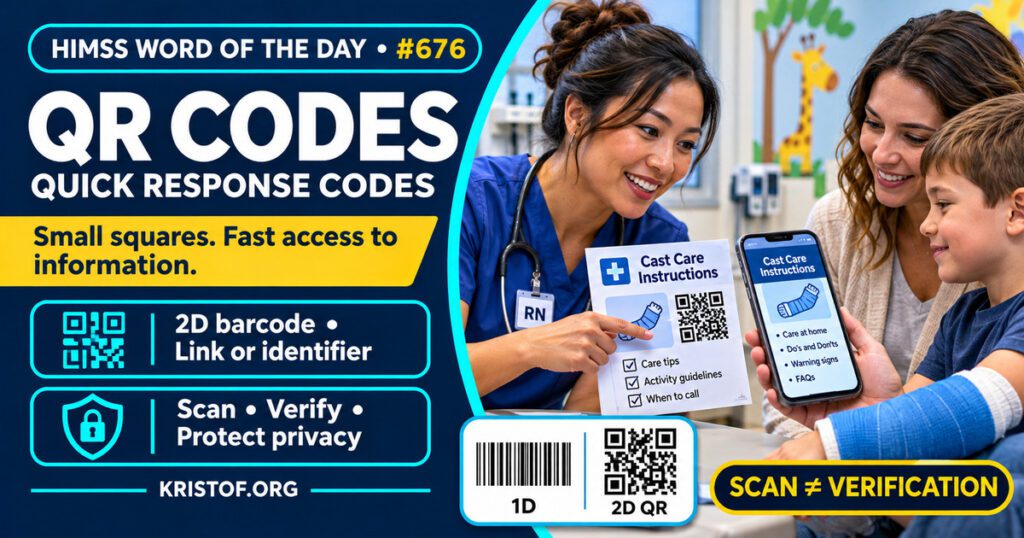
A QR code on a child’s cast. Basso-Williams et al. (2020) embedded a QR code with cast care instructions in the casting of 88 children. Google Analytics showed an average of 1.6 scans among 60 participants, and 65% of scans were by a parent. Seventy-nine participants (89.9%) found the code useful, 65 (73.9%) were very satisfied with its convenience, and 37 said the information kept them from contacting the physician. The authors say it “may reduce calls,” but there was no comparison group.
Nurses’ acceptance as a learning tool. Mollaei et al. (2024) labeled selected medical devices on medical and surgical wards with QR codes linking to educational content, and surveyed 185 nurses (166 nurses and 19 head nurses) two months later. Acceptance was moderate (mean 66.1, standard deviation 16.6). Head nurses and nurses with prior QR experience scored higher, and personal and occupational characteristics explained only 6.1% of the variation. The abstract does not give the scale maximum, so the score is hard to interpret beyond the authors’ word “moderate.” The title calls the design quasi-experimental while the abstract describes a cross-sectional study, which I could not reconcile.
A waiting-room view of barriers. Hu et al. (2024) recorded 263 scans of a QR code in two general practice waiting areas between October 2022 and October 2023 and interviewed 12 people. Facilitators included familiarity from the COVID-19 pandemic, anonymity when accessing sensitive information, convenience, and less paper. Barriers included the size and location of the code, wait time, privacy and security concerns, and the risk of excluding people without technology access or with low technological literacy. Twelve interviews is a small sample from two sites.
What I could not confirm. I did not review the QR code technical standard or its data capacity, so I make no claim about the dictionary’s “high-density” wording beyond paraphrase. I did not look for evidence on security risks beyond what participants raised. I found no study in this review showing that QR codes improve patient outcomes, and I did not find data on how widely hospitals use them.
Common QR codes problems:
- Codes that are too small or placed where people do not scan them
- Privacy and security concerns about what a code opens
- Excluding patients without a smartphone or with low technology literacy
- Lower acceptance among staff with no prior QR code experience
- Needing a camera device and compatible software to read the code
What supports QR codes:
- Convenience and reduced paper, as participants in the waiting-room study reported
- Training and infrastructure, which the nurse study’s authors recommend
- Pairing a scan with manual reconfirmation for identification, as in the blood draw process
- Instructions tied to the object, such as a cast
- Reading the code into different local computer systems, as in the Taiwan prescription trial
🏥 The Nurse’s Perspective: Clinical, Bedside, & Workflow
Nurses meet QR codes as a scanning step, a patient education handout, and a learning prompt.
At the Bedside
In the outpatient blood draw study, a QR code on a guide sheet was scanned for automatic verification and patient information was then manually reconfirmed, and the abstract does not say who performed each step. That pairs an automated check with a manual one, so the code supported verification instead of replacing it. In the cast study, parents did most of the scanning, so the nurse’s role is to explain what the code is for.
In Clinical Workflow
In the device-label study, acceptance of QR codes as a learning tool was moderate among 185 nurses, with higher scores among head nurses and those with prior QR experience. That suggests training and familiarity matter, as the authors recommend. The abstract does not say how often nurses scanned the codes in practice.
In EHR Implementation (Go-Live Perspective)
During an Epic Go-Live, analysts and at-the-elbow support staff might point staff to tip sheets or quick-reference guides through a code on a device or workstation. The device-label study is the closest analogue among these five. No study reviewed examines go-lives.
🎓 CAHIMS / CPHIMS & HIMSS Perspective
CAHIMS Exam Domain Mapping
QR codes appear in questions about identification, data capture, and patient engagement:
| CAHIMS Domain | How QR Codes Appear |
|---|---|
| Healthcare & Technology Environments | Data capture technologies and barcodes |
| Clinical Informatics | Patient identification and education workflows |
| Healthcare Information & Systems Management | Scanning devices, software, and security |
| Management & Leadership | Training, adoption, and equity of access |
Key Terms to Know Alongside QR Codes
- Two-dimensional barcode — a barcode that encodes data in two directions, which includes QR codes
- Scanner — a device or camera with software that reads a code
- GS1 standards — standards for identifying products and encoding data in barcodes
- Patient identification — confirming that care is delivered to the right patient
- Technology acceptance model — a framework for studying whether users accept a technology, used in two of the studies above
- Microlearning — teaching in short units, which the nurse study applied through QR codes
HIMSS Organizational Position
HIMSS offers education and research on health information and technology topics through its Resource Center. Members can find related information on the HIMSS Resource Center page.
🧭 More HIMSS Word of The Day Terms
Related terms in the Connected Health series:
Browse all Connected Health terms or the A–Z glossary.
🔗 Explore Further: External References
- Wu et al. (2022), BMC Medical Informatics and Decision Making — Using information technology to optimize the identification process for outpatients having blood drawn and improve patient satisfaction. https://pubmed.ncbi.nlm.nih.gov/35272653/
- Lin et al. (2012), Journal of Clinical Pharmacy and Therapeutics — The feasibility of QR-code prescription in Taiwan. https://pubmed.ncbi.nlm.nih.gov/22612397/
- Basso-Williams et al. (2020), Journal of the American Academy of Orthopaedic Surgeons. Global Research & Reviews — Application of a Quick Response Code as an Alternative Method to Provide Pediatric Cast Care Instructions. https://pubmed.ncbi.nlm.nih.gov/32672722/
- Mollaei et al. (2024), BMC Medical Education — Adoption of quick response codes as a digital microlearning tool among clinical nurses: a quasi-experimental study. https://pubmed.ncbi.nlm.nih.gov/39501213/
- Hu et al. (2024), Australian Journal of Primary Health — Using quick response codes to access digital health resources in the general practice waiting room. https://pubmed.ncbi.nlm.nih.gov/41121985/
- HIMSS — Resource Center https://www.himss.org/resource-center
Term source: HIMSS Dictionary of Health Information and Technology Terms, Acronyms, and Organizations, 6th Edition (2025). All definitions in this series are paraphrased for editorial purposes. Readers are encouraged to consult the primary source for exact language.
Eric Andrew Kristof, RN, CAHIMS is a Healthcare IT professional and HIMSS Arkansas Chapter member based in Hot Springs Village, AR, with hands-on Epic Go-Live experience and a diverse healthcare and IT background. He writes at kristof.org at the intersection of clinical care and healthcare technology.
Leave a Reply